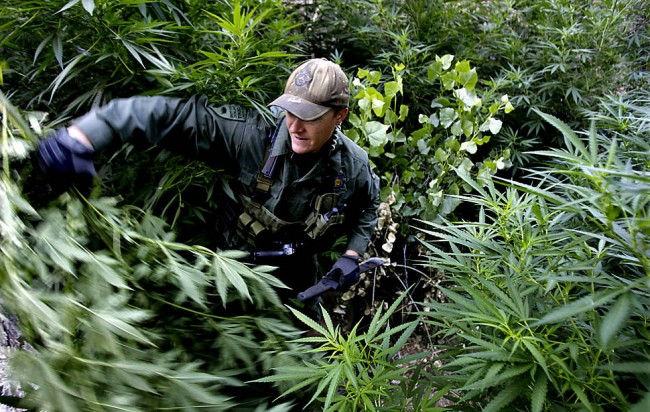
Marijuana-Like Compounds Fight AIDS, Study Finds

“Marijuana-like drugs can do more for AIDS patients than simply help them with their nausea or loss of appetite, according to a new study.

Doctor Tipster found new research published in the medical journal PLoS One that suggests marijuana-like compounds actually fight the HIV virus in late-stage AIDS patients.

Researchers told Doctor Tipster that they already know “cannabinoid drugs” like marijuana can have a therapeutic effect in AIDS patients. But they wanted to further understand how they “influence the spread of the virus itself.”

The study found that “cannabinoid receptors” are triggered by marijuana-like compounds and can actually block the spread of the HIV virus throughout the body.”

More: http://www.huffingtonpost.com/2012/03/22/marijuana-fights-aids_n_1373224.html

Human Immunodeficiency Virus In Late-Stage AIDS Inhibited By Marijuana-Like Chemicals – MedicalNewsToday

“Mount Sinai School of Medicine researchers have discovered that marijuana-like chemicals trigger receptors on human immune cells that can directly inhibit a type of human immunodeficiency virus (HIV) found in late-stage AIDS, according to new findings published online in the journal PLoS ONE.

Medical marijuana is prescribed to treat pain, debilitating weight loss and appetite suppression, side effects that are common in advanced AIDS. This is the first study to reveal how the marijuana receptors found on immune cells – called cannabinoid receptors CB1 and CB2 – can influence the spread of the virus. Understanding the effect of these receptors on the virus could help scientists develop new drugs to slow the progression of AIDS.

“We knew that cannabinoid drugs like marijuana can have a therapeutic effect in AIDS patients, but did not understand how they influence the spread of the virus itself,” said study author Cristina Costantino, PhD, Postdoctoral Fellow in the Department of Pharmacology and Systems Therapeutics at Mount Sinai School of Medicine. “We wanted to explore cannabinoid receptors as a target for pharmaceutical interventions that treat the symptoms of late-stage AIDS and prevent further progression of the disease without the undesirable side effects of medical marijuana.”

HIV infects active immune cells that carry the viral receptor CD4, which makes these cells unable to fight off the infection. In order to spread, the virus requires that “resting” immune cells be activated. In advanced AIDS, HIV mutates so it can infect these resting cells, gaining entry into the cell by using a signaling receptor called CXCR4. By treating the cells with a cannabinoid agonist that triggers CB2, Dr. Costantino and the Mount Sinai team found that CB2 blocked the signaling process, and suppressed infection in resting immune cells.

Triggering CB1 causes the drug high associated with marijuana, making it undesirable for physicians to prescribe. The researchers wanted to explore therapies that would target CB2 only. The Mount Sinai team infected healthy immune cells with HIV, then treated them with a chemical that triggers CB2 called an agonist. They found that the drug reduced the infection of the remaining cells.

“Developing a drug that triggers only CB2 as an adjunctive treatment to standard antiviral medication may help alleviate the symptoms of late-stage AIDS and prevent the virus from spreading,” said Dr. Costantino. Because HIV does not use CXCR4 to enhance immune cell infection in the early stages of infection, CB2 agonists appear to be an effective antiviral drug only in late-stage disease.

As a result of this discovery, the research team led by Benjamin Chen, MD, PhD, Associate Professor of Infectious Diseases, and Lakshmi Devi, PhD, Professor of Pharmacology and Systems Therapeutics at Mount Sinai School of Medicine, plans to develop a mouse model of late-stage AIDS in order to test the efficacy of a drug that triggers CB2 in vivo. In 2009 Dr. Chen was part of a team that captured on video for the first time the transfer of HIV from infected T-cells to uninfected T-cells.”

http://www.medicalnewstoday.com/releases/243183.php

Banning Psychedelic Drugs Hurts Research, Scientists Say

“Restricting the use of psychoactive drugs in research represents the most serious case of scientific censorship since the Catholic Church banned the works of Copernicus and Galileo, some scientists say.” 

psychedelic smoke


“In a paper published online today (June 12) in the journal Nature Reviews Neuroscience, a group of researchers argues that drug laws enacted in the United States and the United Kingdom during the 1960s and 1970s have hindered vital research into the drugs’ functions and therapeutic uses.”

More: http://www.livescience.com/37365-drugs-bans-restrict-research.html

Effects of Schedule I drug laws on neuroscience research and treatment innovation.

“Many psychoactive drugs are used recreationally, particularly by young people. This use and its perceived dangers have led to many different classes of drugs being banned under national laws and international conventions.

 Indeed, the possession of cannabis, 3,4-methylenedioxy-N-methylamphetamine (MDMA; also known as ecstasy) and psychedelics is stringently regulated.

An important and unfortunate outcome of the controls placed on these and other psychoactive drugs is that they make research into their mechanisms of action and potential therapeutic uses – for example, in depression and post-traumatic stress disorder – difficult and in many cases almost impossible.”

http://www.ncbi.nlm.nih.gov/pubmed/23756634

The cannabinoid Δ9-tetrahydrocannabivarin (THCV) ameliorates insulin sensitivity in two mouse models of obesity

“Δ9-Tetra-hydrocannabivarin (THCV) is a naturally occurring analogue of the psychoactive principle of cannabis, Δ9-tetra-hydrocannabinol (THC).

THCV is a new potential treatment against obesity-associated glucose intolerance with pharmacology different from that of CB1 inverse agonists/antagonists.

In conclusion, THCV produces therapeutic metabolic effects in two different mouse models of obesity. In particular, its strongest effects are exerted on plasma glucose and insulin levels, especially following an OGTT in DIO mice and on liver triglycerides in ob/obmice.

Based on these data, it can be suggested that THCV may be useful for the treatment of the metabolic syndrome and/or type 2 diabetes, either alone or in combination with existing treatments. Given the reported benefits of another non-THC cannabinoid, CBD in type 1 diabetes, a CBD/THCV combination may be beneficial for different types of diabetes mellitus.”

Full Text: http://www.ncbi.nlm.nih.gov/pmc/articles/PMC3671751/

Marijuana and its receptor protein in brain control epilepsy

“VCU study is first to test anticonvulsant potential of marijuana and brain recurrent seizures. 

Ingredients in marijuana and the cannabinoid receptor protein produced naturally in the body to regulate the central nervous system and other bodily functions play a critical role in controlling spontaneous seizures in epilepsy, according to a new study by researchers at Virginia Commonwealth University.

The study, the first to look at marijuana and the brain’s cannabinoid system in live animals with spontaneous, recurrent seizures, suggests new avenues that researchers can explore in their search for more-effective drugs to treat epileptic patients who don’t respond to today’s anticonvulsant medications or surgery.

The results appear in the Oct. 1 issue of the Journal of Pharmacology and Experimental Therapeutics.

“Although marijuana is illegal in the United States, individuals both here and abroad report that marijuana has been therapeutic for them in the treatment of a variety of ailments, including epilepsy,” says Dr. Robert J. DeLorenzo, professor of neurology in the VCU School of Medicine.

 “If we can understand how marijuana works to end seizures, we may be able to develop novel drugs that might do a better job of treating epileptic seizures.” 

Epilepsy is one of the most common neurological conditions, characterized by spontaneously recurrent seizures. Approximately 1 percent of Americans have epilepsy, and 30 percent of those patients are resistant to conventional anticonvulsant drug treatments.

Cannabinoids have been used as a natural remedy for seizures for thousands of years, and studies since at least 1974 have found that the primary psychoactive compound in marijuana displays anticonvulsant properties.” 

More:http://www.news.vcu.edu/news/Marijuana_and_its_receptor_protein_in_brain_control_epilepsy

Activation of Cortical Type 2 Cannabinoid Receptors Ameliorates Ischemic Brain Injury, Study Suggests

“A new study published in the March issue of The American Journal of Pathology suggests that cortical type 2 cannabinoid (CB2) receptors might serve as potential therapeutic targets for cerebral ischemia.

Researchers found that the cannabinoid trans-caryophyllene (TC) protected brain cells from the effects of ischemia in both in vivo and in vitro animal models. In rats, post-ischemic treatment with TC decreased cerebral infarct size and edema. In cell cultures composed of rat cortical neurons and glia exposed to oxygen-glucose deprivation and reoxygenation (OGD/R), TC decreased neuronal injury and mitochondrial depolarization, specifically through type 2 cannabinoid receptor (CB2R) pathways.

“To our knowledge, novel data presented in this study provide evidence for the first time supporting a previously unappreciated role of cortical CB2R, especially neuronal CB2Rs, in ischemia,” says lead investigator Won-Ki Kim, PhD, of the Department of Neuroscience, College of Medicine, Korea University in Seoul. “This study suggests that further investigation is warranted to establish the clinical usefulness of TC as a preventative and therapeutic agent for treatment of stroke.””

More: http://www.sciencedaily.com/releases/2013/02/130221141140.htm

Study: Cannabinoids Offer Likely Therapeutic Option For Patients With Post-Traumatic Stress

“Future research targeting cannabinoids and their receptors may lead to evidence-based treatments for patients diagnosed with post-traumatic stress disorder (PTSD), according to clinical trial data published in May in the journal Molecular Psychiatry.

Investigators at the New York University School of Medicine reported that subjects diagnosed with PTSD typically possess elevated quantities of endogenous cannabinoid receptors in regions of the brain associated with fear and anxiety. Investigators also determined that many of these subjects experience a decrease in their natural production of anandamide, an endogenous cannabinoid neurotransmitter, resulting in an imbalanced endocannibinoid regulatory system.

Researchers speculated that an increase in the body’s production of cannabinoids would likely restore subjects’ natural brain chemistry and psychological balance. They affirmed, “[Our] findings substantiate, at least in part, emerging evidence that … plant-derived cannabinoids such as marijuana may possess some benefits in individuals with PTSD by helping relieve haunting nightmares and other symptoms of PTSD.”

Authors concluded: “The data reported herein are the first of which we are aware of to demonstrate the critical role of CB1 (cannabinoid) receptors and endocannabinoids in the etiology of PTSD in humans. As such, they provide a foundation upon which to develop and validate informative biomarkers of PTSD vulnerability, as well as to guide the rational development of the next generation of evidence-based treatments for PTSD.”

More: http://norml.org/news/2013/05/30/study-cannabinoids-offer-likely-therapeutic-option-for-patients-with-post-traumatic-trauma

The Feds Finally Recognize The Anti-Cancer Potential Of Cannabis — 36 Years Too Late!

3-24-2011: “Scientific trials have for decades documented the anti-cancer properties of cannabis and its constituents. Yet it took until this week for the website of the National Institute of Cancer, a component of the U.S. government’s National Institutes of Health, to finally acknowledged the herb’s therapeutic utility for patients living with disease or suffering from the adverse side-effects of cancer treatment.

In a newly added section to the website, entitled ‘Cannabis and Cannabinoids,’ the Institute states:

Cannabinoids may cause antitumor effects by various mechanisms, including induction of cell death, inhibition of cell growth, and inhibition of tumor angiogenesis and metastasis. Cannabinoids appear to kill tumor cells but do not affect their nontransformed counterparts and may even protect them from cell death.”

…The potential benefits of medicinal cannabis for people living with cancer include antiemetic effects, appetite stimulation, pain relief, and improved sleep. In the practice of integrative oncology, the health care provider may recommend medicinal cannabis not only for symptom management but also for its possible direct antitumor effect.”

It’s a stunning acknowledgment, given that the NIH is a branch of the very same government that presently maintains that the cannabis plant and all of its naturally-derived components have ‘no accepted medical use.’ Yet it also begs the question: Where has the National Institute of Cancer been all these years?

After all, the anti-tumor activity of cannabinoids were initially documented in 1975! That’s right; it’s taken 36 years for the Institute to get with the program.

Hopefully it won’t take them another 36 years to demand that the Feds finally assess whether these preclinical results are replicable in human trials.”

by Paul Armentano, NORML Deputy Director

http://blog.norml.org/2011/03/24/the-feds-finally-recognize-the-anti-cancer-potential-of-cannabis-36-years-too-late/

Marijuana first plants cultivated by man for medication (Update)

“Marijuana (Cannabis sativa L.) is one of the first plants cultivated by man. Shrouded in controversy, the intriguing history of cannabis as a medication dates back thousands of years before the era of Christianity.

Scientists believe the hemp plant originated in Asia. In 2737 B.C., Emperor Shen Neng of China prescribed tea brewed from marijuana leaves as a remedy for muscle injuries, rheumatism, gout, malaria, and memory loss. During the Bronze Age in 1400 B.C., cannabis was used throughout the eastern Mediterranean to ease the pain of childbirth and menstrual maladies.

More than 800 years before the birth of Christ, hemp was extensively cultivated in India for both its fiber and healing medicinal properties. William Brooke O’Shaughnessy, an Irish physician famous for his investigative research in pharmacology, is credited with introducing the therapeutic, healing properties of cannabis to Western medicine. During the 1830’s Dr. O’Shaughnessy, working for the British in India, conducted extensive experiments on lab animals. Encouraged by his results, Dr. O’Shaughnessy commenced patient treatment with marijuana for pain and muscle spasms. Further experiments indicated that marijuana was beneficial in the treatment of stomach cramps, migraine headaches, insomnia and nausea. Marijuana was also proven to be an effective anticonvulsant.

From the 1840s to the 1890s, hashish and marijuana extracts were among the most widely prescribed medications in the United States The 1850 United States Census records 8,327 marijuana plantations, each larger than 2000 acres. Recreational use of marijuana was not evident until early in the 20th century. Marijuana cigarettes became popular, introduced by migrants workers that brought marijuana with them from Mexico. With the onset of Prohibition, recreational use of marijuana skyrocketed. During the early 1930s, hash bars could be found all across the United States.

Although protested by the American Medical Association, the 1937 Marijuana Tax Act banned the cultivation and use of cannabis by federal law. Under the law, cultivation, distribution and consumption of cannabis products for medicinal, practical or recreational was criminalized and harsh penalties were implemented.”

More: http://guardianlv.com/2013/06/marijuana-first-plants-cultivated-by-man-for-medication/

marijuana