Pharmacological Insights into Cannabidiol for Wound Healing and Bone Regeneration

“Cannabidiol (CBD), a major nonpsychoactive phytocannabinoid derived from Cannabis sativa L., has recently gained prominence for its broad pharmacological profile and emerging applications in regenerative medicine.

Beyond its well-established neuroprotective, antiepileptic, anxiolytic, antipsychotic, anti-inflammatory, analgesic, and anticancer effects, CBD has demonstrated the capacity to modulate key biological processes involved in tissue repair. Increasing evidence indicates that CBD promotes wound healing by regulating inflammatory responses, cellular proliferation, and extracellular matrix remodeling through interactions with cannabinoid and noncannabinoid receptors expressed in neural, immune, and epithelial cells.

Notably, these receptors are also present in osteogenic and progenitor cells, suggesting that CBD may influence bone metabolism and regeneration. Recent preclinical studies have reported that CBD enhances osteoblastic differentiation, angiogenesis, and matrix mineralization, highlighting its potential as a bioactive molecule for bone tissue engineering.

Within the dental field, such properties open new perspectives for the development of CBD-based biomaterials aimed at improving osseointegration, soft tissue healing, and the overall biological performance of implantable devices.

Accordingly, this review aims to provide a comprehensive overview of the pharmacological and molecular mechanisms underlying the effects of CBD on wound healing and bone regeneration. Furthermore, it discusses dose-response relationships, delivery routes, formulation strategies, and the current legal and regulatory frameworks influencing CBD translation into clinical dental applications.

These insights may support the rational design of next-generation bioactive materials incorporating CBD for oral and maxillofacial regenerative therapies.”

https://pubmed.ncbi.nlm.nih.gov/42077915

“In conclusion, this critical review examined the biological mechanisms through which cannabidiol (CBD) may contribute to wound healing and bone repair/regeneration. Current preclinical evidence supports the therapeutic potential of CBD in enhancing both soft- and hard-tissue repair by modulating key molecular pathways involved in inflammation, cellular proliferation, angiogenesis, and extracellular matrix remodeling.”

https://pubs.acs.org/doi/10.1021/acsomega.5c13259

Modulation of the endocannabinoid system reduces inflammatory signalling in canine mammary carcinoma cells

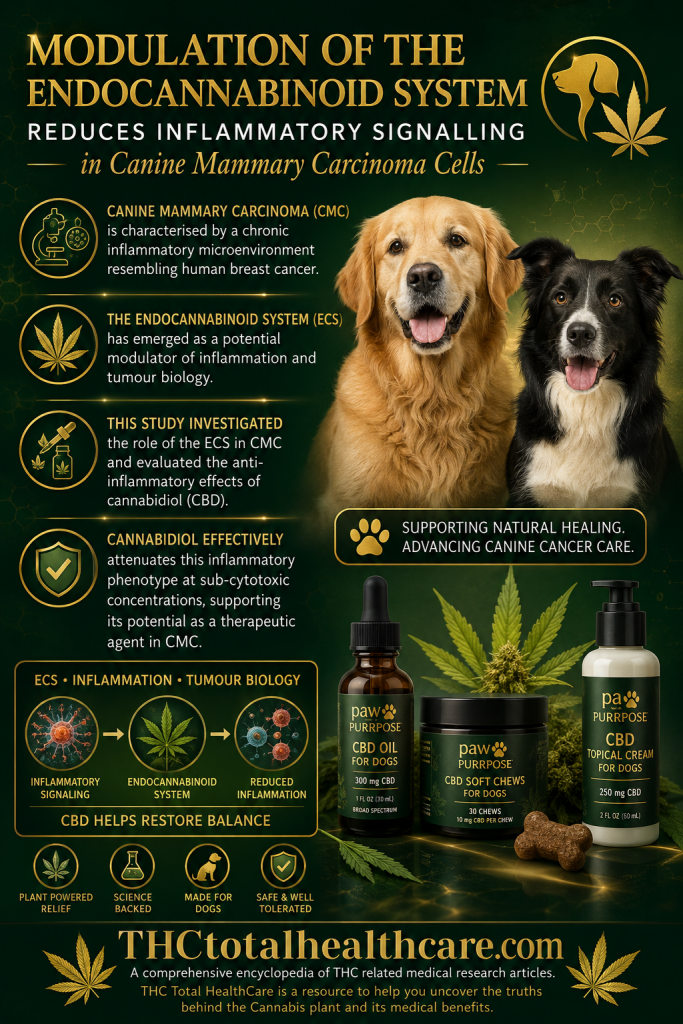
Background: Canine mammary carcinoma (CMC) is characterised by a chronic inflammatory microenvironment resembling human breast cancer; however, the upstream regulatory mechanisms driving this phenotype remain unclear. The endocannabinoid system (ECS) has emerged as a potential modulator of inflammation and tumour biology. This study investigated the role of the ECS in CMC and evaluated the anti-inflammatory effects of cannabidiol (CBD).

Methods: Primary cell cultures were established from surgically excised CMC tissues, with matched normal mammary epithelium used as controls. Basal mRNA expression of ECS-related receptors (CB1, CB2, transient receptor potential vanilloid 1 [TRPV1], G-protein-coupled receptor 55 [GPR55] and peroxisome proliferator-activated receptor alpha [PPAR-α]) and inflammatory mediators (COX-1, COX-2, interleukin [IL]-4, IL-6, IL-33, IL-17A, tumour necrosis factor-alpha [TNF-α] and LCN2) was assessed by reverse transcription quantitative polymerase chain reaction. Cytokine secretion (IL-6, IL-8, TNF-α and IL-17A) was quantified by enzyme-linked immunosorbent assay. Cell viability assays were performed to determine the 24-h IC50 of CBD (32 µM), and sub-cytotoxic concentrations (3, 10 and 20 µM) were subsequently applied for 24 h.

Results: Canine mammary carcinoma-derived cells exhibited significant overexpression of ECS receptors (CB1, CB2, TRPV1, GPR55 and PPAR-α) compared to normal controls. These cells also showed increased secretion of pro-inflammatory cytokines, including IL-6, IL-8, TNF-α and IL-17A. Treatment with CBD at 10-20 µM significantly downregulated key inflammatory genes, particularly COX-2, IL-6 and TNF-α, and reduced corresponding cytokine release without compromising cell viability.

Conclusion: The ECS is upregulated in CMC and appears to contribute to the inflammatory tumour microenvironment. Cannabidiol effectively attenuates this inflammatory phenotype at sub-cytotoxic concentrations, supporting its potential as a therapeutic agent in CMC.”

https://pubmed.ncbi.nlm.nih.gov/42078490

“These findings may also have relevant implications for human health, as CMC shares key molecular and pathological features with human breast cancer. Therefore, the modulation of ECS-related pathways observed in this study may reflect conserved mechanisms that could be exploited for the development of novel anti-inflammatory and anti-tumour strategies in human oncology.”

https://bvajournals.onlinelibrary.wiley.com/doi/10.1002/vro2.70034

The Effect of Cannabidiol on Cancer-Pathway Genes in Doxorubicin-Sensitive and Resistant Breast Cancer Cells

Purpose: Cannabidiol (CBD) is a primary bioactive, non-intoxicating cannabinoid found in the cannabis plant. Studies have shown that CBD causes anticancer activity by inhibiting the expression of growth factors and inducing apoptosis, leading to cell cycle arrest. In this study, we aimed to determine how CBD influences the expression of genes that affect cancer pathways in doxorubicin-sensitive (MCF-7) and doxorubicin-resistant (MCF-7/Adr) breast cancer cells. 

Materials and Methods: IC50 concentrations of CBD in MCF-7 and MCF-7/Adr cell lines were determined by the MTT cell cytotoxicity assay. RNA isolation and subsequent cDNA synthesis were performed for qPCR experiments with the determined IC50 values. The effects of CBD on the cell cycle and apoptosis were studied using flow cytometry. IC50 values of CBD were determined in MCF-7 and MCF-7/Adr breast cancer cell lines at eight different concentrations and at three different incubation periods (24 h, 48 h, and 72 h) with different doses. RT-qPCR was used to investigate the molecular mechanisms underlying the expression of genes involved in cancer pathway analysis. 

Results: Treatment with CBD at concentrations of 17.57 μM (MCF-7) and 11.41 μM (MCF-7/Adr) for 48 h decreased colony formation, induced apoptosis, and inhibited cell invasion in both cell lines. In addition, we observed significant alterations of angiogenesis, apoptosis, cell cycle, cellular senescence, DNA damage and repair, epithelial-to-mesenchymal transition, hypoxia, metabolism, telomeres, and telomerase in both cell lines. 

Conclusions: Our research indicates that CBD could be an effective natural bioactive compound for breast cancer treatment, inhibiting tumor cell proliferation and inducing apoptosis.”

https://pubmed.ncbi.nlm.nih.gov/42075870

“The plant Cannabis sativa has been used medicinally for several thousand years.”

“These findings support the relevance of CBD as a potential therapeutic agent in breast cancer and provide a basis for further investigation “

https://www.mdpi.com/1424-8247/19/4/615

Cannabinoid-Driven Rewiring of GPCR and Ion Channel Signaling in Lung Cancer

“Lung cancer remains the leading cause of cancer-related mortality worldwide, with non-small cell lung cancer accounting for the majority of cases and exhibiting persistent challenges related to therapy resistance and metastatic progression. Increasing evidence indicates that dysregulated G protein-coupled receptor signaling and ion channel activity function cooperatively as master regulators of tumor cell proliferation, migration, survival, and therapeutic response.

Cannabinoids, including phytocannabinoids such as delta-9-tetrahydrocannabinol and cannabidiol, as well as endogenous endocannabinoids, are uniquely positioned to modulate both G protein-coupled receptors and ion channels, thereby influencing key oncogenic signaling networks.

This review synthesizes current knowledge on the role of major ion channel families, including transient receptor potential channels, potassium channels, and sodium channels, and principal G protein-coupled receptor pathways involved in lung cancer progression. We further discuss how cannabinoids reprogram these interconnected signaling systems through canonical cannabinoid receptors, non-classical targets such as G protein-coupled receptor 55 and adenosine receptors, and direct modulation of ion channel activity.

Special attention is given to G protein-coupled receptor-ion channel coupling within membrane microdomains and to the capacity of cannabinoids to act as biased ligands, redirecting downstream pathways, such as the phosphoinositide 3-kinase-protein kinase B-mechanistic target of rapamycin and epidermal growth factor receptor signaling, toward apoptosis and reduced metastatic potential. Emerging strategies, including cannabinoid-based combination therapies, selective receptor biasing, and targeted delivery systems, are also highlighted.

Altogether, cannabinoid-driven rewiring of G protein-coupled receptor and ion channel signaling represents a promising mechanistic framework for developing innovative therapeutic approaches against lung cancer.”

https://pubmed.ncbi.nlm.nih.gov/42072396

“While challenges remain (optimal dosing, patient selection, and regulatory hurdles), the insight that can simultaneously target GPCRs and ion channels to cripple lung cancer is a paradigm shift. The convergence of cancer signaling biology with cannabinoid pharmacology opens up exciting possibilities for combination treatments that might tackle tumor resistance and recurrence. In summary, cannabinoid-driven modulation of GPCR and ion channel signaling represents a promising multi-pronged strategy against lung cancer, warranting further investigation and translation into clinical trials.”

https://www.mdpi.com/2227-9059/14/4/856

Cannabinoid receptors orchestrate distinct anti-tumour pathways in gastric cancer via and beyond specialized pro-resolving mediators

“Endocannabinoids (ECS) and specialized pro-resolving mediators (SPMs) are both lipid-based compounds, but differ significantly in origin, mechanisms, and functions. Their mechanistic interaction in cancer remains undefined, particularly in gastric cancer (GC). Several interconnections have been described between these two “bioactive lipids” involved in inflammation resolution, homeostatic and anti-tumour functions.

Cannabinoid signalling can modulate SPM biosynthesis in immune cells, thus we investigated whether this crosstalk operates in GC cells, and whether SPMs mediate part of the anti-tumour activity of cannabinoid receptors.

Using synthetic and selective agonists for the cannabinoid G-protein-coupled receptors CB1 and CB2 (ACEA and JWH133, respectively), we found that receptor activation in GC cells (AGS and MKN45) sustains the synthesis of two SPMs, Resolvin D1 and Lipoxin B4, which in turn suppresses the angiogenic potential of GC cells. These CB1/CB2-driven activities required a SRC/MAPK signalling. At physiological concentrations, these SPMs further enhanced the binding affinity of ACEA and JWH133 for CB1 and CB2, indicating a functional crosstalk between the two systems.

Beyond angiogenesis, CB1/2 stimulation reduced cell proliferation and viability, induced apoptosis, impaired the migration and the epithelial-to-mesenchymal program in GC cells. Only CB2 activation reduced the stemness properties of GC cells. Interestingly, while the anti-angiogenic properties of CB1 and CB2 required SPM production, their other anti-tumour actions were independent of the pro-resolving pathway.

Our results extend the current knowledge of the endocannabinoid system by defining a new dual mechanism, SPM-dependent and SPM-independent, that restrains GC progression and identify the ECS-SPM axis as a potential target for therapeutic intervention.”

https://pubmed.ncbi.nlm.nih.gov/41775095

“CB1 and CB2 activation sustain potent anti-tumour effects in gastric cancer (GC).”

“In conclusion, this work demonstrates that cannabinoid receptor activation restrains gastric cancer cell proliferation, migration, stemness, and angiogenesis through both SPM-dependent and SPM-independent mechanisms. By linking ECS activation to pro-resolving lipid metabolism via SRC-ERK signalling, our data position CB1 and CB2 as regulators of tumour control rather than progression. These findings open the way for preclinical in vivo studies aimed at exploiting cannabinoid-SPM crosstalk as a novel therapeutic axis in gastric cancer.”

https://www.sciencedirect.com/science/article/pii/S0753332226002192?via%3Dihub

Comprehensive two-dimensional liquid chromatographic analysis of Cannabis phenolics and first evidence of flavoalkaloids in Cannabis

“Cannabis contains a large number of diverse metabolites. Compared to the well-studied cannabinoids and terpenoids, characterization of the phenolic composition of Cannabis has received little attention. With studies reporting synergistic effects in Cannabis, the importance of investigating polyphenols in Cannabis is becoming more apparent.

We report an on-line comprehensive 2D HILIC × RP-LC method hyphenated to high resolution (HR) MS for the detailed characterization of polar phenolics in Cannabis inflorescence and leaf samples of three commercial strains. Optimal HILIC × RP-LC conditions were derived using an automated method optimization program, and provided excellent separation performance (peak capacity > 3000) and high orthogonality. Diode array and HR-MS data enabled tentative identification of 79 compounds, comprising mainly flavone and (hydroxy)cinnamic acid derivatives. Compound assignment was facilitated by the group-type separation obtained between the phenolic acids and flavonoids, as well as the structured elution patterns for the flavone glycosides.

The presence of three C-glycosylated flavones, as well as several of their O-glycosylated derivatives, distinguished one of the strains from the other two. In the same strain, flavoalkaloids were detected, mainly in the leaf extracts.

The structures of the alkaloid moieties could not be unambiguously assigned based on the available HR-MS data, but four classes of flavoalkaloids comprising 16 flavone derivates could be tentatively identified.

This is the first time that this relatively rare and chemically interesting class of compounds has been detected in Cannabis.

These findings highlight the diversity of Cannabis, and the utility of HILIC × RP-LC-HR-MS for the in-depth study of its phenolic composition.”

https://pubmed.ncbi.nlm.nih.gov/40359741

Cannabis is a herbaceous plant of the Cannabaceae family originating from Western Asia, that has been cultivated across the world for many purposes ranging from textile to medicinal uses for more than six millennia “

https://www.sciencedirect.com/science/article/pii/S0021967325003711?via%3Dihub

“Don’t toss cannabis leaves: Scientists found rare compounds with medical potential. Cannabis just revealed a hidden chemical treasure—rare compounds scientists never knew were there.” https://www.sciencedaily.com/releases/2026/05/260501002156.htm