
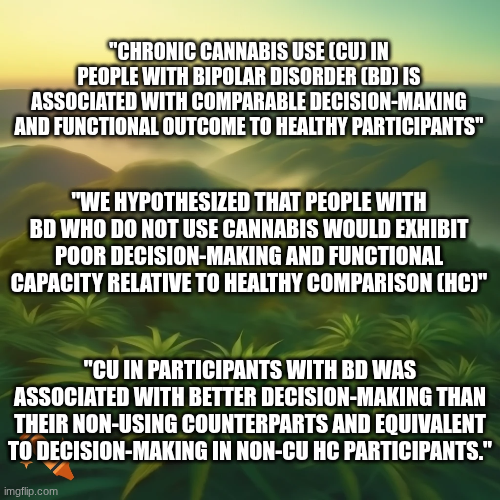
“Impaired decision-making is often seen in people with bipolar disorder (BD), even those undergoing treatment. Targeted therapeutics are therefore needed.
People with BD report that cannabis use (CU) attenuates such cognitive and behavioral symptoms.
We hypothesized that 1) people with BD who do not use cannabis would exhibit poor decision-making and functional capacity relative to healthy comparison (HC) participants and 2) CU in people with BD would be associated with decision-making and functional capacity comparable to that of HC participants who do not use cannabis.
HC and BD participants that either reported regular (≥4x/weekly) CU or no-CU were recruited (n = 87). Participants were tested on decision-making and functional capacity using the Iowa Gambling Task and UCSD Performance-based skills assessment (UPSA-2), respectively.
CU was associated with impaired decision-making in healthy participants while CU in participants with BD was associated with better decision-making than their non-using counterparts and equivalent to decision-making in non-CU HC participants.
Additionally, CU in people with BD was associated with UPSA-2 scores comparable to non-CU HC participants. Studies are needed to determine whether cannabinoid-related treatments improve such decision-making and function in people with BD.”
https://pubmed.ncbi.nlm.nih.gov/41309543
“In summary, people with BD who use cannabis had decision-making and functional capacity comparable to non-CU HC participants.”
 “The Endocannabinoid System (ECS) is primarily responsible for maintaining homeostasis, a balance in internal environment (temperature, mood, and immune system) and energy input and output in living, biological systems.
  “Borderline Personality Disorder (BPD) is a chronic debilitating psychiatric disorder characterized mainly by emotional instability, chaotic interpersonal relationships, cognitive disturbance (e.g. dissociation and suicidal thoughts) and maladaptive behaviors. BPD has a high rate of comorbidity with other mental disorders and high burden on society.
 “This review is to summarize most recent evidence published in the last 18 months on medical and recreational use of cannabis and
  “Mood disorders are the most prevalent mental conditions encountered in psychiatric practice. Numerous patients suffering from mood disorders present with treatment-resistant forms of depression, co-morbid anxiety, other psychiatric disorders and bipolar disorders.
 “Bipolar disorder (BD) is a debilitating, lifelong neuropsychiatric illness characterised by unsteady mood states which vacillate from (hypo)mania to depression. Despite the availability of pharmaceutical agents which can be effective in ameliorating the acute affective symptoms and prevent episodic relapse, BD is inadequately treated in a subset of patients.
 “The present review will provide an overview of the neurobiology, epidemiology, clinical impact, and treatment of cannabis use disorder (CUD) in mood disorders.