“Background: Cannabis-containing medicines have been successfully used in our practice for more than 20 years in pain and especially in geriatric and palliative patients. While it was initially a very indication-specific use (pain, loss of appetite, etc.) and also with higher THC doses, this changed over time to low THC doses and a therapy focus on suffering-perpetuating symptoms and especially on stress (Matrix of Symptoms).
Method: As part of the legally prescribed companion survey, we evaluated our data in parallel and discussed it publicly in a series of publications. Based on these published results, the article is intended to show an overview of our experiences.
Results: Low-dose THC has a positive effect on morbidity, side effects, quality of life and mortality in geriatric and palliative patients.
Conclusion: Early therapy is particularly appropriate in geriatric and palliative patients due to the clear benefit-risk ratio of low-dose THC.”
“Background: Almost 90% of patients with dementia suffer from some type of neurobehavioral symptom, and there are no approved medications to address these symptoms.
Objective: To evaluate the safety and efficacy of the medical cannabis oil “Avidekel” for the reduction of behavioral disturbances among patients with dementia.
Materials and methods: In this randomized, double-blind, single-cite, placebo-controlled trial conducted in Israel (ClinicalTrials.gov: NCT03328676), patients aged at least 60, with a diagnosis of major neurocognitive disorder and associated behavioral disturbances were randomized 2:1 to receive either “Avidekel,” a broad-spectrum cannabis oil (30% cannabidiol and 1% tetrahydrocannabinol: 295 mg and 12.5 mg per ml, respectively; n = 40) or a placebo oil (n = 20) three times a day for 16 weeks. The primary outcome was a decrease, as compared to baseline, of four or more points on the Cohen-Mansfield Agitation Inventory score by week 16.
Results: From 60 randomized patients [mean age, 79.4 years; 36 women (60.0%)], 52 (86.7%) completed the trial (all eight patients who discontinued treatment were from the investigational group). There was a statistically significant difference in the proportion of subjects who had a Cohen-Mansfield Agitation Inventory score reduction of ≥ 4 points at week 16: 24/40 (60.0%) and 6/20 (30.0%) for investigational and control groups, respectively (χ2 = 4.80, P = 0.03). There was a statistically significant difference in the proportion of subjects who had a Cohen-Mansfield Agitation Inventory score reduction of ≥ 8 points at week 16: 20/40 (50%) and 3/20 (15%), respectively (χ2 = 6.42, P = 0.011). The ANOVA repeated measures analysis demonstrated significantly more improvement in the investigational group compared to the control group at weeks 14 and 16 (F = 3.18, P = 0.02). Treatment was mostly safe, with no significant differences in the occurrence of adverse events between the two groups.
Conclusion: In this randomized controlled trial, ‘Avidekel’ oil significantly reduced agitation over placebo in patients suffering from behavioral disturbances related to dementia, with non-serious side-effects. Further research is required with a larger sample size.”
“Peripheral inputs continuously shape brain function and can influence memory acquisition, but the underlying mechanisms have not been fully understood. Cannabinoid type-1 receptor (CB1R) is a well-recognized player in memory performance, and its systemic modulation significantly influences memory function. By assessing low arousal/non-emotional recognition memory in mice, we found a relevant role of peripheral CB1R in memory persistence. Indeed, the peripherally-restricted CB1R specific antagonist AM6545 showed significant mnemonic effects that were occluded in adrenalectomized mice, and after peripheral adrenergic blockade. AM6545 also transiently impaired contextual fear memory extinction. Vagus nerve chemogenetic inhibition reduced AM6545-induced mnemonic effect. Genetic CB1R deletion in dopamine β-hydroxylase-expressing cells enhanced recognition memory persistence. These observations support a role of peripheral CB1R modulating adrenergic tone relevant for cognition. Furthermore, AM6545 acutely improved brain connectivity and enhanced extracellular hippocampal norepinephrine. In agreement, intra-hippocampal β-adrenergic blockade prevented AM6545 mnemonic effects. Altogether, we disclose a novel CB1R-dependent peripheral mechanism with implications relevant for lengthening the duration of non-emotional memory.”
“Alzheimer’s disease (AD) is the most common form of dementia, but there is still no available treatment.
Δ9-tetrahydrocannabinol (THC) is emerging as a promising therapeutic agent. Using THC in conventional high doses may have deleterious effects. Therefore, we propose to use an ultra-low dose of THC (ULD-THC). We previously published that a single injection of ULD-THC ameliorated cognitive functioning in several models of brain injuries as well as in naturally aging mice.
Here, 5xFAD AD model mice received a single treatment of ULD-THC (0.002 mg/kg) after disease onset and were examined in two separate experiments for cognitive functions, neurotropic, and inflammatory factors in the hippocampus.
We show that a single injection of ULD-THC alleviated cognitive impairments in 6- and 12-month-old 5xFAD mice. On the biochemical level, our results indicate an imbalance between the truncated TrkB receptor isoform and the full receptor, with AD mice showing a greater tendency to express the truncated receptor, and ULD-THC improved this imbalance. We also investigated the expression of three AD-related inflammatory markers and found an ameliorating effect of ULD-THC.
The current research demonstrates for the first time the beneficial effects of a single ultra-low dose of THC in a mouse model of AD after disease onset.”
“The current research demonstrates for the first time the beneficial effects of a single ultra-low dose of THC in a mouse model of AD after disease onset. As THC is a cheap, widely available substance already approved for use in other conditions, this research brings us closer to understanding its mechanisms and will possibly lead to new treatments.”
“Cannabinoids are compounds that were initially isolated from cannabis marihuana and are also widely present in both nervous and immune systems of animals.
In recent years, with in-depth research on cannabinoids, their clinical medicinal value has been evaluated, and many exciting achievements have been continuously accumulating, especially in the field of neurodegenerative disease.
Alzheimer’s disease is the most common type of neurodegenerative disease that causes dementia and has become a global health problem that seriously impacts human health today.
In this review, we discuss the therapeutic potential of cannabinoids for the treatment of Alzheimer’s disease.
How cannabinoids act on different endocannabinoid receptor subtypes to regulate Alzheimer’s disease, the roles of the endocannabinoid system in Alzheimer’s disease are outlined, and the underlying mechanisms are discussed.
Finally, we summarize the most relevant opportunities of cannabinoid pharmacology related to Alzheimer’s disease and discuss the potential usefulness of cannabinoids in the clinical treatment of Alzheimer’s disease.”
“THC has been used as a promising treatment approach for neurological disorders, but the highly psychoactive effects have largely warned off many scientists from pursuing it further. We conducted an intranasal treatment using low-dose THC on 12-month-old APP/PS1 mice daily for 3 months to overcome any potential psychoactive response induced by the systemic delivery.
Our results demonstrate that the THC nasal treatment at 0.002 and 0.02 mg/kg significantly slowed the memory decline compared to that in the vehicle-treated transgenic mouse control group.
An enzyme-linked immunosorbent assay showed that the Aβ1-40 and 1-42 peptides decreased in the THC-treated groups. The Western blot data indicate that long-term low-dose THC intranasal administration promoted p-tau level reduction and mitochondrial function marker redistribution. The blood biochemical parameter data demonstrate some insignificant changes in cytokine, immunoglobulin, and immune cell profiles during intranasal THC treatment.
Intranasal delivery is a non-invasive and convenient method that rapidly targets therapeutics to the brain, minimizing systemic exposure to avoid unwanted adverse effects. Our study provides new insights into the role of low-dose THC intranasal treatment as a pharmacological strategy to counteract alterations in Alzheimer’s disease-related cognitive performance.”
“Low-Dose Delta-9-Tetrahydrocannabinol as Beneficial Treatment for Aged APP/PS1 Mice. In conclusion, treatment with THC at 0.2 and 0.02 mg/kg improved the spatial learning of aged APP/PS1 mice, suggesting low-dose THC is a safe and effective treatment for AD.”
“Cannabis sativa L. is an annual herb oldest cultivated plants as a source of fiber since about 5000 B.C. On the other hand, the cannabis flower and seed are listed in Shennong’s classic Materia Medica approximately 2000 years ago. The formulas prescribed with cannabis in Kampo medicine have been summarized. Cannabidiol (CBD) and tetrahydrocannabinol (THC) are the major neurological and psychiatric cannabinoids, and develop to drugs. It becomes evident that the therapeutic CBD and/or THC are the important candidate of anti-dementia drugs having different mechanism for Alzheimer’s patients. Two receptors and endocannabinoids are also discussed for underlying mechanism of action. In order to promote the breeding of cannabis plant containing higher concentration of target cannabinoid the biosynthetic enzymes were isolated, cloning and the tertiary structure of THCA synthase determined by x-ray analysis resulting in the possibility of molecular breeding for cannabinoids.”
“Frontotemporal dementia (FTD) and Alzheimer’s disease (AD) share the pathological hallmark of intracellular neurofibrillary tangles, which result from the hyperphosphorylation of microtubule associated protein tau. The P301S mutation in human tau carried by TAU58/2 transgenic mice results in brain pathology and behavioural deficits relevant to FTD and AD. The phytocannabinoid cannabidiol (CBD) exhibits properties beneficial for multiple pathological processes evident in dementia. Therefore, 14-month-old female TAU58/2 transgenic and wild type-like (WT) littermates were treated with 100 mg/kg CBD or vehicle i.p. starting three weeks prior to conducting behavioural paradigms relevant to FTD and AD. TAU58/2 females exhibited impaired motor function, reduced bodyweight and less anxiety behaviour compared to WT. Impaired spatial reference memory of vehicle-treated transgenic mice was restored by chronic CBD treatment. Chronic CBD also reduced anxiety-like behaviours and decreased contextual fear-associated freezing in all mice. Chronic remedial CBD treatment ameliorated several disease-relevant phenotypes in 14-month-old TAU58/2 transgenic mice, suggesting potential for the treatment of tauopathy-related behavioural impairments including cognitive deficits.”
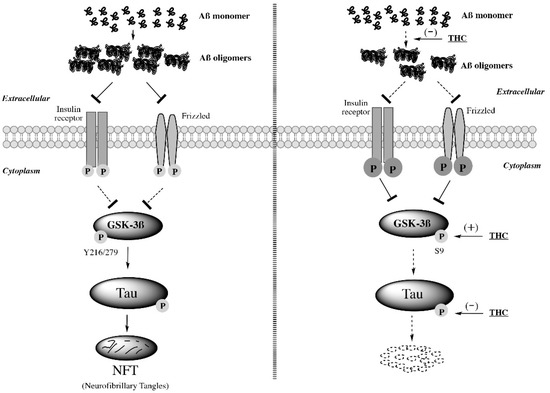
“Studies on the effective and safe therapeutic dosage of delta-9-tetrahydrocannabinol (THC) for the treatment of Alzheimer’s disease (AD) have been sparse due to the concern about THC’s psychotropic activity. The present study focused on demonstrating the beneficial effect of low-dose THC treatment in preclinical AD models.
The effect of THC on amyloid-β (Aβ) production was examined in N2a/AβPPswe cells. An in vivo study was conducted in aged APP/PS1 transgenic mice that received an intraperitoneal injection of THC at 0.02 and 0.2 mg/kg every other day for three months.
The in vitro study showed that THC inhibited Aβ aggregation within a safe dose range. Results of the radial arm water maze (RAWM) test demonstrated that treatment with 0.02 and 0.2 mg/kg of THC for three months significantly improved the spatial learning performance of aged APP/PS1 mice in a dose-dependent manner.
Results of protein analyses revealed that low-dose THC treatment significantly decreased the expression of Aβ oligomers, phospho-tau and total tau, and increased the expression of Aβ monomers and phospho-GSK-3β (Ser9) in the THC-treated brain tissues.
In conclusion, treatment with THC at 0.2 and 0.02 mg/kg improved the spatial learning of aged APP/PS1 mice, suggesting low-dose THC is a safe and effective treatment for AD.”
“The concept of neurons as irreplaceable cells does not hold true today. Experiments and evidence of neurogenesis, also, in the adult brain give hope that some compounds or drugs can enhance this process, helping to reverse the outcomes of diseases or traumas that once were thought to be everlasting.
Cannabinoids, both from natural and artificial origins, already proved to have several beneficial effects (e.g., anti-inflammatory, anti-oxidants and analgesic action), but also capacity to increase neuronal population, by replacing the cells that were lost and/or regenerate a damaged nerve cell.
Neurogenesis is a process which is not highly represented in literature as neuroprotection, though it is as important as prevention of nervous system damage, because it can represent a possible solution when neuronal death is already present, such as in neurodegenerative diseases.
The aim of this review is to resume the experimental evidence of phyto- and synthetic cannabinoids effects on neurogenesis, both in vitro and in vivo, in order to elucidate if they possess also neurogenetic and neurorepairing properties.”
“The current results of cannabinoids effects on neurogenesis are encouraging, and it is expectable that the amount of evidence continues to increase in the future with other experiments.”






 “The concept of neurons as irreplaceable cells does not hold true today. Experiments and evidence of neurogenesis, also, in the adult brain give hope that some compounds or drugs can enhance this process, helping to reverse the outcomes of diseases or traumas that once were thought to be everlasting.