
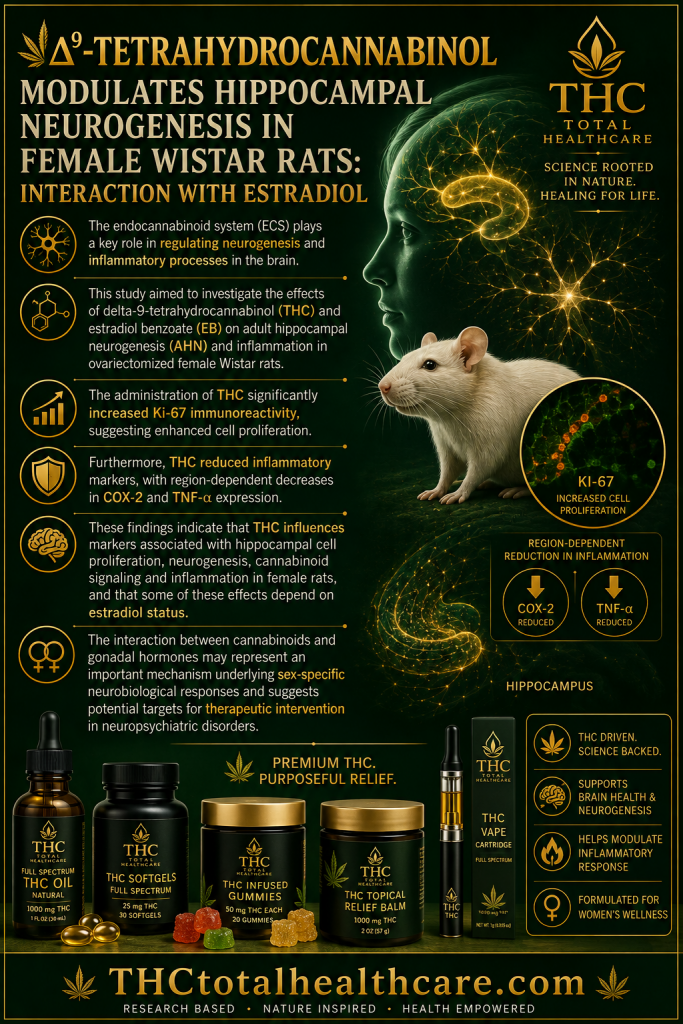
“The endocannabinoid system (ECS) plays a key role in regulating neurogenesis and inflammatory processes in the brain.
The increasing prevalence of Cannabis use among women highlights the importance of understanding sex-specific effects of cannabinoids, particularly in the context of hormonal interactions.
This study aimed to investigate the effects of delta-9-tetrahydrocannabinol (THC) and estradiol benzoate (EB) on adult hippocampal neurogenesis (AHN) and inflammation in ovariectomized female Wistar rats.
Sixteen rats were allocated to four experimental groups receiving THC, EB, both treatments, and vehicle. Immunohistochemical analyses were conducted to evaluate markers of proliferation (Ki-67), neurogenesis (doublecortin and PSA-NCAM), cannabinoid receptor expression (CB1), and inflammation (COX-2 and TNF-α) in the hippocampal formation.
The administration of THC significantly increased Ki-67 immunoreactivity, suggesting enhanced cell proliferation. A trend toward increased doublecortin expression was observed, particularly in EB-treated animals. THC also modulated CB1 receptor expression, with significant increases in the dentate gyrus and hilus following combined THC and EB treatment. Furthermore, THC reduced inflammatory markers, with region-dependent decreases in COX-2 and TNF-α expression.
These findings indicate that THC influences markers associated with hippocampal cell proliferation, neurogenesis, cannabinoid signaling and inflammation in female rats, and that some of these effects depend on estradiol status.
The interaction between cannabinoids and gonadal hormones may represent an important mechanism underlying sex-specific neurobiological responses and suggests potential targets for therapeutic intervention in neuropsychiatric disorders.”
https://pubmed.ncbi.nlm.nih.gov/42570151
https://link.springer.com/article/10.1007/s11064-026-04857-w
 “The concept of neurons as irreplaceable cells does not hold true today. Experiments and evidence of neurogenesis, also, in the adult brain give hope that some compounds or drugs can enhance this process, helping to reverse the outcomes of diseases or traumas that once were thought to be everlasting.
  “During the last decades, researchers have investigated the functional relevance of adult hippocampal neurogenesis in normal brain function as well as in the pathogenesis of diverse psychiatric conditions.
 “Studies have reported changes in the endocannabinoid system in the brain of patients with Alzheimer’s disease (AD), playing a role in the pathophysiology of AD. Cannabinoids have been shown to have neuroprotective properties, reduce neuroinflammation, and enhance neurogenesis. Evidence suggests that the utilization of marijuana products containing both tetrahydrocannabinol (THC) and cannabidiol (CBD) or CBD alone have been effective and safe for use in older people with agitation associated with dementia.
 “The endocannabinoid system (eCB) is a ubiquitous lipid signaling system composed of at least two receptors, their endogenous ligands, and the enzymes responsible for their synthesis and degradation. Within the brain, the eCB system is highly expressed in the hippocampus and controls basic biological processes, including neuronal proliferation, migration and differentiation, which are intimately linked with embryonal neurogenesis. Accumulated preclinical evidence has indicated that eCBs play a major role also in regulating adult neurogenesis. Increased
  “The G-protein coupled cannabinoid receptor 2 (CB2) has been implicated in the regulation of adult neurogenesis in the hippocampus. The contribution of CB2 towards basal levels of proliferation and the number of neural progenitors in the subgranular zone (SGZ) of the dentate gyrus, however, remain unclear. We stained hippocampal brain sections of 16- to 17-week-old wildtype and CB2-deficient mice, for neural progenitor and immature neuron markers doublecortin (DCX) and calretinin (CR) and for the proliferation marker Ki67 and quantified the number of positive cells in the SGZ. The quantification revealed that CB2 deficiency neither altered overall cell proliferation nor the size of the DCX+ or DCX and CR double-positive populations in the SGZ compared to control animals. The results indicate that CB2 might not contribute to basal levels of adult neurogenesis in four-month-old healthy mice. CB2 signaling might be more relevant in conditions where adult neurogenesis is dynamically regulated, such as neuroinflammation.”
 “The administration of cannabidiol has shown promising evidence in the treatment of some neuropsychiatric disorders, including cocaine addiction. However, little information is available as to the mechanisms by which cannabidiol reduces drug use and compulsive seeking.