
 “Brain trauma was clinically associated with increased osteogenesis in the appendicular skeleton. We showed previously in C57BL/6J mice that mild traumatic brain injury (mTBI) transiently induced bone formation in the femur via the cannabinoid-1 (CB1) receptor. Here, we subjected ICR mice to mTBI and examined the bone response in the skull using microCT. We also measured mast cell degranulation (MCD)72 h post-injury. Finally, we measured brain and calvarial endocannabinoids levels post-mTBI. mTBI led to decreased bone porosity on the contralateral (untouched) side. This effect was apparent both in young and mature mice. Administration of rimonabant (CB1 inverse agonist) completely abrogated the effect of mTBI on calvarial porosity and significantly reduced MCD, compared with vehicle-treated controls. We also found that mTBI resulted in elevated levels of anandamide, but not 2-arachidonoylglycerol, in the contralateral calvarial bone, whereas brain levels remained unchanged. In C57BL/6J CB1 knockout mice, mTBI did not reduce porosity but in general the porosity was significantly lower than in WT controls. Our findings suggest that mTBI induces a strain-specific CB1-dependent bone anabolic response in the skull, probably mediated by anandamide, but seemingly unrelated to inflammation. The endocannabinoid system is therefore a plausible target in management of bone response following head trauma.”
Category Archives: Endocannabinoid System
The Expanded Endocannabinoid System/Endocannabinoidome as a Potential Target for Treating Diabetes Mellitus.
 “The endocannabinoid (eCB) system, i.e. the receptors that respond to the psychoactive component of cannabis, their endogenous ligands and the ligand metabolic enzymes, is part of a larger family of lipid signals termed the endocannabinoidome (eCBome). We summarize recent discoveries of the roles that the eCBome plays within peripheral tissues in diabetes, and how it is being targeted, in an effort to develop novel therapeutics for the treatment of this increasingly prevalent disease.
RECENT FINDINGS:
As with the eCB system, many eCBome members regulate several physiological processes, including energy intake and storage, glucose and lipid metabolism and pancreatic health, which contribute to the development of type 2 diabetes (T2D). Preclinical studies increasingly support the notion that targeting the eCBome may beneficially affect T2D. The eCBome is implicated in T2D at several levels and in a variety of tissues, making this complex lipid signaling system a potential source of many potential therapeutics for the treatments for T2D.”
https://www.ncbi.nlm.nih.gov/pubmed/31686231
https://link.springer.com/article/10.1007%2Fs11892-019-1248-9
Anticancer effects of n-3 EPA and DHA and their endocannabinoid derivatives on breast cancer cell growth and invasion.
 “The anticancer effects of the omega-3 long chain polyunsaturated fatty acids (LCPUFA), EPA and DHA may be due, at least in part, to conversion to their respective endocannabinoid derivatives, eicosapentaenoyl-ethanolamine (EPEA) and docosahexaenoyl-ethanolamine (DHEA).
Here, the effects of EPEA and DHEA and their parent compounds, EPA and DHA, on breast cancer (BC) cell function was examined. EPEA and DHEA exhibited greater anti-cancer effects than EPA and DHA in two BC cells (MCF-7 and MDA-MB-231) whilst displaying no effect in non-malignant breast cells (MCF-10a).
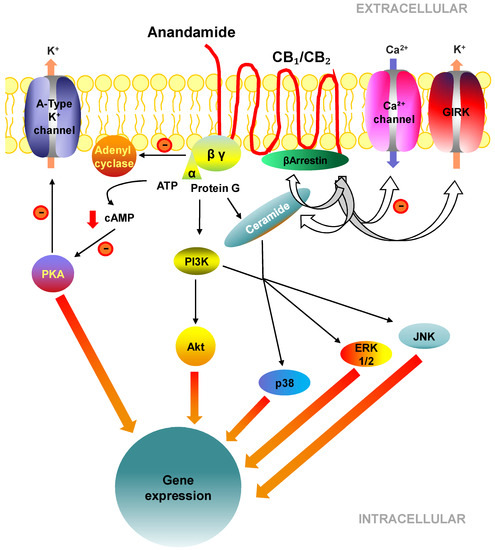
Both BC lines expressed CB1/2 receptors that were responsible, at least partly, for the observed anti-proliferative effects of the omega-3 endocannabinoids as determined by receptor antagonism studies. Additionally, major signalling mechanisms elicited by these CB ligands included altered phosphorylation of p38-MAPK, JNK, and ERK proteins.
Both LCPUFAs and their endocannabinoids attenuated the expression of signal proteins in BC cells, albeit to different extents depending on cell type and lipid effectors. These signal proteins are implicated in apoptosis and attenuation of BC cell migration and invasiveness.
Furthermore, only DHA reduced in vitro MDA-MB-231 migration whereas both LCPUFAs and their endocannabinoids significantly inhibited invasiveness. This finding was consistent with reduced integrin β3 expression observed with all treatments and reduced MMP-1 and VEGF with DHA treatment.
Attenuation of cell viability, migration and invasion of malignant cells indicates a potential adjunct nutritional therapeutic use of these LCPUFAs and/or their endocannabinoids in treatment of breast cancer.”
https://www.ncbi.nlm.nih.gov/pubmed/31679810
https://www.plefa.com/article/S0952-3278(19)30112-7/fulltext
Targeting the cannabinoid receptor CB2 in a mouse model of l-dopa induced dyskinesia.
 “L-dopa induced dyskinesia (LID) is a debilitating side-effect of the primary treatment used in Parkinson’s disease (PD), l-dopa. Here we investigate the effect of HU-308, a cannabinoid CB2 receptor agonist, on LIDs.
Utilizing a mouse model of PD and LIDs, induced by 6-OHDA and subsequent l-dopa treatment, we show that HU-308 reduced LIDs as effectively as amantadine, the current frontline treatment. Furthermore, treatment with HU-308 plus amantadine resulted in a greater anti-dyskinetic effect than maximally achieved with HU-308 alone, potentially suggesting a synergistic effect of these two treatments. Lastly, we demonstrated that treatment with HU-308 and amantadine either alone, or in combination, decreased striatal neuroinflammation, a mechanism which has been suggested to contribute to LIDs.
Taken together, our results suggest pharmacological treatments with CB2 agonists merit further investigation as therapies for LIDs in PD patients. Furthermore, since CB2 receptors are thought to be primarily expressed on, and signal through, glia, our data provide weight to suggestion that neuroinflammation, or more specifically, altered glial function, plays a role in development of LIDs.”
https://www.ncbi.nlm.nih.gov/pubmed/31669673
“Collectively, our findings suggest CB2 agonists offer a putative target to treat LIDs, with efficacy comparable to the frontline treatment amantadine. Our study suggests that targeting glial function may be an important strategy for developing therapies for treating LIDs, a major unmet need for PD patients.”
https://www.sciencedirect.com/science/article/pii/S0969996119303213?via%3Dihub
Endocannabinoid System Alterations in Posttraumatic Stress Disorder: A Review of Developmental and Accumulative Effects of Trauma.
 “The role of the endocannabinoid system in stress-related psychiatric symptoms has been investigated in many animal and human studies.
Although most of these studies consistently report long-lasting effects of prolonged stress and trauma on the endocannabinoid system, the nature and direction of these changes are controversial.
We reviewed the available preclinical and clinical studies investigating the endocannabinoid system alterations long after chronic stress and trauma.
We propose that the effects of prolonged stress or trauma on the endocannabinoid system are different based on the developmental age of subjects at the time of experiencing the trauma and its repetitiveness and accumulative effects.
The current literature consistently demonstrates decreased levels of endocannabinoid ligands and receptors if the trauma occurs in childhood, whereas decreased levels of endocannabinoid ligands and increased levels of cannabinoid receptors are reported when trauma has happened in adulthood.
It is important to note that these changes are region-specific in the brain and also there are important sex differences, which are beyond the scope of this review.”
https://www.ncbi.nlm.nih.gov/pubmed/31660473
“More studies are needed to compare the effects of childhood and adulthood trauma, with or without PTSD presentations, on the eCB system. These studies would have important clinical implications, not only for individuals with trauma and PTSD who commonly have comorbid recreational cannabis use, and medical marijuana users with PTSD being one of its main indicators but also for studies investigating the potential therapeutic use of cannabinoids and eCB enhancers in PTSD treatment.”
Structure of an allosteric modulator bound to the CB1 cannabinoid receptor.

CB1 also responds to allosteric modulators, which influence cannabinoid binding and efficacy.
To understand the mechanism of these compounds, we solved the crystal structure of CB1 with the negative allosteric modulator (NAM) ORG27569 and the agonist CP55940.
The structure reveals that the NAM binds to an extrahelical site within the inner leaflet of the membrane, which overlaps with a conserved site of cholesterol interaction in many G protein-coupled receptors (GPCRs).
The ternary structure with ORG27569 and CP55940 captures an intermediate state of the receptor, in which aromatic residues at the base of the agonist-binding pocket adopt an inactive conformation despite the large contraction of the orthosteric pocket.
The structure illustrates a potential strategy for drug modulation of CB1 and other class A GPCRs.”
Cannabinoid receptor 2‑selective agonist JWH015 attenuates bone cancer pain through the amelioration of impaired autophagy flux induced by inflammatory mediators in the spinal cord.
 “Bone cancer pain (BCP) is a severe complication of advanced bone cancer.
Although cannabinoid receptor 2 (CB2) agonists may have an analgesic effect, the underlying mechanism remains unclear.
CB2 serves a protective role in various pathological states through the activation of autophagy. Therefore, the present study aimed to determine whether the analgesic effects of the selective CB2 agonist JWH015 was mediated by the activation of autophagy in BCP.
The results of the present study suggested that the impairment of autophagy flux was induced by glia‑derived inflammatory mediators in spinal neurons. Intrathecal administration of the selective CB2 agonist JWH015 ameliorated autophagy flux through the downregulation of IL‑1β and IL‑6 and attenuated BCP.”
https://www.ncbi.nlm.nih.gov/pubmed/31661120
https://www.spandidos-publications.com/10.3892/mmr.2019.10772
Roles of the Hepatic Endocannabinoid and Apelin Systems in the Pathogenesis of Liver Fibrosis.
 “Hepatic fibrosis is the consequence of an unresolved wound healing process in response to chronic liver injury and involves multiple cell types and molecular mechanisms. The hepatic endocannabinoid and apelin systems are two signalling pathways with a substantial role in the liver fibrosis pathophysiology-both are upregulated in patients with advanced liver disease. Endogenous cannabinoids are lipid-signalling molecules derived from arachidonic acid involved in the pathogenesis of cardiovascular dysfunction, portal hypertension, liver fibrosis, and other processes associated with hepatic disease through their interactions with the CB1 and CB2 receptors. Apelin is a peptide that participates in cardiovascular and renal functions, inflammation, angiogenesis, and hepatic fibrosis through its interaction with the APJ receptor. The endocannabinoid and apelin systems are two of the multiple cell-signalling pathways involved in the transformation of quiescent hepatic stellate cells into myofibroblast like cells, the main matrix-producing cells in liver fibrosis. The mechanisms underlying the control of hepatic stellate cell activity are coincident despite the marked dissimilarities between the endocannabinoid and apelin signalling pathways. This review discusses the current understanding of the molecular and cellular mechanisms by which the hepatic endocannabinoid and apelin systems play a significant role in the pathophysiology of liver fibrosis.”
Medical Marijuana Guidelines for Practice: Health Policy Implications.
 “Cannabis use in pediatric health care remains limited, however, there is increasing evidence on the pharmacologic benefits of medical marijuana for chronic conditions in childhood. Realizing the need for guidance in practice, the National Council of State Boards of Nursing (NCSBN) published guidelines to aid in decision making in nursing practice. While focusing primarily on adult use of cannabis, the guidelines do address special populations such as children and adolescents. This article reviews the endocannabinoid system, current state of legislation on medical marijuana, policy considerations, recent FDA approval of a cannabis product for pediatric use, NCSBN National Nursing Guidelines for Medical Marijuana, and pediatric implications for nursing practice.”
https://www.ncbi.nlm.nih.gov/pubmed/31655786
https://www.jpedhc.org/article/S0891-5245(19)30399-2/fulltext
Effects of Cannabis and Its Components on the Retina: A Systematic Review.
 “Cannabis is the most prevalent drug in the world and its consumption is growing. Cannabinoid receptors are present in the human central nervous system. Recent studies show evidence of the effects of cannabinoids on the retina, and synthesizing the results of these studies may be relevant for ophthalmologists. Thus, this review adopts standardized, systematic review methodology to investigate the effects of exposure to cannabis and components on the retina.
RESULTS:
We retrieved 495 studies, screened 229 studies, assessed 52 studies for eligibility, and included 16 studies for qualitative analysis. The cannabinoids most frequently investigated were delta-9-tetrahydrocannabinol (THC), abnormal cannabidiol, synthetic cannabinoid, and cannabidiol (CDB). The outcomes most studied were neuroretinal dysfunction, followed by vascular effects. The studies also included investigation of neuroprotective and anti-inflammatory effects and teratogenic effects.
CONCLUSIONS:
This review suggests that cannabinoids may have an important role in retinal processing and function.”
https://www.ncbi.nlm.nih.gov/pubmed/31648567
https://www.tandfonline.com/doi/abs/10.1080/15569527.2019.1685534?journalCode=icot20