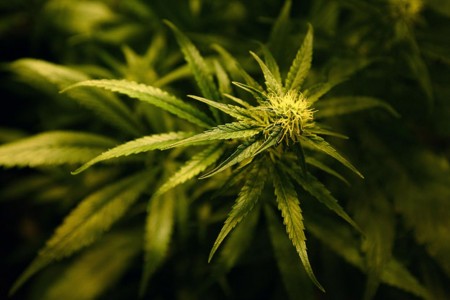
Inhibition of tumor angiogenesis by cannabinoids

“Cannabinoids, the active components of marijuana and their derivatives, inhibit tumor growth in animal models… Because the generation of a new vascular supply (angiogenesis) is causally involved in the progression of the majority of solid tumors, the aim of this study was to test whether cannabinoids inhibit tumor angiogenesis.”

Figure 1.

“PRINCIPAL FINDINGS

1. Cannabinoid administration inhibits tumor angiogenesis

2. Cannabinoid administration inhibits vascular endothelial cell migration and survival

3. Cannabinoid administration inhibits tumor expression of proangiogenic factors and improves other markers of tumor malignancy


 …In the context of the renaissance in the study of the therapeutic effects of cannabinoids, our findings show that these compounds may be considered promising anti-tumoral agents as they inhibit tumor angiogenesis and growth in vivo with no significant side effects.

 This report provides a mechanistic basis for the anti-tumoral action of cannabinoids and a novel pharmacological target for cannabinoid-based anti-tumoral therapies…”

Full text:  http://www.fasebj.org/content/17/3/529.full

Amphiregulin is a factor for resistance of glioma cells to cannabinoid-induced apoptosis.

“Gliomas, one of the most malignant forms of cancer, exhibit high resistance to conventional therapies. Identification of the molecular mechanisms responsible for this resistance is therefore of great interest to improve the efficacy of the treatments against these tumors. Delta9-Tetrahydrocannabinol (THC), the major active ingredient of marijuana, and other cannabinoids inhibit tumor growth in animal models of cancer, including glioma, an effect that relies, at least in part, on the ability of these compounds to induce apoptosis of tumor cells.

…we identified the epidermal growth factor receptor ligand amphiregulin as a candidate factor to mediate the resistance of glioma cells to cannabinoid treatment… in vivo silencing of amphiregulin rendered the resistant tumors xenografts sensitive to cannabinoid antitumoral action.

Amphiregulin expression was associated with increased extracellular signal-regulated kinase (ERK) activation, which mediated the resistance to THC by blunting the expression of p8 and TRB3-two genes involved in cannabinoid-induced apoptosis of glioma cells.

 Our findings therefore identify Amphirregulin as a factor for resistance of glioma cells to THC-induced apoptosis and contribute to unraveling the molecular bases underlying the emerging notion that targeted inhibition of the EGFR pathway can improve the efficacy of antitumoral therapies.”

http://www.ncbi.nlm.nih.gov/pubmed/19229996

Stimulation of the midkine/ALK axis renders glioma cells resistant to cannabinoid antitumoral action

“Δ9-Tetrahydrocannabinol (THC), the major active ingredient of marijuana, and other cannabinoids inhibit tumor growth in animal models of cancer, including glioma, an effect that relies, at least in part, on the stimulation of autophagy-mediated apoptosis in tumor cells. 

…Altogether, our findings identify Mdk as a pivotal factor involved in the resistance of glioma cells to THC pro-autophagic and antitumoral action, and suggest that selective targeting of the Mdk/ALK axis could help to improve the efficacy of antitumoral therapies for gliomas.”

Full text: http://www.ncbi.nlm.nih.gov/pmc/articles/PMC3131933/

Stimulation of ALK by the growth factor midkine renders glioma cells resistant to autophagy-mediated cell death

“Δ9-tetrahydrocannabinol (THC), the main active component of marijuana, promotes cancer cell death via autophagy stimulation.

We find that activation of the tyrosine kinase receptor ALK by its ligand midkine interferes with the signaling mechanism by which THC promotes autophagy-mediated glioma cell death.”

 http://www.ncbi.nlm.nih.gov/pubmed/21593591

Marijuana Chemical May Fight Brain Cancer – CBSNews

“The active chemical in marijuana promotes the death of brain cancer cells by essentially helping them feed upon themselves, researchers in Spain report.

Guillermo Velasco and colleagues at Complutense University in Spain have found that the active ingredient in marijuana, THC, causes brain cancer cells to undergo a process called autophagy. Autophagy is the breakdown of a cell that occurs when the cell essentially self-digests.

The team discovered that cannabinoids such as THC had anticancer effects in mice with human brain cancer cells and people with brain tumors . When mice with the human brain cancer cells received the THC, the tumor growth shrank.

Two patients enrolled in a clinical trial received THC directly to the brain as an experimental treatment for recurrent glioblastoma multiforme , a highly aggressive brain tumor. Biopsies taken before and after treatment helped track their progress. After receiving the THC, there was evidence of increased autophagy activity.

The findings appear in the April 1 issue of the Journal of Clinical Investigation.

The patients did not have any toxic effects from the treatment. Previous studies of THC for the treatment of cancer have also found the therapy to be well tolerated, according to background information in journal article.

Study authors say their findings could lead to new strategies for preventing tumor growth.”

http://www.cbsnews.com/2100-500368_162-4913095.html

“Cannabinoid action induces autophagy-mediated cell death through stimulation of ER stress in human glioma cells…These findings describe a mechanism by which THC can promote the autophagic death of human and mouse cancer cells and provide evidence that cannabinoid administration may be an effective therapeutic strategy for targeting human cancers.” http://www.ncbi.nlm.nih.gov/pmc/articles/PMC2673842/


Marijuana Study Shows Brain Cancer Cells Eat Themselves

“… a study released by researchers at the Complutense University in Madrid describes how marijuana’s active chemical, tetrahydrocannabinol, can aid anti-cancer therapies due to its ability to coax cancerous brain cells to self-digest.

The research involved stimulating cancer growth in mice and then injecting sites near the tumors with THC every day. An experimental trial involving two brain cancer patients were also analyzed by the researchers.

It studied how an aggressive brain tumor type was affected by THC, noting that the findings fell in line with the tests done on mice. They say the work shows how “a new family of potential antitumoral agent” exists among THC and related cannabinoids.”

http://www.shortnews.com/start.cfm?id=78020

“Cannabinoid action induces autophagy-mediated cell death through stimulation of ER stress in human glioma cells”

Full Text: http://www.ncbi.nlm.nih.gov/pmc/articles/PMC2673842/

Fighting Cancer: Another Study Reveals the Cannabis and Cancer Prevention Link

“Does marijuana cause cancer? Revealing the link between cannabis and cancer yet again, researchers with the California Pacific Medical Center in San Francisco have released findings that further bolster cannabis as an anti-cancer solution.
The researchers have found a compound in the much-talked-about plant could “halt the spread” of many types of aggressive cancers, including breast cancer.

The Cannabis and Cancer Link

Cannabidiol is the compound, and while it fights cancer cells, it does not produce the high feelings commonly associated with cannabis. Instead, it seems to “switch off” the gene responsible for metastasizing breast cancer.

They reportedly found the compound doesn’t only stop the breast cancer cells from growing, but even causes them to return back to normal cells, cancer-free.”

More: http://naturalsociety.com/study-positive-cannabis-and-cancer-link/

Smoking Marijuana Does Not Cause Lung Cancer

“New research shows here seems to be something in pot that actually undermines cancer, instead of causing it. — and the media are doing their best to ignore it.
 
There is a groundswell of attention in the news to marijuana’s role in causing and preventing various types of cancers. Last week, AlterNet published an article from the Marijuana Policy Project about a new study finding that pot smokers have a lower risk of head and neck cancers than people who don’t smoke pot…
 
Smoking pot doesn’t cause lung cancer. In fact, the study found that cigarette smokers who also smoked marijuana were at a lower risk of contracting lung cancer than tobacco-only smokers…
 

You’d think it would have been very big news in June 2005 when UCLA medical school professor Donald Tashkin reported that components of marijuana smoke somehow prevent them from becoming malignant.

 In other words, something in marijuana exerts an anti-cancer effect!”

More:http://www.alternet.org/story/142271/smoking_marijuana_does_not_cause_lung_cancer

Marijuana Unlikely to Cause Head, Neck, or Lung Cancer – WebMD

“Marijuana, unlike tobacco and alcohol, does not appear to cause head, neck, or lung cancer, says a researcher from Johns Hopkins Medical School in Baltimore who presented findings from a study here recently at a meeting of internal medicine physicians.

There has been an ongoing debate about whether marijuana is as dangerous as tobacco in terms of cancer development. Daniel E. Ford, MD, tried to sort out the evidence by the lifestyles — including marijuana, tobacco, and alcohol use — of 164 persons who were newly diagnosed with head, neck, or lung cancer compared to a group of 526 healthy persons living in the same area. The average age of patients was 49, while the average age of the healthy volunteers was 44. The cancer patients were all treated at four Baltimore-area hospitals, and the “controls” (healthy comparison group) were selected from a large group of people living in the Baltimore area who had been participating in an ongoing study. Ford tells WebMD that he wanted to find out whether the cancer patients were more likely to smoke marijuana or tobacco or to drink than were the healthy volunteers.

According to Ford, he thought he would find an association between marijuana use and cancer, but “that the association would fall away when we corrected for tobacco use. That was not the case. The association was never there.” And that surprised him because of the way marijuana is smoked: deep inhalations, with the smoke held in for effect. “It seemed natural that there would be some connection,” he tells WebMD.

Based on these findings, Ford says that cancer prevention efforts should “remain focused on tobacco and alcohol, two known carcinogens.””

More: http://www.webmd.com/smoking-cessation/news/20000508/marijuana-unlikely-to-cause-cancer

Update from WebMD:

“Pot Smoking Not Linked to Lung Cancer

Study Shows No Increased Risk for Even the Heaviest Marijuana Smokers.
 
People who smoke marijuana do not appear to be at increased risk for developing lung cancer, new research suggests.While a clear increase in cancercancer risk was seen among cigarette smokers in the study, no such association was seen for regular cannabis users.Even very heavy, long-term marijuana users who had smoked more than 22,000 joints over a lifetime seemed to have no greater risk than infrequent marijuana users or nonusers.”

More: http://www.webmd.com/lung-cancer/news/20060523/pot-smoking-not-linked-to-lung-cancer

Medical Marijuana Inc Announces Positive Developments in Recent Studies Using Cannabidiol (CBD) Compound; NBC News, ABC News and Huffington Post Report California Pacific Medical Center’s Findings That CBD Stops Metastasis in Aggressive Cancers – The Wall Street Journal

“Medical Marijuana Inc Announces Positive Developments in Recent Studies Using Cannabidiol (CBD) Compound; NBC News, ABC News and Huffington Post Report California Pacific Medical Center’s Findings That CBD Stops Metastasis in Aggressive Cancers

SAN DIEGO, May 28, 2013 (GLOBE NEWSWIRE) — Medical Marijuana Inc (OTC Pink:MJNA) is pleased to inform shareholders and the general public of recent developments in the research involving Cannabidiol (CBD) and other Phyto-cannabinoids.

The Following is taken from a Huffington Post interview with Dr. McAllister and Dr. Desprez:

A pair of scientists at California Pacific Medical Center in San Francisco has found that a compound derived from marijuana could stop metastasis in many kinds of aggressive cancer, potentially altering the fatality of the disease forever.

“It took us about 20 years of research to figure this out, but we are very excited,” said Pierre Desprez, one of the scientists behind the discovery, to The Huffington Post. “We want to get started with trials as soon as possible.”

The Daily Beast first reported on the finding, which has already undergone both laboratory and animal testing, and is awaiting permission for clinical trials in humans.

Desprez, a molecular biologist, spent decades studying ID-1, the gene that causes cancer to spread. Meanwhile, fellow researcher Sean McAllister was studying the effects of Cannabidiol, or CBD, a non-toxic, non-psychoactive chemical compound found in the cannabis plant. Finally, the pair collaborated, combining CBD and cells containing high levels of ID-1 in a petri dish.

“What we found was that his Cannabidiol could essentially ‘turn off’ the ID-1,” Desprez told HuffPost. The cells stopped spreading and returned to normal.

“We likely would not have found this on our own,” he added. “That’s why collaboration is so essential to scientific discovery.”

Desprez and McAllister first published a paper about the finding in 2007. Since then, their team has found that CBD works both in the lab and in animals. And now, they’ve found even more good news.

“We started by researching breast cancer,” said Desprez. “But now we’ve found that Cannabidiol works with many kinds of aggressive cancers–brain, prostate–any kind in which these high levels of ID-1 are present.”

Desprez hopes that clinical trials will begin immediately.

“We’ve found no toxicity in the animals we’ve tested, and Cannabidiol is already used in humans for a variety of other ailments,” he said. Indeed, the compound is used to relieve anxiety and nausea, and, since it is non-psychoactive, does not cause the “high” associated with THC.

While marijuana advocates will surely praise the discovery, Desprez explained that it’s not so easy as just lighting up.

“We used injections in the animal testing and are also testing pills,” he said. “But you could never get enough Cannabidiol for it to be effective just from smoking.”

Additional Information:

Dr. McAllister & CBD Research

Dr. Sean McAllister says that he is ready to begin testing CBD on humans to evaluate anti-cancer properties. Dr. McAllister and colleague Pierre Desprez, PhD from California Pacific Medical Center have previously mentioned, “Cannabidiol offers hope of a non-toxic therapy that could treat aggressive forms of cancer without any of the painful side effects of chemotherapy.” “We found that this one compound, CBD, had a specific effect on metastatic cancer cells, very aggressive tumor cells. CBD in animal studies has been used to ‘switch off’ a specific gene regulator.” Dr. McAllister explains: “We find when you treat with CBD, you down regulate the expression of this protein and that inhibits the disease process.” Dr. McAllister and Dr. Desprez have developed a synthetic version of CBD, which they say targets a specific gene in the body related to the spread of cancer (metastasis). Article: http://abclocal.go.com/kgo/story?section=news/health&id=9057615

Additional Cannabidiol Information

ABC News-

http://abclocal.go.com/kgo/story?section=news/health&id=9057615

Huffington Post-

http://www.huffingtonpost.com/2012/09/19/marijuana-and-cancer_n_1898208. html?ncid=edlinkusaolp00000003&ir=Weird%20News

US. National Cancer Institute

http://www.cancer.gov/cancertopics/pdq/cam/cannabis/healthprofessional/p age4

Additional Dr. McAllister Publications

http://www.ncbi.nlm.nih.gov/pubmed/?term=Sean%20McAllister

Additional Published Material on Cannabidiol (CBD)

http://www.ncbi.nlm.nih.gov/gquery/?term=CANNABIDIOL”

More: http://online.wsj.com/article/PR-CO-20130528-906109.html