“Cannabinoids, such as tetrahydrocannabinolic acid (THCA), cannabidiolic acid (CBDA) and cannabichromenic acid (CBCA), are bioactive and medicinally relevant compounds found in the cannabis plant (Cannabis sativa L.). These three compounds are synthesised from a single precursor, cannabigerolic acid (CBGA), through regioselective reactions catalysed by different cannabinoid oxidocyclase enzymes.
Despite the importance of cannabinoid oxidocyclases for determining cannabis chemotype and properties, the functional evolution and molecular mechanism of this enzyme family remain poorly understood. To address this gap, we combined ancestral sequence reconstruction and heterologous expression to resurrect and functionally characterise three ancestral cannabinoid oxidocyclases.
Results showed that the ability to metabolise CBGA originated in a recent ancestor of cannabis and that early cannabinoid oxidocyclases were promiscuous enzymes producing all three THCA, CBDA and CBCA. Gene duplication and diversification later facilitated enzyme subfunctionalisation, leading to extant, highly-specialised THCA and CBDA synthases. Through rational engineering of these ancestors, we designed hybrid enzymes which allowed identifying key amino acid mutations underlying the functional evolution of cannabinoid oxidocyclases. Ancestral and hybrid enzymes also displayed unique activities and proved to be easier to produce heterologously than their extant counterparts.
Overall, this study contributes to understanding the origin, evolution and molecular mechanism of cannabinoid oxidocyclases, which opens new perspectives for breeding, biotechnological and medicinal applications.”
“Cannabis and cannabis-derived products (CCDPs) have gained recognition for their therapeutic potential, driving legal and social shifts worldwide. In the United States, state-level medical cannabis programs exist alongside the federal drug development framework, which remains the gold standard for ensuring safety and efficacy.
The Food and Drug Administration (FDA) botanical drug development guidance provides a structured approval pathway for plant-derived products, including CCDPs, accounting for their unique chemical complexity. Despite this guidance, significant gaps persist in preclinical and clinical data, particularly for minor cannabinoids.
Development of botanical drugs from cannabis is further complicated by regulatory oversight from the Drug Enforcement Administration, which constrains the cultivation, handling, and distribution of cannabis and imposes logistical and security requirements during drug development.
This article discusses the unique experience of drug developers navigating the scientific and regulatory challenges inherent in advancing CCDPs toward FDA drug approval. Collaborative efforts among federally compliant drug developers, regulatory bodies, healthcare providers, academic institutions, investors, and patients/patient advocacy groups are critical to generate rigorous, reproducible evidence to support the safe and effective use of CCDPs in medical conditions where they hold the greatest therapeutic potential. Such partnerships can advance studies that elucidate cannabinoid pharmacology, optimize dosing with rigorously characterized materials via clinically relevant routes, and identify clinical outcomes that are meaningful to patients.
Advancing CCDPs through federally compliant drug development pathways will enable the translation of promising botanical therapies into safe, effective, and evidence-based treatments, ultimately informing clinical practice and benefiting patients.”
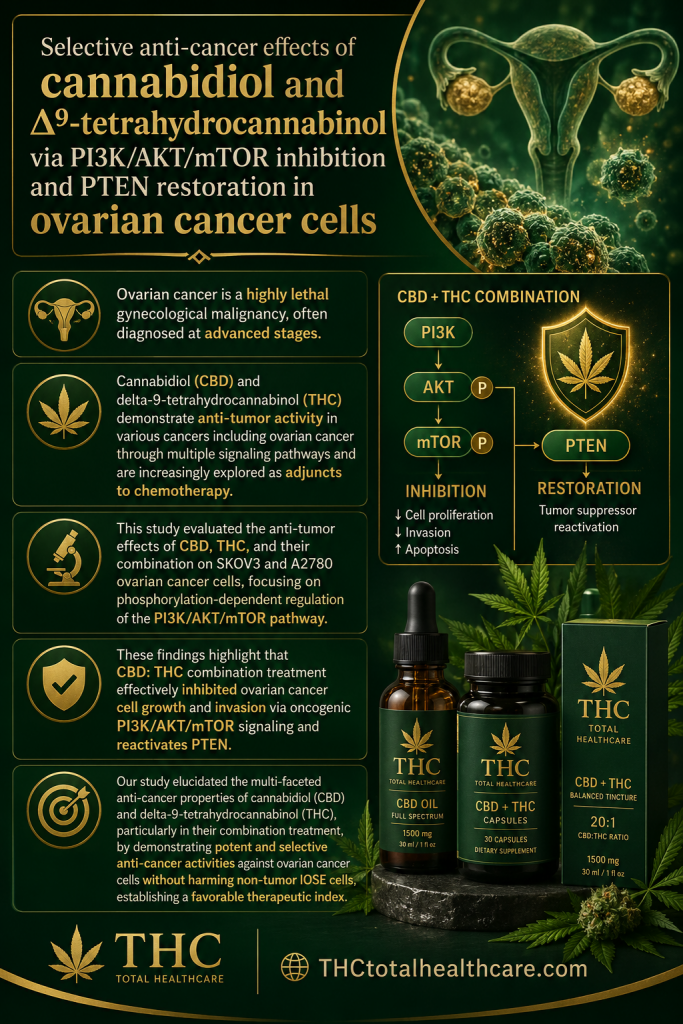
“Introduction: Ovarian cancer is a highly lethal gynecological malignancy, often diagnosed at advanced stages. Cannabidiol (CBD) and delta-9-tetrahydrocannabinol (THC) demonstrate anti-tumor activity in various cancers including ovarian cancer through multiple signaling pathways and are increasingly explored as adjuncts to chemotherapy. However, the effects of CBD and THC combination treatment and its specific mechanisms remain unclear. This study evaluated the anti-tumor effects of CBD, THC, and their combination on SKOV3 and A2780 ovarian cancer cells, focusing on phosphorylation-dependent regulation of the PI3K/AKT/mTOR pathway.
Methods: SKOV3, A2780, and IOSE cells were treated with CBD, THC, and equimolar CBD: THC combinations. Cytotoxicity was assessed using Sulforhodamine B assay, while synergistic interactions were analyzed by the Chou-Talay method using CompuSyn. Cell cycle distribution and apoptosis were evaluated, and phosphorylation of PI3K, AKT, mTOR, and PTEN was examined by Western blotting.
Results: The CBD: THC combination treatment showed potent, selective cytotoxicity at 48 h, with lower IC50 values than in non-tumor IOSE80 cells. The Chou–Talalay method validated a synergistic effect between CBD and THC. The combination treatment induced cell cycle arrest and enhanced apoptosis. Western blot analysis exhibited that equimolar CBD: THC (2.5:2.5 μM) markedly reduced phosphorylation of PI3K, AKT, and mTOR, while increasing phosphorylation of PTEN, thereby reactivating tumor-suppressive signaling.
Conclusion: These findings highlight that CBD: THC combination treatment effectively inhibited ovarian cancer cell growth and invasion via oncogenic PI3K/AKT/mTOR signaling and reactivates PTEN. The combination may represent a promising targeted therapeutic approach, warranting further in vivo validation to elucidate its clinical potential.”
“Our study elucidated the multi-faceted anti-cancer properties of cannabidiol (CBD) and delta-9-tetrahydrocannabinol (THC), particularly in their combination treatment, by demonstrating potent and selective anti-cancer activities against ovarian cancer cells without harming non-tumor IOSE cells, establishing a favorable therapeutic index.
The combination treatment of CBD and THC exhibited concentration- and ratio-dependent synergy, inhibiting proliferation, and hindering metastatic potential through impaired migration and invasion while inducing apoptosis and attributing to mitochondrial membrane depolarization.
Mechanistically, we revealed that CBD and THC, particularly the CBD: THC combination effectively suppresses the PI3K/AKT/mTOR signaling axis by downregulating the phosphorylation of p-PI3K, p-Akt, and p-mTOR, whereas restoring the function of the tumor suppressor PTEN. This dual modulation of oncogenic and tumor-suppressive pathways endorses the therapeutic potential of CBD: THC treatment as a targeted anti-cancer strategy.
Our findings warrant further in functional phosphatase activity to confirm the reactivation of PTEN lipid phosphatase enzyme, and vivo validation and clinical exploration to optimize cannabinoid-based regimens for ovarian cancer treatment, especially considering the precise concentration- and ration-dependent nature of their interactions.”
“Cannabis compounds show unexpected power against ovarian cancer”
“Scientists have discovered that key compounds from cannabis—CBD and THC—show surprisingly strong effects against ovarian cancer cells. Used together, they slow cell growth, reduce colony formation, and may even block the cancer’s ability to spread. Even more promising, the treatment caused minimal harm to healthy cells and appears to work by restoring a disrupted signaling pathway that fuels tumor growth”
“The potential use of phytocannabinoids in neurodegenerative disorders is currently under intense investigation based on their potential anti-inflammatory, antioxidant, and neuroprotective effects.
Here, we tested the effects of chronic (28 days) treatment with a complex botanical mixture of purified cannabidiol:Δ9-tetrahydrocannabinol (CBD:THC, 99:1) in male 5xFAD mice, a murine model of Alzheimer’s disease that recapitulates amyloid pathology. Effects of exposure to this cannabinoid mixture were evaluated using behavioral tests (elevated plus maze for anxiety, tail suspension for depression-like behavior, rotarod for motor coordination, open field for locomotor activity, and novel object recognition for memory), quantification of protein expression (IL-1β, CD40, TREM2, COX2), assessment of functional parameters (microglial phagocytic activity by flow cytometry), and in vivo multiphoton microscopy (time-course of changes of neuritic plaque structural features). Twice daily dosing with 50 mg/kg subcutaneously (s.c.) significantly reduced locomotion, increased anxiety- and depression-like behaviors and had no effect on memory and motor coordination.
In vivo imaging experiments suggest that the CBD:THC treatment enhanced microglial phagocytic activity on amyloid plaques; this effect was observed both in plaque features (multiphoton microscopy measurements) as well as in microglia (flow cytometry data). Exposure to CBD:THC induced significant changes in in vivo microglia-amyloid interactions, increasing phagocytic activity and reducing the amyloid peptide accumulation in the neuritic plaques.
Thus, CBD:THC (99:1) may be a promising treatment to reduce amyloid pathology, though caution should be noted due to the behavioral alterations observed, i.e., increased anxiety- and depression-like behaviors as well as decreased locomotion.”
“Appropriate treatment of muscle spasticity and spasms is important as these conditions may significantly impair patients’ quality of life. Conventional pharmacological treatments for these conditions have poor effectiveness and/or tolerability.
Cannabis is being explored as a treatment.
This was a longitudinal study of patient use of different cannabis products. Data was collected from patient surveys, clinic records, and changes in Patient Reported Outcome Measures Information System 29-Item scores over time. Patient-reported responses on health-related quality of life adverse events (n = 150) and outcomes (n = 78) from treatment for spasticity or spasms were analyzed. No improvements in physical functioning were observed for either group of patients across all product types. However, patients with spasticity who were using cannabidiol-only products experienced an improvement in sleep disturbance, fatigue, pain interference, and pain intensity.
Patients with spasms who were using balanced, cannabidiol-dominant, or tetrahydrocannabinol-dominant products also experienced improvements in these 4 outcomes. Commonly reported adverse events were dry mouth, drowsiness, fatigue, dizziness, and nausea. Despite no observation of improvement in physical functioning, the results suggest that cannabis may help relieve some of the secondary complications associated with these conditions, such as poor sleep and pain.
SIGNIFICANCE STATEMENT: This longitudinal study highlights differential benefits across cannabis product types, with cannabidiol-only formulations aiding spasticity-related symptoms and tetrahydrocannabinol- or cannabidiol-dominant products benefiting those with spasms.
These findings support the potential of cannabis as a potential therapy to improve health-related quality of life in patients with limited options from conventional pharmacological treatments.”
“Importance: Cannabis use is prevalent among adolescents and young adults who vape nicotine. It is not known if cannabis use affects nicotine vaping cessation success.
Objective: To assess whether baseline frequency of cannabis use or cannabis use disorder (CUD) symptom severity was associated with nicotine vaping cessation in a randomized clinical trial.
Design, setting, and participants: This secondary analysis of a randomized clinical trial with youth who vaped nicotine recruited at a single site in Massachusetts from June 2022 to May 2024. The trial included 3 groups receiving 12 weeks of varenicline treatment and placebo (both double-masked, paired with counseling), as well as single-masked referral to texting-app-based nicotine vaping cessation support (enhanced usual care [EUC]). Eligible participants were aged 16 to 25 years who reported vaping nicotine regularly and did not smoke tobacco.
Exposure: Baseline cannabis use was assessed via self-reported number of days of cannabis use per week and with Cannabis Use Disorder Identification Test (CUDIT) scores.
Main outcomes and measures: Biochemically verified 7-day point prevalence nicotine vaping abstinence at week 12. Logistic regression models estimated associations between baseline cannabis use and vaping abstinence. Interaction terms were evaluated to examine whether cannabis use moderated the effect of varenicline on nicotine abstinence.
Results: Among the 261 participants randomized to nicotine vaping cessation treatment (mean [SD] age, 21.5 [2.0] years; 139 female [53%]), 28% (73 participants) reported no past-month cannabis use, 38% (100 participants) reported using cannabis more than 0 and less than 4 d/wk, and 30% (78 participants) reported using cannabis 4 to 7 d/wk. Cannabis use frequency was not significantly associated with nicotine vaping cessation (eg, 4 to 7 d/wk use vs no use: adjusted odds ratio [aOR], 1.14; 95% CI, 0.51-2.57; overall P = .20). Nor did cannabis frequency modify the effect of varenicline (eg, abstinence varenicline vs placebo or EUC among those with 4 to 7 d/wk use: aOR, 8.47; 95% CI, 2.78-28.25; vs among those with no use: aOR, 5.60; 95% CI, 1.97-17.06; overall interaction P = .32). Findings were similar for CUD symptom severity.
Conclusions and relevance: Among adolescents and young adults attempting to reduce or stop nicotine vaping, baseline cannabis use was not associated with nicotine vaping abstinence. Varenicline proved helpful for nicotine vaping cessation regardless of cannabis use, indicating that co-use of cannabis may not represent a barrier to successful nicotine vaping cessation treatment.”
“Findings indicate that regular cannabis or alcohol use is not expected to diminish the effectiveness of offering varenicline for nicotine vaping cessation in youth.”
“Purpose: Metabolic syndrome (MetS) is common in schizophrenia and drives cardiovascular risk. While cannabis use and potency are increasing, the impact of cannabis on cardiometabolic health in schizophrenia remains unclear. This study assessed the association between objectively measured cannabis use and MetS prevalence in a large schizophrenia cohort.
Methods: We conducted a cross-sectional analysis of 988 participants with DSM-IV schizophrenia from the CATIE study. Cannabis use was measured via hair testing for tetrahydrocannabinol (THC), the gold standard for long-term use detection. MetS was defined per International Diabetes Federation criteria using physical and biochemical data. Multivariable logistic regression, adjusting for demographic, clinical, and lifestyle confounders, assessed the association between THC use and MetS.
Results: THC-positive participants (14.8 %) exhibited a significantly lower prevalence of MetS compared to non-users (42.5 % vs. 60.5 %, p < 0.001). After adjusting for confounders including age, sex, ethnicity, smoking, and other substance use, cannabis use remained independently associated with reduced odds of MetS (adjusted OR 0.64, 95 %CI 0.44-0.93, p = 0.02). Among MetS components, cannabis users had significantly lower odds of elevated waist circumference after adjustment (adjusted OR 0.61, 95 %CI 0.41-0.91, p = 0.02). Cannabis use was also associated with lower weight, BMI and triglycerides and higher HDL in unadjusted analyses. No significant differences were found in blood pressure or fasting glucose.
Conclusions: In schizophrenia, cannabis use was associated with lower rates of both metabolic syndrome and central obesity. While these findings support emerging evidence of metabolic differences in cannabis users, the cross-sectional design precludes conclusions regarding causality. Longitudinal studies are needed to clarify long-term metabolic effects and guide targeted interventions.”
“Cannabis use is associated with better cardiometabolic health in the general population, with users showing lower fasting insulin and glucose levels, reduced waist circumference, lower BMI, reduced systolic blood pressure (SBP) and higher high-density lipoprotein (HDL) cholesterol compared to non-users.”
“Growing evidence suggests cannabis users with psychotic disorders may have better metabolic health compared to non-users.”
“In summary, our findings demonstrate a significant association between cannabis use and a lower prevalence of metabolic syndrome in individuals with schizophrenia.”
“Cannabis sativa synthesizes diverse cannabinoids with significant pharmacological value, but existing suspension cultures show low metabolite yields and limited scalability.
This study establishes bioreactor-based cell suspension system to enhance cannabinoid biosynthesis in C. sativa. Petiole explants cultured on MS medium with 4 mg/L BAP and 0.01 mg/L NAA produced 95.83 ± 0.74% friable callus. Suspension cultures accumulated 352.29 ± 3.90 g/L fresh biomass in 28 days, showing 22.4-fold increase upon scale-up in stirred-tank bioreactor.
Methanolic extracts (60 °C) showed strong anti-inflammatory activity, reducing TNF-α and IL-6 by 88.40 ± 0.87 and 92.03 ± 1.55% at 30 μg mL-1 without cytotoxicity. Metabolomic profiling identified putative cannabinoid derivatives, with THCA-C1 (0.05%) exhibiting highest binding affinity (-8.4 kcal/mol) to inflammatory targets based on docking and dynamics analyses.
Overall, these results provide the first evidence for scalable cannabinoid biosynthesis in bioreactor-grown C. sativa cell suspensions, underscoring their potential for sustainable production of anti-inflammatory therapeutics.”
“Importance: Medical cannabis is increasingly considered a substitute for prescription opioid medications for chronic pain, driven by the urgent need for opioid alternatives to combat the ongoing epidemic.
Objective: To determine the association between participation in the New York State (NYS) medical cannabis program and prescription opioid receipt among adults with chronic pain.
Design, setting, and participants: This cohort study used data from the NYS Prescription Monitoring Program (PMP) from September 2018 through July 2023. Adults prescribed opioids for chronic pain who were newly certified for medical cannabis use in NYS were recruited from a large academic medical center and nearby medical cannabis dispensaries in the Bronx, New York. Monthly dispensation of medical cannabis to study participants was monitored for 18 months. Data analyses were performed from February 3, 2025, to July 15, 2025.
Exposure: Portion of days covered each month by pharmacist report of dispensed medical cannabis.
Main outcomes and measures: Prescription opioid receipt, defined as NYS PMP-reported prescription monthly opioid dispensation (mean daily dose in morphine milliequivalents [MME]), was assessed with marginal structural models adjusted for time-invariant and time-varying confounders, including self-reported unregulated cannabis use. Nonprescribed opioid use was also assessed during the study period.
Results: Among 204 participants, the mean (SD) age at baseline was 56.8 (12.8) years, and 113 (55.4%) were female. At baseline, participants’ mean (SD) pain severity score was 6.6 (1.8) out of 10, and mean (SD) pain interference score was 6.8 (1.9) out of 10. Baseline mean (SD) daily MME was 73.3 (133.0). During the 18-month follow-up period, participants’ mean (SD) daily MME decreased to 57.4 (127.8). This reduction in mean daily MME was associated with the monthly portion of days covered with medical cannabis; compared with no medical cannabis dispensed, participants dispensed a 30-day supply of medical cannabis were exposed to 3.53 fewer MME per day (β = -3.53; 95% CI, -6.68 to -0.04; P = .03).
Conclusions and relevance: In this cohort study, participation in NYS’s medical cannabis program was associated with reduced prescription opioid receipt during 18 months of prospective follow-up, accounting for unregulated cannabis use.”
“These findings suggest that participation in a pharmacist-directed medical cannabis program may help reduce prescription opioid receipt among adults with chronic pain.”
“Introduction: Cannabinoids hold promise in oncology for symptom relief and antitumor effects, though concerns about safety and efficacy persist. This study assessed the impact of JWH-182 and phytocannabinoids NC1 – Cannabixir® Medium dried flowers and NC2 – Cannabixir® THC full extract, in a murine breast cancer model with paclitaxel-induced peripheral neuropathy (CIPN).
Methods: Female BALB/c mice with breast tumors received paclitaxel alone or combined with cannabinoids, and outcomes included pain sensitivity, tumor progression (imaging and histopathology), cachexia (body weight, food intake, imaging), as well as hematological and organ toxicity profiles.
Results: All cannabinoids alleviated neuropathic pain, with NC1 most effective for central and thermal protection (72% and 100%, p < 0.0001), NC2 showing strong central and mechanical benefit (>60% and >33%), and JWH-182 intermediate (∼50%). Tumor growth was not significantly altered, but metastasis incidence was 41.7% for NC1, 58.3% for NC2, compared with 70% for PTX, suggesting antitumoral activity. Effects on cachexia were modest, JWH-182 tended to improve food intake, whereas NC1 and NC2 reduced it, yet body weight remained stable and significant muscle loss was observed only with NC2 (p < 0.05). Hematology showed immunomodulatory effects, with cannabinoids reversing lymphopenia (p = 0.0005), raising monocytes and neutrophils, and partly restoring platelets. Toxicity was highest with NC2 (renal and hepatic injury), moderate with NC1, and lowest for kidney with JWH-182 but with greater hepatic inflammation.
Conclusion: Cannabinoids show potential in oncology by relieving CIPN and influencing tumor dynamics, with mostly neutral effects on cachexia. GMP-certified formulations enhance translational value, though safety concerns warrant further study.”
“Cannabinoids have emerged as promising agents in oncology for both symptom relief and potential antitumor effects. By acting on cannabinoid receptors 1 and 2 (CB1R, CB2R), Tetrahydrocannabinol (THC) and Cannabidiol (CBD) help regulate pain, appetite, and inflammation, making them effective in managing CIPN, cancer pain, and cachexia.
Preclinical studies also suggest that cannabinoids can inhibit tumor growth, metastasis, angiogenesis, and reverse chemoresistance, with potential to enhance chemotherapy efficacy and reduce its toxicity.”