
 “Multiple sclerosis (MS) is an autoimmune demyelinating disease of the central nervous system, affecting ambulation even in people with only mild neurological signs. Patients with MS frequently experience spasticity, which contributes significantly to impair their motor functions, including ambulation, owing to muscle stiffness, spasms, and pain.
Objectives: To clarify the role of delta-9-tetrahydrocannabinol(THC):cannabidiol(CBD) oromucosal spray, coupled to robot-aided gait training (RAGT) using the Lokomat©Pro to improve functional ambulation in patients with MS.
Methods: We compared 20 patients with MS, who were treated with THC:CBD oromucosal spray in add-on to the ongoing oral antispastic therapy (OAT) (group A), with 20 individuals with MS (matched for clinical-demographic characteristics) who were treated only with OAT (group B). Both the groups underwent RAGT using the Lokomat-Pro (three 45-minute sessions per week). Our primary outcome measures were the Functional Independence Measure (FIM) and the 10 meters walking test (10MWT). As secondary outcome measures we evaluated the brain cortical excitability by using Transcranial Magnetic Stimulation. Both parameters were taken before and after the end of the RAGT.
Results: FIM improved in group A more than in group B (p<0.001). Moreover, 10MWT decreased in group A more than in group B (p<0.001). These clinical findings were paralleled by a more evident reshape of intracortical excitability in both upper and lower limbs, as suggested by motor evoked potential amplitude increase (p<0.001), intracortical inhibition strengthening (p<0.001), and intracortical facilitation decrease (p=0.01) in group A as compared to group B.
Conclusions: Our results suggest that the combined THC:CBD-RAGT approach could be useful in improving gait performance in patients with MS.”
https://pubmed.ncbi.nlm.nih.gov/32447249/
“The coupled therapy is preliminarily demonstrated as safe and efficacious.”
https://www.msard-journal.com/article/S2211-0348(20)30253-4/pdf
 “Medical cannabis (MC) is becoming more and more popular among patients with chronic pain syndromes.
 “Historical relevance: Cannabis sativa L. (C. sativa) is a plant whose use as a therapeutic agent shares its origins with the first Far East’s human societies. Cannabis has been used not only for recreational purposes, but as a food to obtain textile fibers, to produce hemp paper, to treat many physical and mental disorders.
 “The cannabis plant has been widely researched for many therapeutic indications and found to be effective in many chronic conditions such as epilepsy, neuropathic or chronic pain and more. However, biased opinion against compounds of the plant, regulatory as well as compounding challenges have led to very few approved medicinal products. Those formulations which are approved are dosed several times a day, creating an unmet need for controlled release (CR) formulations of
 “While natural Δ9-tetrahidrocannabinol (Δ9THC),
  “HIV infection affects an estimated 38 million people. Approximately 50% of HIV patients exhibit neurocognitive dysfunction termed HIV-Associated Neurocognitive Disorder (HAND). HAND is a consequence of chronic low-level neuroinflammation due to HIV entry into the brain. Initially, monocytes become activated in circulation and traffic to the brain. Monocytes, when activated, become susceptible to infection by HIV and can then carry the virus across the blood brain barrier. Once in the brain, activated monocytes secrete chemokines, which recruit virus-specific CD8+ T cells into the brain to further promote neuroinflammation. HAND is closely linked to systemic inflammation driven, in part, by HIV but is also due to persistent translocation of microorganisms across the GI tract. Persistent anti-viral responses in the GI tract compromise microbial barrier integrity. Indeed, HIV patients can exhibit remarkably high levels of activated (CD16+) monocytes in circulation.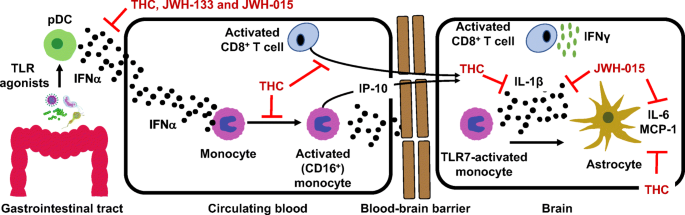
.jpg) “Despite limited data demonstrating pronounced negative effects of prenatal cannabis exposure, popular opinion and public policies still reflect the belief that cannabis is fetotoxic.
“Despite limited data demonstrating pronounced negative effects of prenatal cannabis exposure, popular opinion and public policies still reflect the belief that cannabis is fetotoxic. “An emerging area of preclinical research has investigated whether drug use in parents prior to conception influences drug responsivity in their offspring.
 “Cannabis sativa and its principal components, Δ9-tetrahydrocannabinol (Δ9-THC) and