
 “Toll-like receptors (TLRs) are sensors of pathogen-associated molecules that trigger inflammatory signalling in innate immune cells including macrophages. All TLRs, with the exception of TLR3, promote intracellular signalling via recruitment of the myeloid differentiation factor 88 (MyD88) adaptor, while TLR3 signals via Toll-Interleukin-1 Receptor (TIR)-domain-containing adaptor-inducing interferon (IFN)-β (TRIF) adaptor to induce MyD88-independent signalling. Furthermore, TLR4 can activate both MyD88-dependent and -independent signalling (via TRIF).
The study aim was to decipher the impact of the highly purified plant-derived (phyto) cannabinoids Δ9-tetrahydrocannabinol (THC) and cannabidiol (CBD), when delivered in isolation and in combination (1:1), on MyD88-dependent and -independent signalling in macrophages.
TLRs are attractive therapeutic targets given their role in inflammation and initiation of adaptive immunity, and data herein indicate that both CBD and THC preferentially modulate TLR3 and TLR4 signalling via MyD88-independent mechanisms in macrophages. This offers mechanistic insight into the role of phytocannabinoids in modulating cellular inflammation.”
https://www.ncbi.nlm.nih.gov/pubmed/32244040
https://www.jni-journal.com/article/S0165-5728(20)30057-6/pdf
“Cannabinoids have been shown to exert anti-inflammatory activities in various in vivo and in vitro experimental models as well as ameliorate various inflammatory degenerative diseases. Δ9-Tetrahydrocannabinol (THC) is a major constituent of Cannabis. The second major constituent of Cannabis extract is cannabidiol (CBD). Both THC and CBD have been shown to exert anti-inflammatory properties and to modulate the function of immune cells. In summary, our results show that although both THC and CBD exert anti-inflammatory effects, the two compounds engage different, although to some extent overlapping, intracellular pathways. Both THC and CBD decrease the activation of proinflammatory signaling.” https://www.ncbi.nlm.nih.gov/pmc/articles/PMC2804319/
 “Medicinal use of
  “The aim of this study was to explore the effect of health-care providers’ attitudes towards the medical use of
  “There is concern that recreational marijuana legalization (RML) may lead to increased
 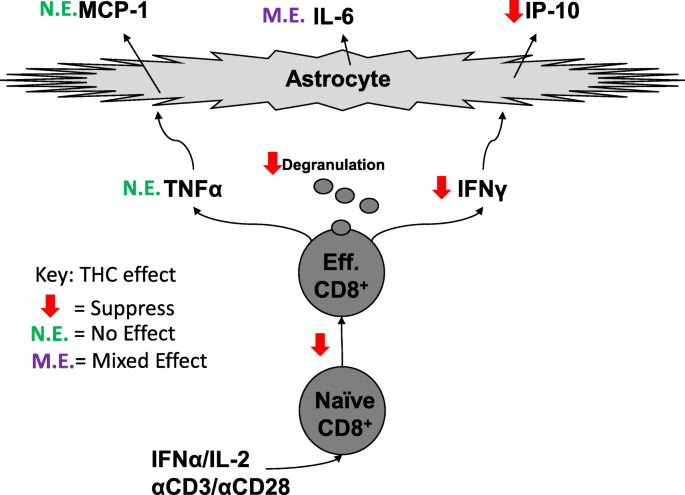 “CD8+ T cells can contribute to neuroinflammation by secretion of inflammatory cytokines like interferon γ (IFNγ) and tumor necrosis factor α (TNFα). Astrocytes, a glial cell in the brain, can be stimulated by IFNγ and TNFα to secrete the inflammatory cytokines, monocyte chemotactic protein 1 (MCP-1), interleukin 6 (IL-6), and interferon-γ inducible protein 10 (IP-10).
 “Recently, several studies have reported that the pharmacological effects exerted by
  “In the sports domain, cannabis is prohibited by the World Anti-Doping Agency (WADA) across all sports in competition since 2004. The few studies on physical exercise and cannabis focused on the main compound i.e. Δ9-tetrahydrocannabinol.
  “The oil from industrial hemp seeds (
 “The
“The  “The present study investigated the effect of the lack of CB1 and CB2 receptors in mice ovarian morphology, folliculogenesis, oocyte retrieval, and oocyte maturation and evaluated the use of Δ9-tetrahydrocannabinol (THC) on oocyte in vitro maturation (IVM) by comparing classical IVM and two-step IVM by analyzing the meiotic competence of the oocytes and their evolution toward embryos.