
 “Cannabis sativa L. is one of the most-studied species for its phytochemistry due to the abundance of secondary metabolites, including cannabinoids, terpenes and phenolic compounds. In the last decade, fiber-type hemp varieties have received interest for the production of many specialized secondary metabolites derived from the phenylpropanoid pathway. The interest in these molecules is due to their antioxidant activity.
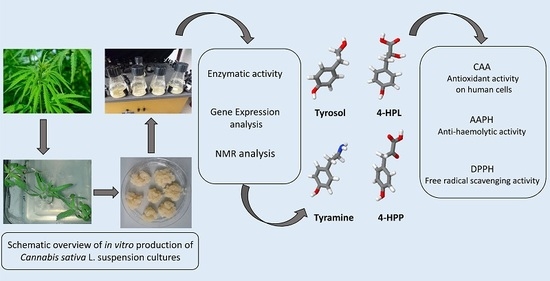
Since secondary metabolite synthesis occurs at a very low level in plants, the aim of this study was to develop a strategy to increase the production of such compounds and to elucidate the biochemical pathways involved. Therefore, cell suspensions of industrial hemp (C. sativa L. var. Futura) were produced, and an advantageous elicitation strategy (methyl jasmonate, MeJA) in combination with precursor feeding (tyrosine, Tyr) was developed.
The activity and expression of phenylalanine ammonia-lyase (PAL) and tyrosine aminotransferase (TAT) increased upon treatment. Through 1H-NMR analyses, some aromatic compounds were identified, including, for the first time, 4-hydroxyphenylpyruvate (4-HPP) in addition to tyrosol. The 4-day MeJA+Tyr elicited samples showed a 51% increase in the in vitro assay (2,2-diphenyl-1-picrylhydrazyl, DPPH) radical scavenging activity relative to the control and a 80% increase in the cellular antioxidant activity estimated on an ex vivo model of human erythrocytes.
Our results outline the active metabolic pathways and the antioxidant properties of hemp cell extracts under the effect of specific elicitors.”
 “The hemp plant (
 “Endocannabinoids are produced within the gastrointestinal (GI) tract and modulate energy homeostasis and food intake, at least in part, via vagally-dependent actions. The recent paper by Christie et al., [Christie, et al. J Physiol, 2019] demonstrate, for the first time, that
  “Cannabis use disorder (CUD) prevalence among people reporting past-year cannabis use declined from 2002–2016.
 “Growing evidence suggests that medical marijuana laws have harm reduction effects across a variety of outcomes related to risky health behaviors. This study investigates the impact of medical marijuana laws on self-reported health using data from the Behavioral Risk Factor Surveillance System from 1993 to 2013. In our analyses we separately identify the effect of a medical marijuana law and the impact of subsequent active and legally protected dispensaries. Our main results show surprisingly limited improvements in self-reported health after the legalization of medical marijuana and legally protected dispensaries. Subsample analyses reveal strong improvements in health among non-white individuals, those reporting chronic pain, and those with a high school degree, driven predominately by whether or not the state had active and legally protected dispensaries. We also complement the analysis by evaluating the impact on risky health behaviors and find that the aforementioned demographic groups experience large reductions in alcohol consumption after the implementation of a medical marijuana law.”
 “For persons living with chronic conditions, health-related quality of life (HRQoL) symptoms, such as pain, anxiety, depression, and insomnia, often interact and mutually reinforce one another.
 “The CB1 receptor mediates the central nervous system response to cannabinoids, and is a drug target for pain, anxiety and seizures.
 “Hemp (Cannabis sativa L.) is an eco‐friendly and multifunctional plant. Hemp hurd is a by‐product of hemp plant during hemp fiber separation. Although hemp hurd is repeatedly announced owing antibacterial activity, it has never been systematically investigated and reported. In this study, the antibacterial activity of hemp hurd powder against Escherichia coli is investigated. This article reveals antibacterial activity of hemp hurd where hemp hurd powder inhibits the growth of E. coli. Meanwhile, the self‐contamination (forming during retting process) inside hemp hurd has dramatic impact on the antibacterial performance. To achieve better antibacterial activity, hemp hurd was heat treated to eliminate self‐contaminations. The impact of the particle sizes and heat treatment on the antibacterial effectiveness was evaluated.”
 “The symptomatic treatment of myotonia and myalgia in patients with dystrophic and non-dystrophic myotonias is often not satisfactory.