
“Despite current therapeutic strategies for immunomodulation and relief of symptoms in multiple sclerosis (MS), remyelination falls short due to dynamic neuropathologic deterioration and relapses, leading to accrual of disability and associated patient dissatisfaction. The potential of cannabinoids includes add-on immunosuppressive, analgesic, neuroprotective, and remyelinative effects. This study evaluates the efficacy of medical marijuana in MS and its experimental animal models. A systematic review was conducted by a literature search through PubMed, ProQuest, and EBSCO electronic databases for studies reported since 2007 on the use of cannabidiol (CBD) and delta-9-tetrahydrocannabinol (THC) in MS and in experimental autoimmune encephalomyelitis (EAE), Theiler’s murine encephalomyelitis virus-induced demyelinating disease (TMEV-IDD), and toxin-induced demyelination models. Study selection and data extraction were performed by 3 reviewers, and 28 studies were selected for inclusion. The certainty of evidence was appraised using the Cochrane GRADE approach. In clinical studies, there was low- and moderate-quality evidence that treatment with ~1:1 CBD/THC mixtures as a nabiximols (Sativex®) oromucosal spray reduced numerical rating scale (NRS) scores for spasticity, pain, and sleep disturbance, diminished bladder overactivity, and decreased proinflammatory cytokine and transcription factor expression levels. Preclinical studies demonstrated decreases in disease severity, hindlimb stiffness, motor function, neuroinflammation, and demyelination. Other experimental systems showed the capacity of cannabinoids to promote remyelination in vitro and by electron microscopy. Modest short-term benefits were realized in MS responders to adjunctive therapy with CBD/THC mixtures. Future studies are recommended to investigate the cellular and molecular mechanisms of cannabinoid effects on MS lesions and to evaluate whether medical marijuana can accelerate remyelination and retard the accrual of disability over the long term.”
Δ 9 -Tetrahydrocannabinol promotes functional remyelination in the mouse brain
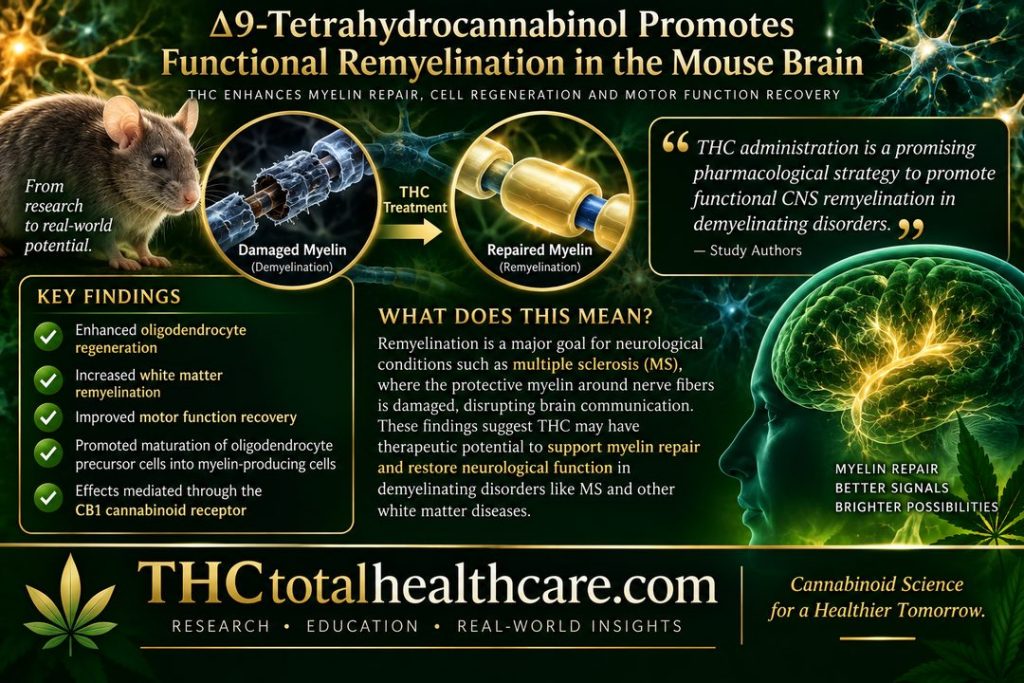
Myelin is the protective coating that surrounds nerve fibers and helps electrical signals move efficiently through the brain and spinal cord. Damage to myelin is a major feature of neurological disorders involving demyelination, making the repair of this protective layer an important therapeutic target.
In this mouse study, Δ9-THC promoted the regeneration of oligodendrocytes, the cells responsible for producing myelin, and enhanced remyelination in damaged white matter. THC treatment was also associated with improved recovery of motor function.
The researchers found that these effects involved activation of the CB1 cannabinoid receptor and the maturation of oligodendrocyte precursor cells into myelin-producing cells. The findings suggest that THC may have potential as a compound capable of supporting functional repair after myelin damage.
“Background and purpose: Research on demyelinating disorders aims to find novel molecules that are able to induce oligodendrocyte precursor cell differentiation to promote central nervous system remyelination and functional recovery. Δ9 -Tetrahydrocannabinol (THC), the most prominent active constituent of the hemp plant Cannabis sativa, confers neuroprotection in animal models of demyelination. However, the possible effect of THC on myelin repair has never been studied.
Experimental approach: By using oligodendroglia-specific reporter mouse lines in combination with two models of toxin-induced demyelination, we analysed the effect of THC on the processes of oligodendrocyte regeneration and functional remyelination.
Key results: We show that THC administration enhanced oligodendrocyte regeneration, white matter remyelination and motor function recovery. THC also promoted axonal remyelination in organotypic cerebellar cultures. THC remyelinating action relied on the induction of oligodendrocyte precursor differentiation upon cell cycle exit and via CB1 cannabinoid receptor activation.
Conclusions and implications: Overall, our study identifies THC administration as a promising pharmacological strategy aimed to promote functional CNS remyelination in demyelinating disorders.”
https://pubmed.ncbi.nlm.nih.gov/34216154/
“THC administration following cuprizone-induced demyelination enhanced oligodendrocyte regeneration, white matter remyelination and motor function recovery.”
“THC administration is a promising pharmacological strategy to promote functional CNS remyelination in demyelinating disorders.”
“Our study provides a novel therapeutic advantage of THC-based interventions in multiple sclerosis by promoting remyelination and functional recovery. New clinical trials with improved designs on cannabinoids in people with multiple sclerosis are needed now, considering these compounds as potential remyelinating/disease-modifying drugs to try to overcome previous failures. Our work also suggests that at least part of the neuroprotective action of phytocannabinoids in multiple sclerosis animal models and potentially in patients as well may be due to an enhanced CNS remyelination. Finally, this study also identifies THC as a potent inductor of oligodendrocyte progenitor cell differentiation under demyelination in mice, opening the possibility for this molecule to become a candidate drug to promote oligodendrocyte regeneration and remyelination in the treatment of demyelinating disorders.”
https://bpspubs.onlinelibrary.wiley.com/doi/10.1111/bph.15608
Need this THC study explained? thcXplained.com
The Efficacy of Cannabis in Reducing Back Pain: A Systematic Review
“Objective: To critically analyze the evidence and efficacy of cannabis to treat surgical and nonsurgical back pain via a Systematic Review.
Methods: We conducted a systematic review to investigate the efficacy of cannabis to treat non-surgical and surgical back pain. A literature search was performed with MEDLINE and Embase databases. Only RCTs and prospective cohort studies with concurrent control were included in this study. Risk of bias and quality grading was assessed for each included study.
Results: Database searches returned 1738 non-duplicated results. An initial screening excluded 1716 results. Twenty-two full text articles were assessed for eligibility. Four articles ultimately met pre-determined eligibility and were included in the study. Two studies addressed post-SCI pain while other two studies addressed low back pain. No studies specifically examined the use of cannabis for surgical back pain. The type of cannabis varied between study and included THC, dronabinol, and Nabilone. A total of 110 patients were included in the four studies reviewed. In each study, there was a quantifiable advantage of cannabis therapy for alleviating back pain. There were no serious adverse effects reported.
Conclusions: In all articles, cannabis was shown to be effective to treat back pain with an acceptable side effect profile. However, long-term follow up is lacking. As medicinal cannabis is being used more commonly for analgesic effect and patients are “self-prescribing” cannabis for back pain, additional studies are needed for healthcare providers to confidently recommend cannabis therapy for back pain.”
Medical Cannabis Use Reduces Opioid Prescriptions in Patients With Chronic Back Pain
“This study investigates whether the use of medical cannabis (MC) in patients with chronic back pain is associated with a decreased opioid prescription.
Results
Patients who started at less than 15 MME/day and patients who started at greater than 15 MME/day decreased from 15.1 to 11.0 (n = 186, p < 0.01), 3.5 to 2.1 (n = 134, p < 0.01), and 44.9 to 33.9 (n = 52, p < 0.01), respectively. Pain and disability scores were improved at follow-up as well.
Conclusion
MC use reduces opioid prescription for patients with chronic back pain and improves pain and disability scores.”
Medical Cannabis Use Reduces Opioid Prescriptions in Patients With Osteoarthritis
“Osteoarthritis (OA) can result in significant pain, requiring pain management with opioids. Medical cannabis (MC) has the potential to be an alternative to opioids for chronic pain conditions. This study investigates whether MC used in the management of OA-related chronic pain can reduce opioid utilization.
Results
Average MME/day decreased from 18.2 to 9.8 (n=40, p<0.05). The percentage of patients who dropped to 0 MME/day was 37.5%. VAS scores decreased significantly at three and six months, and Global Physical Health score increased significantly by three months.
Conclusions
MC reduces opioid prescription for patients with chronic OA pain and improves pain and quality of life.”
[Cannabinoids reduce opioid use in older patients with pain : Retrospective three-year analysis of data from a general practice]
“Background: Relevant data for the prescription and therapeutic effects of medical cannabinoids (CAM) are still missing in everyday medicine especially for elderly and geriatric patients.
Aim of the study: Documentation of prescription (duration, age) of CAM (dronabinol, nabiximols, cannabinoid extracts) and co-medicated opioids in a doctor’s office specializing in pain.
Methods: Analysis of the consumption of opioids (morphine equivalent) and CAM (THC equivalent) for age and gender.
Results: In all, 178 patients with chronic pain were treated for a period of 366 days (median; range 31-2590 days). Median age was 72 years (26-96 years); 115 were women (64.8%). Of these, 34 were younger than 65 years, 42 were 65-80 years and 40 were more than 80 years old. Of the 63 men, 29 were younger than 65 years, 24 were 65-80 years and 10 were older than 80 years. Indications for CAM were chronic pain and the limitations for opioids because of side effects and worsening of quality of life. To total of 1001 CAM were prescribed, 557 (55.6%) dronabinol as liquid, 328 (32.7%) as full spectrum extracts and 66 (6.6%) as oro-mucosal nabiximols spray. 50 prescriptions (5%) contained more than one CAM simultaneously. The daily consumption of dronabinol liquor and extracts were 9.6 mg/day (median), and of spray 13.6 mg. The dosage over time did not change in patients older than 64; in younger patients, there was a non-significant increasing trend. Women requested lower THC dosages compared to men (8.1 mg vs. 14.8 mg). Furthermore, 10 patients (5.6%) stopped CAM because of failing effectivity, 7 (3.9%) because of failing cost coverage and only 5 because of adverse side effects. 115 patients (65%) with CAM also received opioids a median 65 mg/day morphine equivalents. This opioid dosage was significantly reduced in course of time by 24 mg/day morphine equivalents or 50%. This reduction was independent on CAM dosage, age and gender.
Discussion: Patients with chronic pain profit from long-term CAM which safely and significantly lower the consumption of comedicated opioids, even at low dosages (< 7.5 mg/day). For women, low-dose THC may be sufficient. Older patients benefit from CAM, and adverse effects do not limit the (chronic) use and prescription of CAM in the elderly.”
Analyzing the Impact of Cannabinoids on the Treatment of Spinal Disorders
“Purpose of review: Cannabis is among the most used illicit substances globally, with medical applications, increased legalization, and shifting social attitudes leading to increased use in recent years. Cannabinoids are a group of psychoactive substances found within the cannabis plant, with the most common being Δ9-tetrahydrocannabinol and cannabidiol. Due to the high prevalence of use, it is increasingly important to evaluate the effects of cannabis and cannabinoids on spine patients, in both operative and nonoperative settings.
Recent findings: Cannabis and cannabinoids may be effective in treating patients with chronic conditions such as back pain and spinal cord injuries. Longitudinal effects and implications on surgical outcomes and complications are poorly understood. High-quality, outcomes-focused research can inform approaches for clinicians to approach cannabis and cannabinoid use. Studies to elucidate the standardization of cannabis regimens can help develop guidelines for potential therapeutic applications. Cannabis and cannabinoids may be useful alternatives or additions for many spine patients, but future research is needed for recommendations to be determined. Our manuscript reviews the available literature regarding cannabis use and various spinal conditions, organizing our findings into the following narrative themes: (1) the management of chronic lower back pain, (2) perioperative outcomes, (3) cannabis use in general orthopaedic procedures, and (4) spinal cord injuries.”
Mechanistic origin of partial agonism of tetrahydrocannabinol for cannabinoid receptors
“Cannabinoid receptor 1 (CB1) is a therapeutically relevant drug target for controlling pain, obesity, and other central nervous system disorders. However, full agonists and antagonists of CB1 have been reported to cause serious side effects in patients. Therefore, partial agonists have emerged as a viable alternative as they can mitigate overstimulation and side effects. One of the key bottlenecks in the design of partial agonists, however, is the lack of understanding of the molecular mechanism of partial agonism itself. In this study, we examine two mechanistic hypotheses for the origin of partial agonism in cannabinoid receptors and predict the mechanistic basis of partial agonism exhibited by Δ9-Tetrahydrocannabinol (THC) against CB1. In particular, we inspect whether partial agonism emerges from the ability of THC to bind in both agonist and antagonist-binding poses or from its ability to only partially activate the receptor. We used extensive molecular dynamics simulations and Markov state modeling to capture the THC binding in both antagonist and agonist-binding poses in the CB1 receptor. Furthermore, we predict that binding of THC in the agonist-binding pose leads to rotation of toggle switch residues and causes partial outward movement of intracellular transmembrane helix 6 (TM6). Our simulations also suggest that the alkyl side chain of THC plays a crucial role in determining partial agonism by stabilizing the ligand in the agonist and antagonist-like poses within the pocket. Taken together, this study provides important insights into the mechanistic origin of the partial agonism of THC.”
Low-Dose Delta-9-Tetrahydrocannabinol as Beneficial Treatment for Aged APP/PS1 Mice
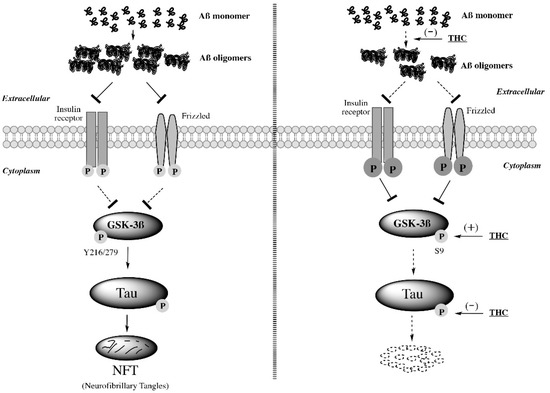
“Studies on the effective and safe therapeutic dosage of delta-9-tetrahydrocannabinol (THC) for the treatment of Alzheimer’s disease (AD) have been sparse due to the concern about THC’s psychotropic activity. The present study focused on demonstrating the beneficial effect of low-dose THC treatment in preclinical AD models.
The effect of THC on amyloid-β (Aβ) production was examined in N2a/AβPPswe cells. An in vivo study was conducted in aged APP/PS1 transgenic mice that received an intraperitoneal injection of THC at 0.02 and 0.2 mg/kg every other day for three months.
The in vitro study showed that THC inhibited Aβ aggregation within a safe dose range. Results of the radial arm water maze (RAWM) test demonstrated that treatment with 0.02 and 0.2 mg/kg of THC for three months significantly improved the spatial learning performance of aged APP/PS1 mice in a dose-dependent manner.
Results of protein analyses revealed that low-dose THC treatment significantly decreased the expression of Aβ oligomers, phospho-tau and total tau, and increased the expression of Aβ monomers and phospho-GSK-3β (Ser9) in the THC-treated brain tissues.
In conclusion, treatment with THC at 0.2 and 0.02 mg/kg improved the spatial learning of aged APP/PS1 mice, suggesting low-dose THC is a safe and effective treatment for AD.”
https://pubmed.ncbi.nlm.nih.gov/35269905/
https://www.mdpi.com/1422-0067/23/5/2757
Thromboembolic Outcomes in Tetrahydrocannabinol-Positive Trauma Patients With Traumatic Brain Injury
“Introduction: Traumatic brain injury (TBI) is a significant source of morbidity and mortality in the United States. Recent shifts in state legislation have increased the use of recreational and medical marijuana. While cannabinoids and tetrahydrocannabinol (THC) have known anti-inflammatory effects, the impact of preinjury THC use on clinical outcomes in the setting of severe TBI is unknown. We hypothesized that preinjury THC use in trauma patients suffering TBI would be associated with decreased thromboembolic events and adverse outcomes.
Methods: The American College of Surgeons Trauma Quality Improvement Program was used to identify patients aged ≥18 y with TBI and severe injury (Injury Severity Score ≥ 16) in admit year 2017. Patients with smoking or tobacco history or missing or positive toxicology tests for drug and/or alcohol use other than THC were excluded. Propensity score matching was used to compare THC+ patients to similar THC- patients.
Results: A total of 13,266 patients met inclusion criteria, of which 1669 were THC+. A total of 1377 THC+ patients were matched to 1377 THC- patients. No significant differences were found in in-hospital outcomes, including mortality, length of stay, cardiac arrest, pulmonary embolism, deep vein thrombosis, or acute respiratory distress syndrome. No patients had ischemic stroke, and THC+ patients had significantly decreased rates of hemorrhagic stroke (0.5% versus 1.5%, P = 0.02, odds ratio 0.41 [95% confidence interval 0.18-0.86]).
Conclusions: Preinjury THC use may be associated with decreased hemorrhagic stroke in severely injured patients with TBI, but there was no difference in thromboembolic outcomes. Further research into pathophysiological mechanisms related to THC are needed.”
https://pubmed.ncbi.nlm.nih.gov/35305485/