

“Mesothelioma is an aggressive cancer with limited treatment options and a poor prognosis. Phytocannabinoids possess anti-tumour and palliative properties in multiple cancers, however their effects in mesothelioma are unknown. We investigated the anti-cancer effects and potential mechanisms of action for several phytocannabinoids in mesothelioma cell lines.
A panel of 13 phytocannabinoids inhibited growth of human (MSTO and H2452) and rat (II-45) mesothelioma cells in vitro, and cannabidiol (CBD) and cannabigerol (CBG) were the most potent compounds. Treatment with CBD or CBG resulted in G0/G1 arrest, delayed entry into S phase and induced apoptosis. CBD and CBG also significantly reduced mesothelioma cell migration and invasion. These effects were supported by changes in the expression of genes associated with the cell cycle, proliferation, and cell movement following CBD or CBG treatment. Gene expression levels of CNR1, GPR55, and 5HT1A also increased with CBD or CBG treatment. However, treatment with CBD or CBG in a syngeneic orthotopic rat mesothelioma model was unable to increase survival.
Our data show that cannabinoids have anti-cancer effects on mesothelioma cells in vitro and alternatives of drug delivery may be needed to enhance their effects in vivo.”
https://pubmed.ncbi.nlm.nih.gov/35954477/
We showed that several phytocannabinoids inhibited growth of mesothelioma cells, with two phytocannabinoids, cannabidiol (CBD) and cannabigerol (CBG), being the most potent. CBD and CBG also inhibited mesothelioma cell migration and invasion. Gene expression analysis highlighted signalling pathways that play a role in how CBD and CBG may exert their anti-cancer effects. CBD and CBG were unable to increase survival in a rat model of mesothelioma but this may be due to limitations in the drug delivery method.
Our data present the first report that plant cannabinoids have anti-proliferative effects on mesothelioma cells, that was associated with apoptosis, rather than autophagy or production of ROS. CBD and CBG were the most potent cannabinoids and also inhibited mesothelioma cell migration and invasion.”
 “Cancer patients experience multiple symptoms throughout their illness, and some report benefit from the use of cannabis. There are concerns that many patients are accessing products inappropriate for their situation and potentially putting themselves at risk.
 “Phytocannabinoids are unique terpenophenolic compounds predominantly produced in the glandular trichomes of the cannabis plant (Cannabis sativa L.). The delta-9- tetrahydrocannabinol (THC) is the main active constituent responsible for the plant’s psychoactive effect and, together with the non- psychoactive cannabidiol (CBD), the most investigated naturally occurring cannabinoid.

 “The endocannabinoid system has emerged as a considerable target for the treatment of diverse diseases.
In addition to the well-established palliative effects of
“The endocannabinoid system has emerged as a considerable target for the treatment of diverse diseases.
In addition to the well-established palliative effects of 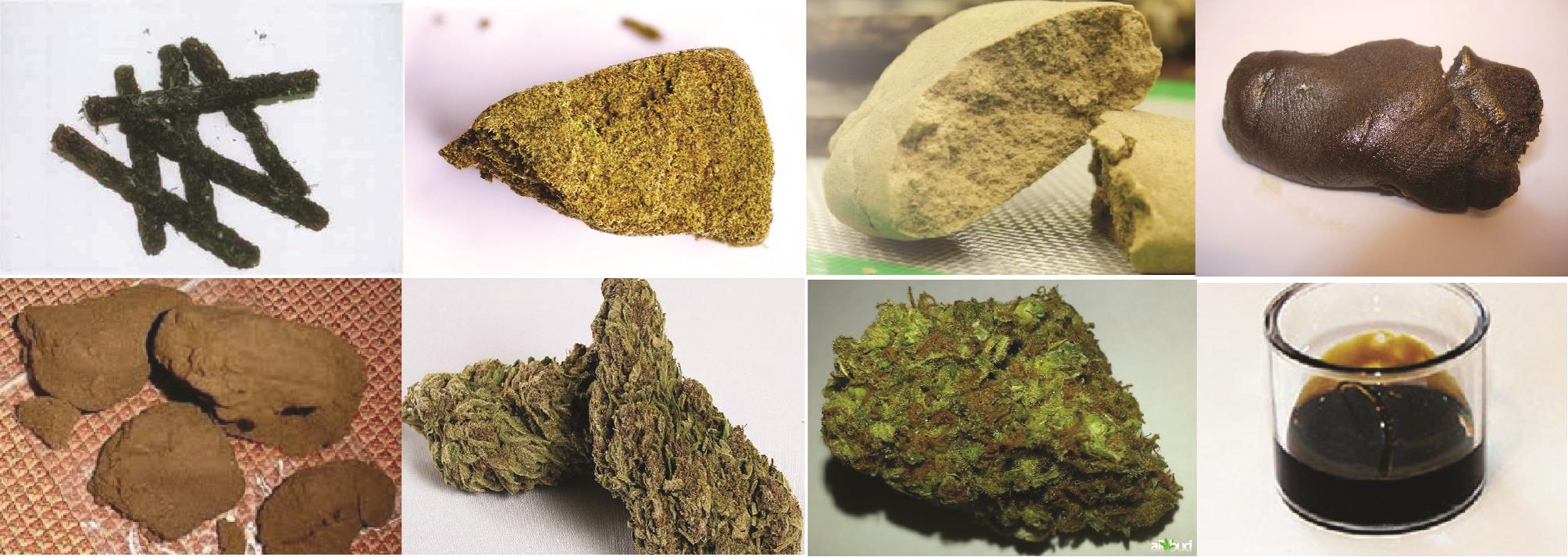 “Cannabis products. First row, left to right: Indian, Lebanese, Turkish and Pakistani hashish. Second row, left to right: Swiss hashish, Zairean marijuana, Swiss marijuana, Moroccan hash oil.”]]>
  “Anandamide is a lipid neurotransmitter derived from arachidonic acid, a polyunsaturated fatty acid.
The chemical differences between anandamide and arachidonic acid result in a slightly enhanced solubility in water and absence of an ionisable group for the neurotransmitter compared with the fatty acid. In this review, we first analyze the conformational flexibility of anandamide in aqueous and membrane phases. We next study the interaction of the neurotransmitter with membrane lipids and discuss the molecular basis of the unexpected selectivity of anandamide for cholesterol and ceramide from among other membrane lipids.
We show that cholesterol behaves as a binding partner for anandamide, and that following an initial interaction mediated by the establishment of a hydrogen bond, anandamide is attracted towards the membrane interior, where it forms a molecular complex with cholesterol after a functional conformation adaptation to the apolar membrane milieu.
The complex is then directed to the anandamide cannabinoid receptor (CB1) which displays a high affinity binding pocket for anandamide. We propose that cholesterol may regulate the entry and exit of anandamide in and out of CB1 by interacting with low affinity cholesterol recognition sites (CARC and CRAC) located in transmembrane helices.
The mirror topology of cholesterol binding sites in the seventh transmembrane domain is consistent with the delivery, extraction and flip-flop of anandamide through a coordinated cholesterol-dependent mechanism. The binding of anandamide to ceramide illustrates another key function of membrane lipids which may occur independently of protein receptors.
Interestingly, ceramide forms a tight complex with anandamide which blocks the degradation pathway of both lipids and could be exploited for anti-cancer therapies.”
“Anandamide is a lipid neurotransmitter derived from arachidonic acid, a polyunsaturated fatty acid.
The chemical differences between anandamide and arachidonic acid result in a slightly enhanced solubility in water and absence of an ionisable group for the neurotransmitter compared with the fatty acid. In this review, we first analyze the conformational flexibility of anandamide in aqueous and membrane phases. We next study the interaction of the neurotransmitter with membrane lipids and discuss the molecular basis of the unexpected selectivity of anandamide for cholesterol and ceramide from among other membrane lipids.
We show that cholesterol behaves as a binding partner for anandamide, and that following an initial interaction mediated by the establishment of a hydrogen bond, anandamide is attracted towards the membrane interior, where it forms a molecular complex with cholesterol after a functional conformation adaptation to the apolar membrane milieu.
The complex is then directed to the anandamide cannabinoid receptor (CB1) which displays a high affinity binding pocket for anandamide. We propose that cholesterol may regulate the entry and exit of anandamide in and out of CB1 by interacting with low affinity cholesterol recognition sites (CARC and CRAC) located in transmembrane helices.
The mirror topology of cholesterol binding sites in the seventh transmembrane domain is consistent with the delivery, extraction and flip-flop of anandamide through a coordinated cholesterol-dependent mechanism. The binding of anandamide to ceramide illustrates another key function of membrane lipids which may occur independently of protein receptors.
Interestingly, ceramide forms a tight complex with anandamide which blocks the degradation pathway of both lipids and could be exploited for anti-cancer therapies.”