
 “Marijuana/cannabinoid research has been transformed into mainstream science during the last half-century. Evidence based research and remarkable biotechnological advances demonstrate that phytocannabinoids and endocannabinoid (eCBs) acting on cannabinoid receptors (CBRs) regulate various aspects of human physiological, behavioral, immunological and metabolic functions. The distribution and function of the components of the endocannabinoid system (ECS) in the central nervous system (CNS) and immune processes have garnished significant research focus with major milestones. With these advances in biotechnology, rapid extension of the ECS research in the periphery has gained momentum. In this chapter, we review the components and tissue distribution of this previously unknown but ubiquitous and complex ECS that is involved in almost all aspects of mammalian physiology and pathology.”
https://www.ncbi.nlm.nih.gov/pubmed/31332731
https://link.springer.com/chapter/10.1007%2F978-3-030-21737-2_1
 “We have previously reported that endocannabinoids modulate permeability in Caco-2 cells under inflammatory conditions and hypothesised in the present study that endocannabinoids could also modulate permeability in ischemia/reperfusion.
 “Protocatechuic acid is an antioxidant which is shown to have analgesic activity in limited studies. However, the mechanisms of action remain unclear.
 “Cognitive impairment is a major source of disability in schizophrenia and current antipsychotic drugs (APDs) have minimal efficacy for this symptom domain.
 “Herein, we report the antioxidant activity of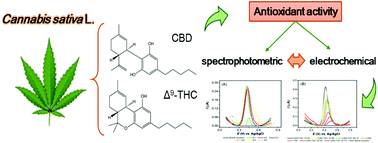
 “It is becoming clear that post-traumatic stress disorder (PTSD) is not simply a psychiatric disorder, but one that involves pervasive physiological impairments as well. These physiological disturbances deserve attention in any attempt at integrative treatment of PTSD that requires a focus beyond the PTSD symptoms themselves. The physiological disturbances in PTSD range over many systems, but a common thread thought to underlie them is that the chronic effects of PTSD involve problems with allostatic control mechanisms that result in an excess in what has been termed “allostatic load” (AL).