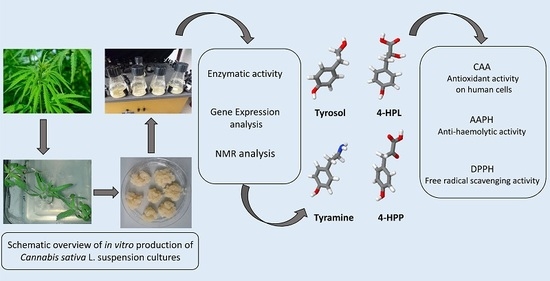
 “Cannabis sativa L. is one of the most-studied species for its phytochemistry due to the abundance of secondary metabolites, including cannabinoids, terpenes and phenolic compounds. In the last decade, fiber-type hemp varieties have received interest for the production of many specialized secondary metabolites derived from the phenylpropanoid pathway. The interest in these molecules is due to their antioxidant activity.
Since secondary metabolite synthesis occurs at a very low level in plants, the aim of this study was to develop a strategy to increase the production of such compounds and to elucidate the biochemical pathways involved. Therefore, cell suspensions of industrial hemp (C. sativa L. var. Futura) were produced, and an advantageous elicitation strategy (methyl jasmonate, MeJA) in combination with precursor feeding (tyrosine, Tyr) was developed.
The activity and expression of phenylalanine ammonia-lyase (PAL) and tyrosine aminotransferase (TAT) increased upon treatment. Through 1H-NMR analyses, some aromatic compounds were identified, including, for the first time, 4-hydroxyphenylpyruvate (4-HPP) in addition to tyrosol. The 4-day MeJA+Tyr elicited samples showed a 51% increase in the in vitro assay (2,2-diphenyl-1-picrylhydrazyl, DPPH) radical scavenging activity relative to the control and a 80% increase in the cellular antioxidant activity estimated on an ex vivo model of human erythrocytes.
Our results outline the active metabolic pathways and the antioxidant properties of hemp cell extracts under the effect of specific elicitors.”
 “Use of
  “In final appraisal documents the UK National Institute for Health and Care Excellence has recommended the use of cannabidiol with clobazam for treating seizures associated with two rare and severe forms of epilepsy: Lennox-Gastaut syndrome and Dravet syndrome.
 “Chronic pain is highly prevalent in most of the industrialized nations around the world. Despite the documented adverse effects, opioids are widely used for pain management.
  “Accumulating evidence implicates the endocannabinoid system in the pathophysiology of psychosis.
 “Medicinal
 “The hemp plant (
 “Depression is a widespread psychological disorder that affects up to 20% of the world’s population. Traditional Chinese medicine (TCM), with its unique curative effect in depression treatment, is gaining increasing attention as the discovery of novel antidepressant drug has become the pursuit of pharmaceutical. This article summarizes the work done on the natural products from TCM that have been reported to conceive antidepressant effects in the past two decades, which can be classified according to various mechanisms including increasing synaptic concentrations of monoamines, alleviating the hypothalamic-pituitary-adrenal (HPA) axis dysfunctions, lightening the impairment of neuroplasticity, fighting towards immune and inflammatory dysregulation. The antidepressant active ingredients identified can be generally divided into saponins, flavonoids, alkaloids, polysaccharides and others. Albiflorin, Baicalein, Berberine chloride, beta-Asarone, cannabidiol, Curcumin, Daidzein, Echinocystic acid (EA), Emodin, Ferulic acid, Gastrodin, Genistein, Ginsenoside Rb1, Ginsenoside Rg1, Ginsenoside Rg3, Hederagenin, Hesperidin, Honokiol, Hyperoside, Icariin, Isoliquiritin, Kaempferol, Liquiritin, L-theanine, Magnolol, Paeoniflorin, Piperine, Proanthocyanidin, Puerarin, Quercetin, Resveratrol (trans), Rosmarinic acid, Saikosaponin A, Senegenin, Tetrahydroxystilbene glucoside and Vanillic acid are Specified in this review. Simultaneously, chemical structures of the active ingredients with antidepressant activities are listed and their sources, models, efficacy and mechanisms are described. Chinese compound prescription and extracts that exert antidepressant effects are also introduced, which may serve as a source of inspiration for further development. In the view of present study, the antidepressant effect of certain TCMs are affirmative and encouraging. However, there are a lot of work needs to be done to evaluate the exact therapeutic effects and mechanisms of those active ingredients, specifically, to establish a unified standard for diagnosis and evaluation of curative effect.”


 “According to recent studies,