
Natural Salicylates and Their Roles in Human Health

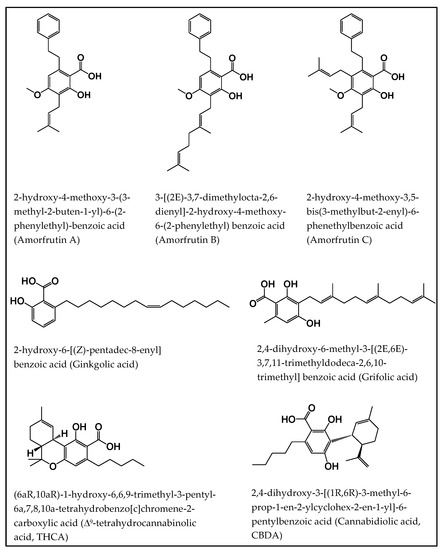
ijms-logo“Salicylic acid (SA) is a plant hormone which plays a crucial role in the plant defense against various pathogens and abiotic stresses. Increasing reports suggest that this phenolic compound and its derivatives, collectively termed salicylates, not only regulate plant defense but also have beneficial effects on human health. Both natural and synthetic salicylates are known to have multiple targets in humans, thereby exhibiting various appreciating pharmacological roles, including anti-inflammatory, anticancer, neuroprotective, antidiabetic effects, and so on. The role of some salicylates, such as acetylsalicylic acid (aspirin), 5-aminosalicylic acid (mesalazine), and amorfrutins in human diseases has been well studied in vitro. However, their clinical significance in different diseases is largely unknown. Based on recent studies, five natural salicylates, including amorfrutin, ginkgolic acid, grifolic acid, tetrahydrocannabinolic acid, and cannabidiolic acid, showed potential roles in different challenging human diseases. This review summarizes together some of the recent information on multitarget regulatory activities of these natural salicylates and their pharmacological roles in human health.”

https://pubmed.ncbi.nlm.nih.gov/33260759/

https://www.mdpi.com/1422-0067/21/23/9049
Anticancer Effect of New Cannabinoids Derived From Tetrahydrocannabinolic Acid on PANC-1 and AsPC-1 Human Pancreas Tumor Cells

View details for Journal of Pancreatic Cancer cover image

“New tetrahydrocannabinolic acid (THCA) derivatives ALAM027 and ALAM108 were proposed for the treatment of the pancreatic cancer disease.

Methods: The in vitro effect of new cannabinoids ALAM027 and ALAM108 was tested against PANC-1 and AsPC-1 cell lines by CellTiter Glo assay. Pancreatic cancer xenograft model was used for the in vivo anticancer activity study of these compounds on PANC-1 cells.

Results: The in vitro study of new cannabinoids showed greater activity of ALAM108 than ALAM027 both for PANC-1 and AsPC-1 cells. The in vivo study of new cannabinoids on PANC-1 cells showed that their oral administration was effective in reducing tumor volume and tumor weight, and did not lead to any discomfort and weight loss of mice.

Conclusion: The cannabinoids ALAM108 and ALAM027 inhibited the tumor growing 1.6-2 times in mice with human PANC-1 cells.”

https://pubmed.ncbi.nlm.nih.gov/32642629/

“The in vitro study of new cannabinoids showed greater activity of ALAM108 than of ALAM027 both for PANC-1 and AsPC-1 pancreas tumor cells. The in vivo study of these cannabinoids on PANC-1 cells showed that their oral administration decreased the tumor size 1.6–2 times and did not lead to any discomfort, psychotic effects, and weight loss of mice. Further study of these compounds will allow to determine the mechanism of their action on cancer cells and may open the way to new therapeutic drugs based on THCA.”

https://www.liebertpub.com/doi/10.1089/pancan.2020.0003

FIG. 1.

Δ9‐TETRAHYDROCANNABINOLIC ACID ALLEVIATES COLLAGEN‐INDUCED ARTHRITIS: ROLE OF PPARγ AND CB1 RECEPTORS

British Journal of Pharmacology “Δ9‐THCA‐A, the precursor of Δ9‐THC, is a non‐psychotropic phytocannabinoid that shows PPARγ agonistic activity. Herein, we investigated Δ9‐THCA ability to modulate classic cannabinoid receptors (CB1 and CB2) and evaluated its anti‐arthritis activity.

Experimental Approach

Cannabinoid receptors binding and intrinsic activity, as well as their downstream signaling were analyzed in vitro and in silico . The anti‐arthritis properties of Δ9‐THCA‐A were studied in human chondrocytes and in the murine model of collagen‐induced arthritis (CIA). Plasmatic disease biomarkers were identified by liquid chromatography‐tandem mass spectrometry (LC‐MS/MS) based on proteomic and ELISA assays.

Key Results

Functional and docking analyses showed that Δ9‐THCA‐A can act as an orthosteric CB1 agonist and also as a positive allosteric modulator in the presence of CP‐55,940. In addition, Δ9‐THCA‐A seemed to be an inverse agonist for CB2. In vivo experiments showed that Δ9‐THCA‐A reduced arthritis in CIA mice. Δ9‐THCA‐A prevented the infiltration of inflammatory cells; synovium hyperplasia and cartilage damage. Furthermore, Δ9‐THCA‐A inhibited the expression of inflammatory and catabolic genes on knee joints. The anti‐arthritic effect of Δ9‐THCA‐A was ablated by either SR141716 or T0070907. Analysis of plasmatic biomarkers as well as determination of cytokines and anti‐collagen antibodies confirmed that Δ9‐THCA‐A mediates its activity mainly through PPARγ and CB1 pathways.

Conclusion and Implications

Δ9‐THCA‐A modulates CB1 receptor through the orthosteric and allosteric binding sites. In addition, our studies document that Δ9‐THCA‐A exerts anti‐arthritis activity through CB1/PPARγ pathways, highlighting its potential for the treatment of chronic inflammatory diseases such as Rheumatoid Arthritis (RA).”

https://pubmed.ncbi.nlm.nih.gov/32510591/

https://bpspubs.onlinelibrary.wiley.com/doi/abs/10.1111/bph.15155

 British Pharmacological Society | Journals

Elucidation of structure-function relationship of THCA and CBDA synthase from Cannabis sativa L.

Journal of Biotechnology “Cannabinoids are secondary natural products from the plant Cannabis sativa L. Therapeutic indications of cannabinoids currently comprise a significant area of medicinal research. We have expressed the Δ9-tetrahydrocannabinolic acid synthase (THCAS) and cannabidiolic acid synthase (CBDAS) recombinantly in Komagataella phaffii and could detect eight different products with a cannabinoid scaffold after conversion of the precursor cannabigerolic acid (CBGA). Besides five products remaining to be identified, both enzymes were forming three major cannabinoids of C. sativa – Δ9-tetrahydrocannabinolic acid (THCA), cannabidiolic acid (CBDA) and cannabichromenic acid (CBCA). These studies lay the groundwork for further research as well as biotechnological cannabinoid production.”
]]>
