
 “The endocannabinoid system (ECS) comprises the canonical receptor subtypes CB1R and CB2R and endocannabinoids (anandamide, AEA and 2-arachidonoylglycerol, 2-AG), and a “non-canonical” extended signaling network consisting of: (i) other fatty acid derivatives; (ii) the defined “ionotropic cannabinoid receptors” (TRP channels); other GPCRs (GPR55, PPARα); (iii) enzymes involved in the biosynthesis and degradation of endocannabinoids (FAAH and MAGL); and (iv) protein transporters (FABP family).The ECS is currently a hot topic due to its involvement in cancer and pain.
The current Research Topic highlights various ways the endocannabinoid system (ECS) can impact cancer and pain. Ramer et al. review the anticancer potential of the canonical and noncanonical endocannabinoid system. Morales and Jagerovic provide a much needed summary of cannabinoid ligands as promising antitumor agents in a wide variety of tumors, in contrast to their palliative applications. In their article, the authors classify cannabinoids with anticancer potential in endocannabinoids, phytocannabinoids, and synthetic cannabinoids. Moreno et al. in their review explored the value of cannabinoid receptor heteromers as potential new targets for anti-cancer therapies and as prognostic biomarkers, showing the potential of the endocannabinoid network in the anti-cancer setting as well as the clinical and ethical pitfalls behind it.
As an ensemble, these studies provide further fuel to the discussion and underline the potential for targeting the ECS at multiple levels to treat certain cancers and for pain relief. Importantly, they also help to move the focal point of the discussion beyond THC, CBD, and the cannonical receptors. Several of these reports either review or provide data to support the use of/targeting of other members of the ECS system as well as alternative natural products beyond THC and CBD.”
https://www.frontiersin.org/articles/10.3389/fphar.2020.00312/full
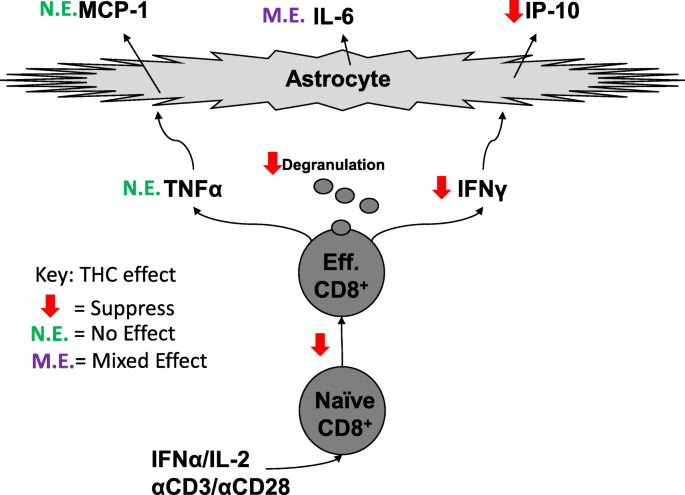 “CD8+ T cells can contribute to neuroinflammation by secretion of inflammatory cytokines like interferon γ (IFNγ) and tumor necrosis factor α (TNFα). Astrocytes, a glial cell in the brain, can be stimulated by IFNγ and TNFα to secrete the inflammatory cytokines, monocyte chemotactic protein 1 (MCP-1), interleukin 6 (IL-6), and interferon-γ inducible protein 10 (IP-10).
 “Cannabis benefits patients with inflammatory bowel disease (IBD).
 “The synthetic atypical cannabinoid Abn-CBD, a
  “Recently, several studies have reported that the pharmacological effects exerted by
  “In the sports domain, cannabis is prohibited by the World Anti-Doping Agency (WADA) across all sports in competition since 2004. The few studies on physical exercise and cannabis focused on the main compound i.e. Δ9-tetrahydrocannabinol.
  “The oil from industrial hemp seeds (
 “The
“The