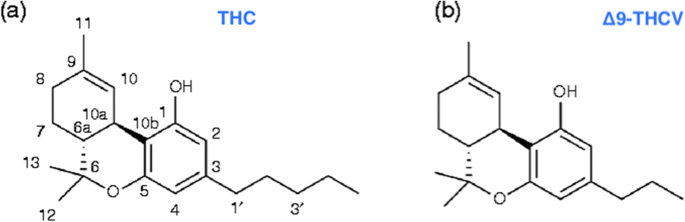
 “Δ9-Tetrahydrocannabivarin (THCV) is a cannabis-derived compound with unique properties that set it apart from the more common cannabinoids, such as Δ9-tetrahydrocannabinol (THC). The main advantage of THCV over THC is the lack of psychoactive effects. In rodent studies, THCV decreases appetite, increases satiety, and up-regulates energy metabolism, making it a clinically useful remedy for weight loss and management of obesity and type 2 diabetic patients. The distinctions between THCV and THC in terms of glycemic control, glucose metabolism, and energy regulation have been demonstrated in previous studies. Also, the effect of THCV on dyslipidemia and glycemic control in type 2 diabetics showed reduced fasting plasma glucose concentration when compared to a placebo group. In contrast, THC is indicated in individuals with cachexia. However, the uniquely diverse properties of THCV provide neuroprotection, appetite suppression, glycemic control, and reduced side effects, etc.; therefore, making it a potential priority candidate for the development of clinically useful therapies in the future. Hopefully, THCV could provide an optional platform for the treatment of life-threatening diseases.”
“The psychoactive effects of THC in marijuana are the main reasons for its classification as a Schedule I substance, even though it is the THC that the U.S. Food and Drug Administration (FDA) approved for appetite stimulation and weight gain. In contrast to THC, clinical and therapeutic advantages of THCV regarding its lack of psychoactive effects in human studies are of great value in pharmacotherapy. It is envisioned that the unique and diverse characteristics of THCV could be explored for further development into clinically useful medicines for the treatment of life-threatening diseases.”
https://jcannabisresearch.biomedcentral.com/articles/10.1186/s42238-020-0016-7
 “Cannabis sativa has been used for recreational, therapeutic and other uses for thousands of years.
The plant contains more than 120 C21 terpenophenolic constituents named phytocannabinoids. The Δ9-tetrahydrocannabinol type class of phytocannabinoids comprises the largest proportion of the phytocannabinoid content.
Δ9-tetrahydrocannabinol was first discovered in 1971. This led to the discovery of the endocannabinoid system in mammals, including the
“Cannabis sativa has been used for recreational, therapeutic and other uses for thousands of years.
The plant contains more than 120 C21 terpenophenolic constituents named phytocannabinoids. The Δ9-tetrahydrocannabinol type class of phytocannabinoids comprises the largest proportion of the phytocannabinoid content.
Δ9-tetrahydrocannabinol was first discovered in 1971. This led to the discovery of the endocannabinoid system in mammals, including the