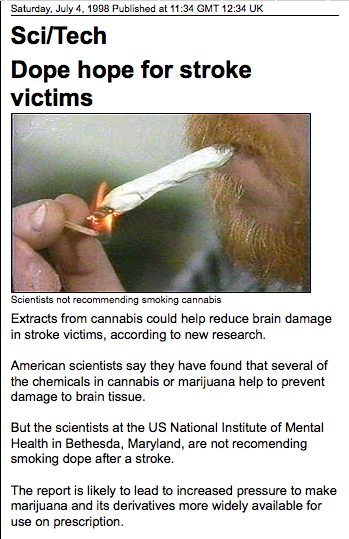
Marijuana Could Reduce Brain Damage After Stroke, Researchers Say

(Photo: Lavender Dreamer/Flickr)

“New research suggests compounds in marijuana may protect the brain from damage following a stroke. Scientists hope to perform human trials in the near future.

Researchers at the University of Nottingham conducted a meta-analysis of previous studies, reports the Nottingham Post, concluding that cannabinoids could reduce the severity of stroke as well as improve neurological outcomes.

Lead author Dr. Tim England, honorary consultant stroke physician at the University of Nottingham and Royal Derby Hospital, presented the findings at this week’s annual UK Stroke Forum conference.

Dr. England explained in an university release that while research thus far has been limited to animals, the latest findings provide support for human studies.

“This meta-analysis of pre-clinical stroke studies provides valuable information on the existing, and importantly, missing data on the use of cannabinoids as a potential treatment for stroke patients. The data are guiding the next steps in experimental stroke in order to be able to progress onto initial safety assessments in a clinical trial.”

Dr. England and his team examined 94 past studies involving the effects of various cannabinoids on 1022 rats, mice or monkeys, reports The New Zealand Herald. The effects on stroke seemed to be consistent across all three types of cannabinoids: synthetic, marijuana-derived and those naturally produced by the body.

Dr. Dale Webb, director of research and information at the Stroke Association, also concluded that scientists should now aim to replicate the findings in humans.

“The findings have identified the potential for cannabinoids to reduce brain damage caused by stroke. Further research is needed to investigate whether cannabinoids have the same effects in humans: the effects of cannabis on the brain are highly complex and it remains a risky substance.”

Following the presentation of the findings, Dr. Madina Kara, a neuroscientist at the Stroke Association, said that human trials are now “under discussion.””

http://www.leafscience.com/2013/12/03/marijuana-reduce-brain-damage-stroke-researchers-say/

Marijuana Use Linked To Lower Stroke Risk

(Photo: comedy_nose/Flickr)

“Those who use marijuana may benefit from a reduced chance of stroke, according to a new study.

As part of The Stroke Prevention in Young Adults Study, researchers from the University of Maryland analyzed past marijuana use among 751 stroke cases and 813 controls.

The results, which spanned 16 years, showed that those who used marijuana were less likely to suffer a stroke. 28.8% of stroke patients reported marijuana use verses 32.7% of those with no history of stroke.

“The question is still out there, the research still needs to be done. Patients are interested, and I think this lays a foundation for that,” said Dr. Billinghurst.

However, cochair Jennifer Majersik, MD, of the University of Utah, said the study “should be reassuring” to people who smoked marijuana in the 1960s or 1970s, adding that Baby Boomers have yet to show any negative marijuana-associated effects.

Factors that seemed to increase the risk of stroke included tobacco and alcohol use and a history of diabetes and hypertension. Stroke sufferers also tended to be male.

‘Extremely Promising’

Other studies have suggested a link between marijuana use and an increased risk of stroke, but opinions remain divided. On the other hand, there is a growing body of evidence that supports a beneficial role of medical marijuana following a stroke.

In 2013, researchers at the University of Nottingham analyzed pre-existing evidence and concluded that marijuana compounds, called cannabinoids, show promise in reducing the severity of stroke and improving patient outcomes.

“The data are guiding the next steps in experimental stroke in order to be able to progress onto initial safety assessments in a clinical trial,” said lead author and stroke specialist Dr. Tim England.

An earlier analysis of cannabinoids in post-stroke treatment, published in 2012, concluded that “both synthetic cannabinoids and endocannabinoids represent extremely promising therapeutic compounds.”

According to the 2012 findings, compounds that bind to the body’s marijuana pathways may offer protection against post-stroke injury due to their “potent anti-inflammatory” effects.”

http://www.leafscience.com/2014/05/13/marijuana-use-linked-lower-stroke-risk/

A Marijuana Bud A Day Keeps The Stroke Away

screen-shot-2013-01-26-at-2-51-32-am.png

Screen shot 2013-01-26 at 2.51.56 AM

http://patients4medicalmarijuana.wordpress.com/2013/01/26/a-marijuana-bud-a-day-keeps-the-stroke-away/

“Heart Surgeon: “Marijuana everyday reduces stroke risk by 50%”. A bud a day keeps the stroke away! That is the claim being made by this Medical Doctor who is also an avid medical marijuana supporter.”  https://www.youtube.com/watch?v=-fM5T_vty58

Cannabis ‘may help stroke recovery’

“Cannabis may help to reduce brain damage after a stroke, new research suggests.

Chemical compounds found in the plant could help shrink the area of the brain affected by stroke, the study suggests.

Cannabinoids that are found in the plant as well as those that can be made artificially and those that are found naturally in the body can also help improve brain function after a stroke attack, the authors said.”

http://www.belfasttelegraph.co.uk/breakingnews/offbeat/cannabis-may-help-stroke-recovery-29803527.html

Marijuana & Stroke: Pot Compounds Protect Brain, New Meta-Study Shows

“Cannabinoids, chemicals related to those found in cannabis could be effective in restoring neurological function by shrinking the area of the brain affected by stroke, according to a new study led by Dr. Tim England, Honorary Consultant Stroke Physician at the University of Nottingham and Royal Derby Hospital.

Stroke, a leading cause of adult disability in the UK leaves over half of all survivors dependent on others for life. Over one million people are living with the effects of stroke and it is reported that in the UK alone, over 150,000 people have a stroke every year. Finding new treatments to help survivors recover quickly has never been more important.

The authors examined 94 studies evaluating the effects of cannabinoids on 1022 mice, monkeys, and male rats. Cannabinoids can be classified into endocannabinoids that occur naturally in the body, phytocannabinoids that are obtained from plant extracts, and synthetic cannabinoids.

A meta-analysis of experimental studies conducted by the researchers at the University of Nottingham identifies the potential of all three categories of these compounds potential to reduce brain damage caused by stroke and help improve brain function after an attack.

The U.S. government sought a patent in 2001 for the naturally occuring marijuana molecule, cannabidiol, for use as a brain protector during stroke. ”

http://blog.sfgate.com/smellthetruth/2013/12/11/marijuana-stroke-pot-compounds-protect-brain-new-meta-study-shows/

Chemicals in Marijuana May Help Stroke Victims

NewsBriefs

“Scientists at the National Institute of Mental Health (NIMH) said a chemical in marijuana may protect the brain from damage inflicted by a stroke.

Their study was reported in the Proceedings of the National Academy of Sciences (Aidan Hampson, et al., “Cannabidiol and Delta-9-tetrahydrocannabinol Are Neuroprotective Antioxidants,” Proceedings of the National Academy of Sciences, July 7, 1998, Vol. 95, Issue 14, p. 8268; “Pot Chemicals Might Inhibit Breast Tumors, Stroke Damage,” Dallas Morning News, July 13, 1998; Vanessa Thorpe, “Chemicals Help Brain Damage After Stroke,” The Independent (UK), July 19, 1998).

NIMH scientists researched the effects of two cannabinoids, cannabidiol and THC, on the brains of rats. THC is the ingredient in marijuana that causes a psychoactive effect. However, cannabidiol is “a better candidate,” in part, because it does not cause a “high” in the patient, said Aidan Hampson, a neuropharmacologist at NIMH who led the study.

The cannabinoids block a neurochemical, known as glutamate, that leads to the formation of toxic oxidizing molecules that kill brain cells. Glutamate is produced in the brain if the oxygen supply is cut off, for example, as the result of blood clot leading to a stroke.

Researchers found that cannabidiol is a more effective antioxidant than vitamins A and E, which already are known to block the damaging effects of glutamate.”

http://www.ndsn.org/julaug98/medmj1.html

Study: Habitual Marijuana Smoking Not Associated With Increased Risk Of Lung Cancer

eNews Park Forest

“Subjects who regularly inhale cannabis smoke possess no greater risk of contracting lung cancer than do those who consume it occasionally or not at all, according to data published online ahead of print in the International Journal of Cancer.

An international team of investigators from Canada, New Zealand, the United Kingdom, and the United States analyzed data from six case-control studies involving over 5,000 subjects (2,159 cases and 2,985 controls) from around the world.

Authors concluded, “Results from our pooled analyses provide little evidence for an increased risk of lung cancer among habitual or long-term cannabis smokers.””

http://www.enewspf.com/latest-news/health-and-fitness/53910-study-habitual-marijuana-smoking-not-associated-with-increased-risk-of-lung-cancer.html

“Cannabis smoking and lung cancer risk: Pooled analysis in the International Lung Cancer Consortium”  http://onlinelibrary.wiley.com/doi/10.1002/ijc.29036/abstract

http://www.thctotalhealthcare.com/category/lung-cancer/

Preliminary, Open-Label, Pilot Study of Add-On Oral Δ9-Tetrahydrocannabinol in Chronic Post-Traumatic Stress Disorder.

“Marijuana is often used as compassion add-on therapy for treatment-resistant PTSD.

This open-label study evaluates the tolerance and safety of orally absorbable Δ9-tetrahydrocannabinol (THC) for chronic PTSD.

RESULTS:

There were mild adverse effects in three patients, none of which led to treatment discontinuation. The intervention caused a statistically significant improvement in global symptom severity, sleep quality, frequency of nightmares, and PTSD hyperarousal symptoms.

CONCLUSIONS:

Orally absorbable Δ9-THC was safe and well tolerated by patients with chronic PTSD.”

http://www.ncbi.nlm.nih.gov/pubmed/24935052

http://www.thctotalhealthcare.com/category/post-traumatic-stress-disorder-ptsd/

Cannabis very effective as painkiller after a major sugery

Fight For medical Marijuana

“The very existence of cannabis as a substance with possible medical use is a contentious topic, to say the least. Its status as an illicit substance is hotly debated, with proponents from both sides (for and against legalization) engaged in a decades-long battle.

The status of marijuana in the United States as a Schedule I Substance under the Controlled Substances Act means not only that it is highly illegal to possess, but it is classified along the likes of cocaine, heroine, and crystal meth.

Schedule I substances are those that a) have high potential to be abused; b) have no currently accepted medical use in treatment in the United States; and c) are lacking in accepted safety in use under medical supervision.

All of these qualifiers are potentially important in classifying drugs and substances, but many people argue that marijuana does not belong in Schedule I…

Pain after surgery remains a problem in the medical community, and traditional prescribed painkillers often have unpleasant side effects as well as diminishing benefits.

Cannabis extracts work due to the cannabinoid receptors in the human brain.

Cannabinoids from marijuana help to effectively strengthen the body’s ability to reduce pain sensation.”

http://www.royalqueenseeds.com/blog-cannabis-very-effective-as-painkiller-after-a-major-sugery–n55

Cannabis very effective as painkiller after a major sugery

Cannabinoids Destroy Leukemia Cells, New Study Finds

(Photo: Alternative Medicine Solutions)

“New research from the University of London suggests chemicals in marijuana could be used to fight leukemia.

Published online in Anticancer Research, researchers at the Department of Oncology at St. George’s, University of London studied six different cannabinoids and found each to have anti-cancer action in leukemia cells.

Lead author Wai Liu, Ph.D explained the results of the latest study in Monday’s press release.

These agents are able to interfere with the development of cancerous cells, stopping them in their tracks and preventing them from growing. In some cases, by using specific dosage patterns, they can destroy cancer cells on their own.

The scientists were able to replicate previous findings on the anti-cancer effects of THC – the compound in marijuana responsible for the high.

However, in the latest study, Dr. Liu’s team decided to focus on cannabinoids that lacked psychoactive activity, including cannabidiol (CBD), cannabigerol (CBG) and cannabigevarin (CBGV).

This study is a critical step in unpicking the mysteries of cannabis as a source of medicine. The cannabinoids examined have minimal, if any, hallucinogenic side effects, and their properties as anti-cancer agents are promising.

The non-psychoactive cannabinoids were shown to inhibit growth of leukemia cells at all stages of the cell cycle. Interestingly, the team observed even greater effects when different cannabinoids were administered together.

“These compounds are inexpensive to produce”

Dr. Liu says drugs derived from cannabis are much cheaper to produce than traditional cancer therapies. He also thinks they could be combined with existing treatments to enhance their effects.

Used in combination with existing treatment, we could discover some highly effective strategies for tackling cancer. Significantly, these compounds are inexpensive to produce and making better use of their unique properties could result in much more cost effective anti-cancer drugs in future.

Dr. Liu’s next study will investigate the potential of cannabinoids when combined with existing treatments as well as different treatment schedules that could maximize their anti-cancer activity.”

http://www.leafscience.com/2013/10/14/cannabinoids-destroy-leukemia-cells-new-study-finds/

http://www.thctotalhealthcare.com/category/leukemia/