“Venous Leg Ulcers are highly prevalent lower limb integumentary wounds that remain challenging to heal despite the use of evidence-based compression therapies. A multitude of adjuvant treatments have been studied but none have demonstrated enough efficacy to gain adoption into treatment guidelines.
Global attention on cannabis-based therapies is increasing and has been driven by quantum scientific advancements in the understanding of the endocannabinoid signalling system. Topical Cannabis-Based Medicines represent a novel treatment paradigm for venous leg ulcers in terms of promoting wound closure.
Fourteen complex patients with sixteen recalcitrant leg ulcers were treated with Topical Cannabis-Based Medicines in conjunction with compression bandaging, every second day, to both wound bed and peri-wound tissues. The cohort had a mean age of 75.8 years and was medically complex as reflected by a mean M3 multimorbidity index score of 2.94 and a mean Palliative Performance Scale score of 67.1%.
Complete wound closure, defined being fully epithelialized, was achieved among 11 patients (79%) and 13 wounds (81%) within a median of 34 days. All three remaining patients demonstrated progressive healing trends but were lost to follow-up. The treatments were well tolerated, and no significant adverse reactions were experienced.
The rapid wound closure of previously non-healing venous leg ulcers among elderly and highly complex patients suggests that Topical Cannabis-Based Medicines may become effective adjuvants in conjunction with compression therapy. This may also indicate that they may have an even broader role within integumentary and wound management. Therefore, this treatment paradigm warrants being subjected to controlled trials.”
 “Positive effect of some cannabinoids in the treatment and prophylaxis of a wide variety of oxidation-associated diseases and growing popularity of supplements containing cannabinoids, mainly cannabinoid oils (e.g. CBD oil, CBG oil), in the self-medication of humans cause a growing interest in the antioxidant properties of these compounds, especially those not showing psychotropic effects.
  “Streptococcus mutans
 “Preclinical studies have shown cannabidiol is protective in models of ischemic stroke. Based on results from our recent systematic review, we investigated the effects of two promising neuroprotective phytocannabinoids, cannabigerol (CBG) and cannabidivarin (CBDV), on cells of the blood-brain barrier (BBB), namely human brain microvascular endothelial cells (HBMECs), pericytes, and astrocytes.
 “An observational research design was used to evaluate which types of commonly labeled Cannabis flower product characteristics are associated with changes in momentary feelings of distress-related symptoms.
 “Foodborne protein hydrolysates exhibit biological activity that may be therapeutic in a number of human disease settings. Hemp peptides (HP) generated by controlled hydrolysis of hemp proteins have a number of health benefits and are of pharmaceutical value. In the present study, we produce small molecular weight HP from hemp seed and investigate its anticancer properties in Hep3B human liver cancer cells. We demonstrate that HP treatment increased apoptosis, reduced cell viability, and reduced cell migration in Hep3B human liver cancer cells without affecting the normal liver cell line L02. We correlate these phenotypes with increased cellular ROS levels, upregulation of cleaved caspase 3 and Bad, and downregulation of antiapoptotic Bcl-2. HP treatment led to increased Akt and GSK-3β phosphorylation, with subsequent downregulation of β-catenin, suggesting β-catenin signaling modulation as a critical mechanism by which HP exhibits anticancer properties. Our findings suggest HP are of potential therapeutic interest for liver cancer treatment.”
 “Agents targeting the endocannabinoid system (ECS) have gained attention as potential cancer treatments. Given recent evidence that cannabinoid receptor 2 (CB2R) regulates lymphocyte development and inflammation, we performed studies on CB2R in the immune response against melanoma. Analysis of The Cancer Genome Atlas (TCGA) data revealed a strong positive correlation between CB2R expression and survival, as well as B cell infiltration in human melanoma. In a murine melanoma model, CB2R expression reduced the growth of melanoma as well as the B cell frequencies in the tumor microenvironment (TME), compared to CB2R-deficient mice. In depth analysis of tumor-infiltrating B cells using single-cell RNA sequencing suggested a less differentiated phenotype in tumors from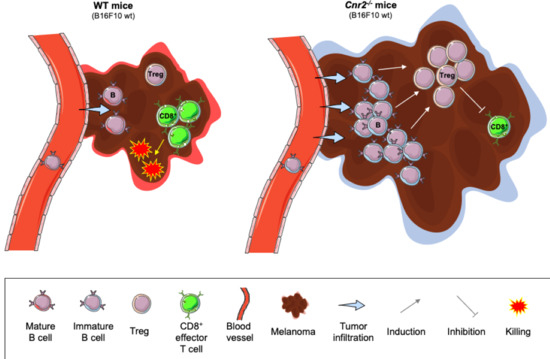
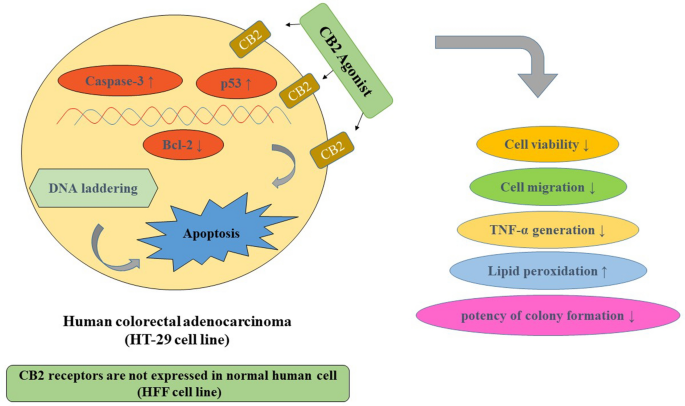
 “Colorectal cancer (CRC) is between the top three occurring cancers worldwide. The anticancer effects of Cannabinoid receptor 2 (CB