

“Neurodegenerative diseases are an increasing cause of global morbidity and mortality. They occur in the central nervous system (CNS) and lead to functional and mental impairment due to loss of neurons. Recent evidence highlights the link between neurodegenerative and inflammatory diseases of the CNS. These are typically associated with several neurological disorders. These diseases have fundamental differences regarding their underlying physiology and clinical manifestations, although there are aspects that overlap.
The endocannabinoid system (ECS) is comprised of receptors (type-1 (CB1R) and type-2 (CB2R) cannabinoid-receptors, as well as transient receptor potential vanilloid 1 (TRPV1)), endogenous ligands and enzymes that synthesize and degrade endocannabinoids (ECBs). Recent studies revealed the involvement of the ECS in different pathological aspects of these neurodegenerative disorders.
The present review will explore the roles of cannabinoid receptors (CBRs) and pharmacological agents that modulate CBRs or ECS activity with reference to Alzheimer’s Disease (AD), Parkinson’s Disease (PD), Huntington’s Disease (HD) and multiple sclerosis (MS).”
https://pubmed.ncbi.nlm.nih.gov/35336814/
“Neurodegenerative diseases represent an important cause of morbidity and mortality worldwide. Existing therapeutic options are limited and focus mostly on improving symptoms and reducing exacerbations. The endocannabinoid system is involved in the pathophysiology of such disorders, an idea which has been highlighted by recent scientific work. The current work focusses its attention on the importance and implications of this system and its synthetic and natural ligands in disorders such as Alzheimer’s, Parkinson’s, Huntington’s and multiple sclerosis.”
https://www.mdpi.com/2079-7737/11/3/440/htm
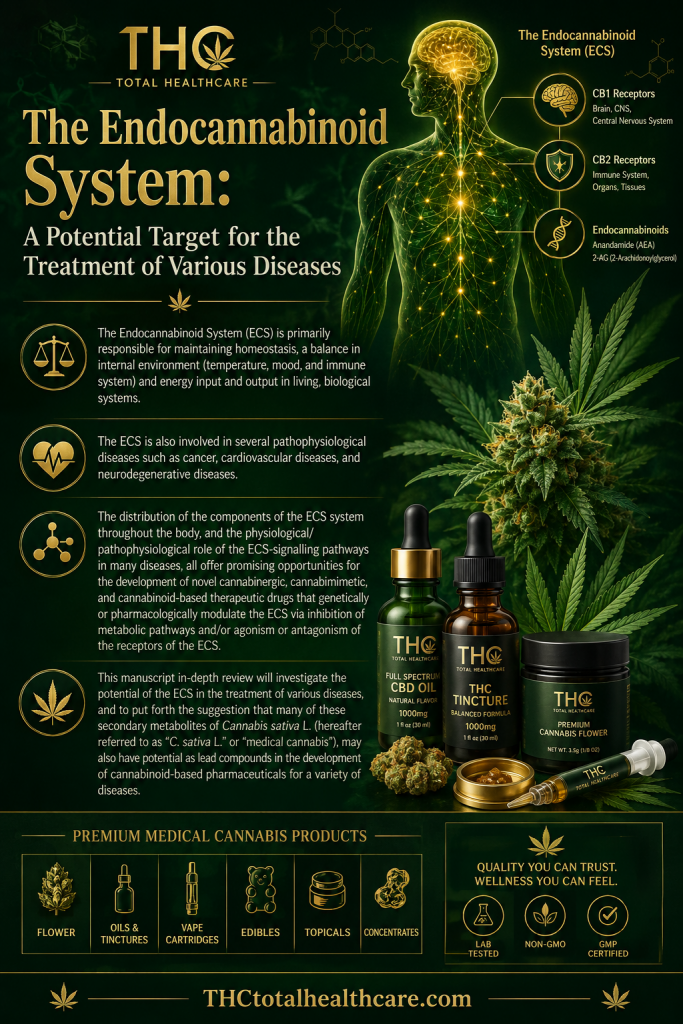
 “The Endocannabinoid System (ECS) is primarily responsible for maintaining homeostasis, a balance in internal environment (temperature, mood, and immune system) and energy input and output in living, biological systems.
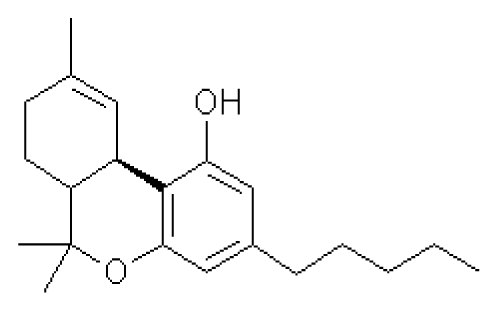
 “Medical cannabis and individual cannabinoids, such as tetrahydrocannabinol (THC) and cannabidiol (CBD), are receiving growing attention in both the media and the scientific literature. The Cannabis plant, however, produces over 100 different cannabinoids, and cannabigerol (CBG) serves as the precursor molecule for the most abundant phytocannabinoids.
 “The aberrant accumulation of disease-specific protein aggregates accompanying cognitive decline is a pathological hallmark of age-associated neurological disorders, also termed as proteinopathies, including Alzheimer’s disease, Parkinson’s disease, Huntington’s disease, amyotrophic lateral sclerosis and multiple sclerosis.
 “We aimed to comprehensively evaluate the effects of medical marijuana on symptoms that are relevant to movement disorders with a focus on Huntington disease (HD).
 “In the last few years research into Cannabis and its constituent phytocannabinoids has burgeoned, particularly in the potential application of novel cannabis phytochemicals for the treatment of diverse illnesses related to neurodegeneration and dementia, including Alzheimer’s (AD), Parkinson’s (PD) and Huntington’s disease (HD). To date, these neurological diseases have mostly relied on symptomatological management. However, with an aging population globally, the search for more efficient and disease-modifying treatments that could delay or mitigate disease progression is imperative. In this context, this review aims to present a state of art in the research with cannabinoids and novel cannabinoid-based drug candidates that have been emerged as novel promising alternatives for drug development and innovation in the therapeutics of a number of diseases, especially those related to CNS-disturbance and impairment.”
 “The basal ganglia (BG), an organized network of nuclei that integrates cortical information, play a crucial role in controlling motor function. In fact, movement disorders such as Parkinson’s disease (PD) and Huntington’s disease (HD) are caused by the degeneration of specific structures within the BG.