Turning Down the Thermostat: Modulating the Endocannabinoid System in Ocular Inflammation and Pain.

Image result for Frontiers in Pharmacology

“The endocannabinoid system (ECS) has emerged as an important regulator of both physiological and pathological processes. Notably, this endogenous system plays a key role in the modulation of pain and inflammation in a number of tissues.

The components of the ECS, including endocannabinoids, their cognate enzymes and cannabinoid receptors, are localized in the eye, and evidence indicates that ECS modulation plays a role in ocular disease states.

Of these diseases, ocular inflammation presents a significant medical problem, given that current clinical treatments can be ineffective or are associated with intolerable side-effects. Furthermore, a prominent comorbidity of ocular inflammation is pain, including neuropathic pain, for which therapeutic options remain limited.

Recent evidence supports the use of drugs targeting the ECS for the treatment of ocular inflammation and pain in animal models; however, the potential for therapeutic use of cannabinoid drugs in the eye has not been thoroughly investigated at this time.

This review will highlight evidence from experimental studies identifying components of the ocular ECS and discuss the functional role of the ECS during different ocular inflammatory disease states, including uveitis and corneal keratitis.

Candidate ECS targeted therapies will be discussed, drawing on experimental results obtained from both ocular and non-ocular tissue(s), together with their potential application for the treatment of ocular inflammation and pain.”

https://www.ncbi.nlm.nih.gov/pubmed/27695415

β-caryophyllene and β-caryophyllene oxide-natural compounds of anticancer and analgesic properties.


Cancer Biology & Medicine

“Natural bicyclic sesquiterpenes, β-caryophyllene (BCP) and β-caryophyllene oxide (BCPO), are present in a large number of plants worldwide.

Both BCP and BCPO (BCP(O)) possess significant anticancer activities, affecting growth and proliferation of numerous cancer cells.

In addition, both compounds potentiate the classical drug efficacy by augmenting their concentrations inside the cells.

BCP is a phytocannabinoid with strong affinity to cannabinoid receptor type 2 (CB2 ), but not cannabinoid receptor type 1 (CB1 ). In opposite, BCP oxidation derivative, BCPO, does not exhibit CB1/2 binding, thus the mechanism of its action is not related to endocannabinoid system (ECS) machinery.

It is known that BCPO alters several key pathways for cancer development, such as mitogen-activated protein kinase (MAPK), PI3K/AKT/mTOR/S6K1 and STAT3 pathways. In addition, treatment with this compound reduces the expression of procancer genes/proteins, while increases the levels of those with proapoptotic properties.

The selective activation of CB2 may be considered a novel strategy in pain treatment, devoid of psychoactive side effects associated with CB1 stimulation. Thus, BCP as selective CB2 activator may be taken into account as potential natural analgesic drug.

Moreover, due to the fact that chronic pain is often an element of cancer disease, the double activity of BCP, anticancer and analgesic, as well as its beneficial influence on the efficacy of classical chemotherapeutics, is particularly valuable in oncology.

This review is focused on anticancer and analgesic activities of BCP and BCPO, the mechanisms of their actions, and potential therapeutic utility.”

https://www.ncbi.nlm.nih.gov/pubmed/27696789

“β-caryophyllene (BCP) is a common constitute of the essential oils of numerous spice, food plants and major component in Cannabis.”  http://www.ncbi.nlm.nih.gov/pubmed/23138934

Anandamide Suppresses Proinflammatory T Cell Responses In Vitro through Type-1 Cannabinoid Receptor-Mediated mTOR Inhibition in Human Keratinocytes.

Image result for The Journal of Immunology

“The endocannabinoid system comprises cannabinoid receptors 1 and 2 (CB1 and CB2), their endogenous ligands, anandamide (AEA) and 2-arachidonoylglycerol, and metabolic enzymes of these ligands.

The endocannabinoid system has recently been implicated in the regulation of various pathophysiological processes of the skin that include immune competence and/or tolerance of keratinocytes, the disruption of which might promote the development of skin diseases.

Recent evidence showed that CB1 in keratinocytes limits the secretion of proinflammatory chemokines, suggesting that this receptor might also regulate T cell dependent inflammatory diseases of the skin.

In this article, we sought to investigate the cytokine profile of IFN-γ-activated keratinocytes, and found that CB1 activation by AEA suppressed production and release of signature TH1- and TH17-polarizing cytokines, IL-12 and IL-23, respectively. We also set up cocultures between a conditioned medium of treated keratinocytes and naive T cells to disclose the molecular details that regulate the activation of highly proinflammatory TH1 and TH17 cells.

AEA-treated keratinocytes showed reduced an induction of IFN-γ-producing TH1 and IL-17-producing TH17 cells, and these effects were reverted by pharmacological inhibition of CB1.

Further analyses identified mammalian target of rapamycin as a proinflammatory signaling pathway regulated by CB1, able to promote either IL-12 and IL-23 release from keratinocytes or TH1 and TH17 polarization.

Taken together, these findings demonstrate that AEA suppresses highly pathogenic T cell subsets through CB1-mediated mammalian target of rapamycin inhibition in human keratinocytes.

Thus, it can be speculated that the latter pathway might be beneficial to the physiological function of the skin, and can be targeted toward inflammation-related skin diseases.”

https://www.ncbi.nlm.nih.gov/pubmed/27694494

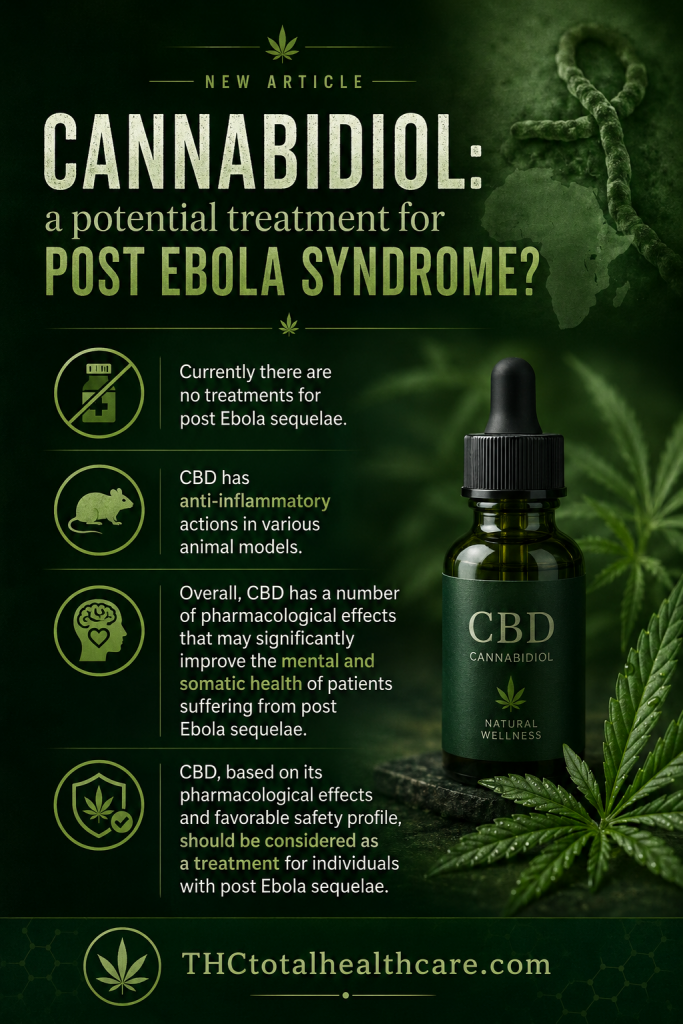
Cannabidiol: a potential treatment for post Ebola Syndrome?

“Patients recovered from Ebola virus infection may experience short- and long-term physical, neuropsychological and social sequelae, including arthralgia, musculoskeletal pain, ophthalmic inflammation, auditory problems, fatigue, confusion, insomnia, short-term memory impairment, anxiety, depression and anorexia, all lasting from 2 weeks to more than 2 years.

Currently there are no treatments for post Ebola sequelae.

We hypothesize that cannabidiol (CBD) may attenuate some of these post Ebola sequelae, several of which have been postulated to result from inflammation and/or an autoimmune response.

CBD has anti-inflammatory actions in various animal models.

Clinical studies have shown that oral administration of CBD, compared to placebo, significantly reduces anxiety, has antinociceptive and anticonvulsant actions, and may be therapeutic for insomnia.

Overall, CBD has a number of pharmacological effects that may significantly improve the mental and somatic health of patients suffering from post Ebola sequelae.

In humans, CBD, at therapeutic doses, does not: 1) elicit dependence or tolerance; 2) significantly alter heart rate or blood pressure; 3) affect gastrointestinal transit; 4) produce significant cognitive or psychomotor impairments. Mild sedation and nausea are the most commonly reported adverse effects associated with CBD.

CBD, based on its pharmacological effects and favorable safety profile, should be considered as a treatment for individuals with post Ebola sequelae.”

https://www.ncbi.nlm.nih.gov/pubmed/27686726

“The use of cannabidiol (CBD) to treat post Ebola clinical sequelae is proposed. CBD could decrease pain, inflammation, and neuropsychological problems. CBD does not elicit significant adverse or toxic effects in humans.”

“In conclusion, it is hypothesized that CBD, based on its pharmacological effects and favorable safety profile, should be considered as a treatment for individuals with post Ebola syndrome.”

https://www.ijidonline.com/article/S1201-9712(16)31177-8/fulltext

Neuroprotective effects of the nonpsychoactive cannabinoid cannabidiol in hypoxic-ischemic newborn piglets.

Image result for Pediatr Res.

“To test the neuroprotective effects of the nonpsychoactive cannabinoid cannabidiol (CBD), piglets received i.v. CBD or vehicle after hypoxia-ischemia (HI: temporary occlusion of both carotid arteries plus hypoxia).

CBD administration was free from side effects; moreover, CBD administration was associated with cardiac, hemodynamic, and ventilatory beneficial effects.

In conclusion, administration of CBD after HI reduced short-term brain damage and was associated with extracerebral benefits.”

https://www.ncbi.nlm.nih.gov/pubmed/18679164

Cannabidiol reduces brain damage and improves functional recovery after acute hypoxia-ischemia in newborn pigs.

Image result for Pediatr Res.

“Newborn piglets exposed to acute hypoxia-ischemia (HI) received i.v. cannabidiol (HI + CBD) or vehicle (HI + VEH). In HI + VEH, 72 h post-HI brain activity as assessed by amplitude-integrated EEG (aEEG) had only recovered to 42 ± 9% of baseline, near-infrared spectroscopy (NIRS) parameters remained lower than normal, and neurobehavioral performance was abnormal (27.8 ± 2.3 points, normal 36). In the brain, there were fewer normal and more pyknotic neurons, while astrocytes were less numerous and swollen. Cerebrospinal fluid concentration of neuronal-specific enolase (NSE) and S100β protein and brain tissue percentage of TNFα(+) cells were all higher. In contrast, in HI + CBD, aEEG had recovered to 86 ± 5%, NIRS parameters increased, and the neurobehavioral score normalized (34.3 ± 1.4 points). HI induced histological changes, and NSE and S100β concentration and TNFα(+) cell increases were suppressed by CBD. In conclusion, post-HI administration of CBD protects neurons and astrocytes, leading to histological, functional, biochemical, and neurobehavioral improvements.”

https://www.ncbi.nlm.nih.gov/pubmed/21654550

Cannabidiol administration after hypoxia-ischemia to newborn rats reduces long-term brain injury and restores neurobehavioral function.

Image result for neuropharmacology journal

“Cannabidiol (CBD) demonstrated short-term neuroprotective effects in the immature brain following hypoxia-ischemia (HI).

We examined whether CBD neuroprotection is sustained over a prolonged period.

In conclusion, CBD administration after HI injury to newborn rats led to long-lasting neuroprotection, with the overall effect of promoting greater functional rather than histological recovery.

These effects of CBD were not associated with any side effects.

These results emphasize the interest in CBD as a neuroprotective agent for neonatal HI.”

https://www.ncbi.nlm.nih.gov/pubmed/22659086

Neuroprotective Effects of Cannabidiol In Hypoxic Ischemic Insult: The Therapeutic Window In Newborn Mice.

Image result for CNS Neurol Disord Drug Targets

“A relevant therapeutic time window (TTW) is an important criterion for considering the clinical relevance of a substance preventing newborn hypoxic-ischemic (HI) brain damage.

OBJECTIVE:

to test the TTW of the neuroprotective effects of cannabidol (CBD), a non-psychoactive cannabinoid in a model of newborn HI brain damage.

RESULTS:

CBD administered up to 18 h after HI reduced IHVL and neuropathological score by 60%, TUNEL+ count by 90% and astrocyte damage by 50%. In addition, CBD blunted the HI-induced increase in microglial population. When CBD administration was delayed 24 h, however, the neuroprotective effect was lost in terms of IHVL, apoptosis or astrogliosis reduction.

CONCLUSION:

CBD shows a TTW of 18 h when administered to HI newborn mice, which represents a broader TTW than reported for other neuroprotective treatments including hypothermia.”

https://www.ncbi.nlm.nih.gov/pubmed/27686886

May cannabinoids prevent the development of chemotherapy-induced diarrhea and intestinal mucositis? Experimental study in the rat.

Image result for neurogastroenterology & motility

“The antineoplastic drug 5-fluoruracil (5-FU) is a pirimidine analog, which frequently induces potentially fatal diarrhea and mucositis.

Cannabinoids reduce gastrointestinal motility and secretion and might prevent 5-FU-induced gut adverse effects.

Here, we asked whether cannabinoids may prevent diarrhea and mucositis induced by 5-FU in the rat.

CONCLUSIONS AND INFERENCES:

5-FU-induced diarrhea, but not mucositis, was partly prevented by WIN at a low dose.

Cannabinoids might be useful to prevent chemotherapy-induced diarrhea.”

https://www.ncbi.nlm.nih.gov/pubmed/27686064

Targeting Cannabinoid CB2 Receptors in the Central Nervous System. Medicinal Chemistry Approaches with Focus on Neurodegenerative Disorders.

Image result for Front Neurosci.

“Endocannabinoids activate two types of specific G-protein-coupled receptors (GPCRs), namely cannabinoid CB1 and CB2. Contrary to the psychotropic actions of agonists of CB1 receptors, and serious side effects of the selective antagonists of this receptor, drugs acting on CB2 receptors appear as promising drugs to combat CNS diseases (Parkinson’s disease, Huntington’s chorea, cerebellar ataxia, amyotrohic lateral sclerosis). Differential localization of CB2 receptors in neural cell types and upregulation in neuroinflammation are keys to understand the therapeutic potential in inter alia diseases that imply progressive neurodegeneration. Medicinal chemistry approaches are now engaged to develop imaging tools to map receptors in the living human brain, to develop more efficacious agonists, and to investigate the possibility to develop allosteric modulators.”