
 “HIV/SIV-associated oral mucosal disease/dysfunction (HAOMD) (gingivitis/periodontitis/salivary adenitis) represents a major comorbidity affecting HIV patients on anti-retroviral therapy.
Using a systems biology approach, we investigated molecular changes (mRNA/microRNA) underlying HAOMD and its modulation by phytocannabinoids (delta-9-tetrahydrocannabinol (∆9-THC)) in uninfected (n = 5) and SIV-infected rhesus macaques untreated (VEH-untreated/SIV; n = 7) or treated with vehicle (VEH/SIV; n = 3) or ∆9-THC (THC/SIV; n = 3).
Relative to controls, fewer mRNAs were upregulated in THC/SIV compared to VEH-untreated/SIV macaques. Gene enrichment analysis showed differential enrichment of biological functions involved in anti-viral defense, Type-I interferon, Toll-like receptor, RIG-1 and IL1R signaling in VEH-untreated/SIV macaques. We focused on the anti-ER-stress anterior gradient-2 (AGR2), epithelial barrier protecting and anti-dysbiotic WAP Four-Disulfide Core Domain-2 (WFDC2) and glucocorticoid-induced anti-inflammatory TSC22D3 (TSC22-domain family member-3) that were significantly downregulated in oropharyngeal mucosa (OPM) of VEH-untreated/SIV macaques.
All three proteins localized to minor salivary gland acini and secretory ducts and showed enhanced and reduced expression in OPM of THC/SIV and VEH/SIV macaques, respectively. Additionally, inflammation associated miR-21, miR-142-3p and miR-29b showed significantly higher expression in OPM of VEH-untreated/SIV macaques. TSC22D3 was validated as a target of miR-29b.
These preliminary translational findings suggest that phytocannabinoids may safely and effectively reduce oral inflammatory responses in HIV/SIV and other (autoimmune) diseases.”
 “Objective: To determine whether cannabis may reduce HIV-related persistent inflammation, we evaluated the relationship of cannabis use in people with HIV (PWH) to inflammatory cytokines in CSF and blood plasma.
 “HIV infection affects an estimated 38 million people. Approximately 50% of HIV patients exhibit neurocognitive dysfunction termed HIV-Associated Neurocognitive Disorder (HAND). HAND is a consequence of chronic low-level neuroinflammation due to HIV entry into the brain. Initially, monocytes become activated in circulation and traffic to the brain. Monocytes, when activated, become susceptible to infection by HIV and can then carry the virus across the blood brain barrier. Once in the brain, activated monocytes secrete chemokines, which recruit virus-specific CD8+ T cells into the brain to further promote neuroinflammation. HAND is closely linked to systemic inflammation driven, in part, by HIV but is also due to persistent translocation of microorganisms across the GI tract. Persistent anti-viral responses in the GI tract compromise microbial barrier integrity. Indeed, HIV patients can exhibit remarkably high levels of activated (CD16+) monocytes in circulation.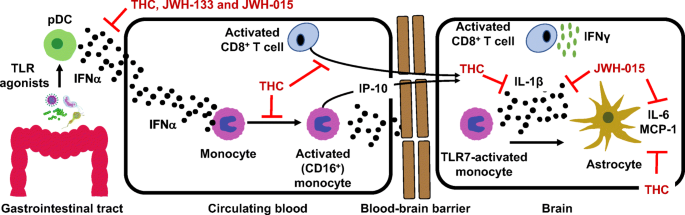
 “HIV infection leads to blood-brain barrier (BBB) dysfunction that does not resolve despite viral suppression on antiretroviral therapy and is associated with adverse clinical outcomes.
 “Neuropathic pain associated with nucleoside reverse transcriptase inhibitors (NRTIs), therapeutic agents for human immunodeficiency virus (HIV), responds poorly to available drugs.
 “Aging and HIV have adverse effects on the central nervous system, including increased inflammation and neural injury and confer risk of neurocognitive impairment (NCI).
 “HIV-associated neurocognitive disorder (HAND) affects nearly half of all HIV-infected individuals. Synaptodendritic damage correlates with neurocognitive decline in HAND, and many studies have demonstrated that HIV-induced neuronal injury results from excitotoxic and inflammatory mechanisms.
 “Heavy cannabis users had decreased frequencies of human leukocyte antigen (HLA)-DR+CD38+CD4+ and CD8+ T-cell frequencies, compared to frequencies of these cells in non-cannabis-using individuals.
 “Thanks to the success of modern antiretroviral therapy (ART), people living with HIV (PLWH) have life expectancies which approach that of persons in the general population. However, despite the ability of ART to suppress viral replication, PLWH have high levels of chronic systemic inflammation which drives the development of comorbidities such as cardiovascular disease, diabetes and non-AIDS associated malignancies.
 “Mortality among individuals co-infected with HIV and hepatitis C virus (HCV) is relatively high. We evaluated the association between psychoactive substance use and both HCV and non-HCV mortality in HIV/HCV co-infected patients in France, using Fine and Gray’s competing-risk model adjusted for socio-demographic, clinical predictors and confounding factors, while accounting for competing causes of death. Over a 5-year median follow-up period, 77 deaths occurred among 1028 patients.