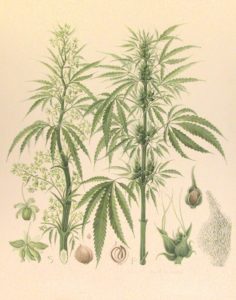
Synthetic and Patented Cannabinoids

“Historically, laboratory synthesis of cannabinoids were often based on the structure of herbal cannabinoids, and a large number of analogs have been produced and tested, especially in a group led by Roger Adams as early as 1941 and later in a group led by Raphael Mechoulam.

Newer compounds are no longer related to natural cannabinoids or are based on the structure of the endogenous cannabinoids.

Synthetic cannabinoids are particularly useful in experiments to determine the relationship between the structure and activity of cannabinoid compounds, by making systematic, incremental modifications of cannabinoid molecules.

Medications containing natural or synthetic cannabinoids or cannabinoid analogs:

  • Dronabinol (Marinol), is Δ9-tetrahydrocannabinol (THC), used as an appetite stimulant, anti-emetic, and analgesic
  • Nabilone (Cesamet), a synthetic cannabinoid and an analog of Marinol. It is Schedule II unlike Marinol, which is Schedule III
  • Sativex, a cannabinoid extract oral spray containing THC, CBD, and other cannabinoids used for neuropathic pain and spasticity in Canada and Spain. Sativex develops whole-plant cannabinoid medicines
  • Rimonabant (SR141716), a selective cannabinoid (CB1) receptor antagonist used as an anti-obesity drug under the proprietary name Acomplia. It is also used for smoking cessation

Other notable synthetic cannabinoids include:

  • CP-55940, produced in 1974, this synthetic cannabinoid receptor agonist is many times more potent than THC
  • Dimethylheptylpyran
  • HU-210, about 100 times as potent as THC
  • HU-331 a potential anti-cancer drug derived from cannabidiol that specifically inhibits topoisomerase II.
  • SR144528, a CB2 receptor antagonists
  • WIN 55, a potent cannabinoid receptor agonist
  • JWH-133, a potent selective CB2 receptor agonist
  • Levonantradol (Nantrodolum), an anti-emetic and analgesic but not currently in use in medicine”

http://www.news-medical.net/health/Synthetic-and-Patented-Cannabinoids.aspx

Cannabinoids – What are Cannabinoids?

“Cannabinoids are a group of terpenophenolic compounds present in Cannabis (”Cannabis sativa”) and occur naturally in the nervous and immune systems of animals.

The broader definition of cannabinoids refers to a group of substances that are structurally related to tetrahydrocannabinol (THC) or that bind to cannabinoid receptors.

The chemical definition encompasses a variety of distinct chemical classes: the classical cannabinoids structurally related to THC, the nonclassical cannabinoids, the aminoalkylindoles, the eicosanoids related to the endocannabinoids, 1, quinolines and arylsulphonamides, and additional compounds that do not fall into these standard classes but bind to cannabinoid receptors.

The term ”cannabinoids” also refers to a unique group of secondary metabolites found in the cannabis plant, which are responsible for the plant’s peculiar pharmacological effects.

At the present time, there are three general types of cannabinoids: ”phytocannabinoids” occur uniquely in the cannabis plant; ”endogenous cannabinoids” are produced in the bodies of humans and other animals; and ”synthetic cannabinoids” are similar compounds produced in a laboratory.”

http://www.news-medical.net/health/Cannabinoids-What-are-Cannabinoids.aspx

Cannabinoid Receptors

“Before the 1980s, it was often speculated that cannabinoids produced their physiological and behavioral effects via nonspecific interaction with cell membranes, instead of interacting with specific membrane-bound receptors.

The discovery of the first cannabinoid receptors in the 1980s helped to resolve this debate.

These receptors are common in animals, and have been found in mammals, birds, fish, and reptiles.

At present, there are two known types of cannabinoid receptors, termed CB1 and CB2, with mounting evidence of more.

Cannabinoid receptor type 1

CB1 receptors are found primarily in the brain, to be specific in the basal ganglia and in the limbic system, including the hippocampus.

They are also found in the cerebellum and in both male and female reproductive systems. CB1 receptors are absent in the medulla oblongata, the part of the brain stem responsible for respiratory and cardiovascular functions. Thus, there is not a risk of respiratory or cardiovascular failure as there is with many other drugs. CB1 receptors appear to be responsible for the euphoric and anticonvulsive effects of cannabis.

Cannabinoid receptor type 2

CB2 receptors are almost exclusively found in the immune system, with the greatest density in the spleen.

While found only in the peripheral nervous system, a report does indicate that CB2 is expressed by a subpopulation of microglia in the human cerebellum.

CB2 receptors appear to be responsible for the anti-inflammatory and possibly other therapeutic effects of cannabis.”

http://www.news-medical.net/health/Cannabinoid-Receptors.aspx

A Brief History of Medical Marijuana – TIME

“Should Professors Cheech and Chong ever receive university tenure teaching the medical history of their favorite subject, the course pack would be surprisingly thick.

As early as 2737 B.C., the mystical Emperor Shen Neng of China was prescribing marijuana tea for the treatment of gout, rheumatism, malaria and, oddly enough, poor memory. The drug’s popularity as a medicine spread throughout Asia, the Middle East and down the eastern coast of Africa, and certain Hindu sects in India used marijuana for religious purposes and stress relief. Ancient physicians prescribed marijuana for everything from pain relief to earache to childbirth…

By the late 18th century, early editions of American medical journals recommend hemp seeds and roots for the treatment of inflamed skin, incontinence and venereal disease. Irish doctor William O’Shaughnessy first popularized marijuana’s medical use in England and America. As a physician with the British East India Company, he found marijuana eased the pain of rheumatism and was helpful against discomfort and nausea in cases of rabies, cholera and tetanus.”

http://content.time.com/time/health/article/0,8599,1931247,00.html

Is marijuana bad for you?

“Hasn’t pot always been considered harmful?
Not at all. Marijuana, the dried form of the plant Cannabis sativa, was used as an herbal remedy for centuries in China, the Middle East, and Asia. William O’Shaughnessy, a physician for the East India Tea Company, brought it west in the 1830s as a treatment for rheumatism, tetanus, and rabies. It was commonly prescribed as a pain reliever in the U.S. until the 1930s, when its growing popularity caused such concern that the newly founded Federal Bureau of Narcotics reclassified it as a narcotic. The bureau soon launched a decidedly unscientific campaign claiming that marijuana use provoked insanity, homicidal tendencies, and uncontrollable lust. The marijuana user, the bureau asserted, “becomes a fiend with savage or ‘caveman’ tendencies. His sex desires are aroused, and some of the most horrible crimes result.””

Adolescents who smoked marijuana at least four times a week, lost an average of 8 IQ points between the ages of 13 and 38, according to a study from New Zealand.

“Was there any evidence for such claims?
None; in fact, the American Medical Association argued against marijuana prohibition in the 1930s, citing its therapeutic potential. But the bureau made its case that marijuana was “dangerous for the mind and the body,” and the federal government outlawed its use in 1937. It wasn’t until the 1970s that a campaign began to restore marijuana’s therapeutic reputation, and in 1996 California became the first state to legalize cannabis for medicinal purposes. Psychiatrist Tod Mikuriya, a founding father in the medical marijuana movement, claimed that cannabis has none of the adverse side effects of opiates. “In fact,” he said, “it really enhances both quality of life and rehabilitation.””

More: http://theweek.com/article/index/236671/is-marijuana-bad-for-you

Cannabis: Drink Your Medicine! A Poor Man’s Guide to Juicing

Add a handful of leaves (less stems)...

“There are currently two camps on curing cancer with cannabis: the hot process created by Canadian Rick Simpson some 13 years ago, and juicing raw leaves advocated by Dr. William Courtney of California. Both have had undeniable success in curing cancer and keeping serious illness at bay with the plant, heated or not…


Poor Man’s Juicing 101

Step 1

Remove stems. Rinse, soak, and rinse leaves again. (I soak overnight if leaves have been sprayed.)

Step 2

Add one heaping handful of leaves to blender.

Step 3

Add one cup of juice or water.

Step 4

Blend to “liquefy.”

Step 5

Strain into a container using a sieve.

Step 6

Store juice in glass jars. Juice will keep for a few days in the fridge.

Step 7

Freeze in ice cube trays or plastic containers, wrap in plastic and store in freezer for several weeks.” 


8. Freeze in plastic containers and turn out into plastic wrap. Drink as soon as thawed.


Smoking Cannabis Reduces Pain, Helps Sleep And Improves Mood For Those With Chronic Symptoms

“For patients with chronic (long-term) neuropathic pain, smoking cannabis was found to reduce symptoms of pain, improve mood and help sleep, a report published in CMAJ (Canadian Medical Journal Association) revealed. When damage or dysfunction of the nervous system results in chronic neuropathic pain, patients have few treatment options, such as antidepressants, local anesthetics, anticonvulsants or opioids. However, these medications often have undesirable side effects and do not work for everybody.

The authors inform that oral cannabinoids have been effective in reducing the symptoms of some types of pain. However, they many have different effects and risks compared to smoked cannabis.

Investigators from McGill University Health Centre (MUHC) and McGill University carried out a randomized, controlled trial to determine the analgesic effect of smoked cannabis in 21 patients, aged 18 years or more, all of them with chronic neuropathic pain. THC levels (drug potencies) were divided into 2.5%, 6% and 9.4%. Some participants also received a placebo (0%).

The researchers inform that there was a correlation between increased THC content and better sleep quality. Symptoms of depression and/or anxiety were also reduced at 9.5% THC level.”

More: http://www.medicalnewstoday.com/articles/199376.php

Cannabinoids ameliorate impairments induced by chronic stress to synaptic plasticity and short-term memory.

“Repeated stress is one of the environmental factors that precipitates and exacerbates mental illnesses like depression and anxiety as well as cognitive impairments. We have previously shown that cannabinoids can prevent the effects of acute stress on learning and memory.

Here we aimed to find whether chronic cannabinoid treatment would alleviate the long-term effects of exposure to chronic restraint stress on memory and plasticity as well as on behavioral and neuroendocrine measures of anxiety and depression. Late adolescence rats were exposed to chronic restraint stress for two weeks followed each day by systemic treatment with vehicle or with the CB1/2 receptor agonist WIN55,212-2 (1.2 mg/kg). Thirty days after the last exposure to stress, rats demonstrated impaired long-term potentiation (LTP) in the ventral subiculum (vSub)-nucleus accumbens (NAc) pathway, impaired performance in the prefrontal cortex (PFC)-dependent object recognition task and the hippocampal-dependent spatial version of this task, increased anxiety levels, and significantly reduced expression of glucocorticoid receptors (GRs) in the amygdala, hippocampus, PFC and NAc. Chronic WIN55,212-2 administration prevented the stress-induced impairment in LTP levels and in the spatial task, with no effect on stress-induced alterations in unconditioned anxiety levels or GR levels. The CB1 antagonist AM251 (0.3 mg/kg) prevented the ameliorating effects of WIN55,212-2 on LTP and short-term memory. Hence, the beneficial effects of WIN55,212-2 on memory and plasticity are mediated by CB1 receptors and are not mediated by alterations in GR levels in the brain areas tested.

 Our findings suggest that cannabinoid receptor activation could represent a novel approach to the treatment of cognitive deficits that accompany a variety of stress-related neuropsychiatric disorders.”

http://www.ncbi.nlm.nih.gov/pubmed/23426383

The effects of cannabidiol on the antigen-induced contraction of airways smooth muscle in the guinea-pig.

“(-)-Δ(9)-Tetrahydrocannabinol has been demonstrated to have beneficial effects in the airways, but its psychoactive effects preclude its therapeutic use for the treatment of airways diseases. In the present study we have investigated the effects of (-)-cannabidiol, a non-psychoactive component of cannabis for its actions on bronchial smooth muscle in vitro and in vivo.

 Guinea-pig bronchial smooth muscle contractions induced by exogenously applied spasmogens were measured isometrically. In addition, contractile responses of bronchial smooth muscle from ovalbumin-sensitized guinea-pigs were investigated in the absence or presence of (-)-cannabidiol. Furthermore, the effect of (-)-cannabidiol against ovalbumin-induced airway obstruction was investigated in vivo in ovalbumin-sensitized guinea pigs. (-)-Cannabidiol did not influence the bronchial smooth muscle contraction induced by carbachol, histamine or neurokinin A. In contrast, (-)-cannabidiol inhibited anandamide- and virodhamine-induced responses of isolated bronchi. A fatty acid amide hydrolase inhibitor, phenylmethanesulfonyl fluoride reversed the inhibitory effect of (-)-cannabidiol on anandamide-induced contractions. In addition, (-)-cannabidiol inhibited the contractile response of bronchi obtained from allergic guinea-pigs induced by ovalbumin. In vivo, (-)-cannabidiol reduced ovalbumin-induced airway obstruction.

 In conclusion, our results suggest that cannabidiol can influence antigen-induced airway smooth muscle tone suggesting that this molecule may have beneficial effects in the treatment of obstructive airway disorders.”

http://www.ncbi.nlm.nih.gov/pubmed/23428645

The trypanocidal effect of Cannabis sativa constituents in experimental animal trypanosomiasis.

Image result for cannabis sativa

“The effect of Cannabis sativa on trypanosome-infected rats was examined. An aqueous extract of the seeds administered at a dose of 50 mg/kg/d cured animals infected with Trypanosome brucei brucei of blood stream parasites.

Six fractions eluted from the crude extract by column chromatography were assessed for trypanocidal properties. Of these, only 2 fractions retained trypanocidal activity by curing mice infected with T brucei brucei.”

http://www.ncbi.nlm.nih.gov/pubmed/7900270

Related image

“Trypanosoma brucei is a species of parasitic kinetoplastid belonging to the genus Trypanosoma. The parasite is the cause of a vector-borne disease of vertebrate animals, including humans, carried by genera of tsetse fly in sub-Saharan Africa. In humans T. brucei causes African trypanosomiasis, or sleeping sickness.”  https://en.wikipedia.org/wiki/Trypanosoma_brucei

“A trypanocidal agent is an antiprotozoal agent that acts upon trypanosome parasites.”  https://en.wikipedia.org/wiki/Trypanocidal_agent