
 “Drugs selectively targeting CB2 hold promise for treating neurodegenerative disorders, inflammation, and pain while avoiding psychotropic side effects mediated by CB1. The mechanisms underlying CB2 activation and signaling are poorly understood but critical for drug design. Here we report the cryo-EM structure of the human CB2-Gi signaling complex bound to the agonist WIN 55,212-2. The 3D structure reveals the binding mode of WIN 55,212-2 and structural determinants for distinguishing CB2 agonists from antagonists, which are supported by a pair of rationally designed agonist and antagonist. Further structural analyses with computational docking results uncover the differences between CB2 and CB1 in receptor activation, ligand recognition, and Gi coupling. These findings are expected to facilitate rational structure-based discovery of drugs targeting the cannabinoid system.”
Activation and Signaling Mechanism Revealed by Cannabinoid Receptor-Gi Complex Structures.
“Human endocannabinoid systems modulate multiple physiological processes mainly through the activation of cannabinoid receptors CB1 and CB2. Their high sequence similarity, low agonist selectivity, and lack of activation and G protein-coupling knowledge have hindered the development of therapeutic applications. Importantly, missing structural information has significantly held back the development of promising CB2-selective agonist drugs for treating inflammatory and neuropathic pain without the psychoactivity of CB1. Here, we report the cryoelectron microscopy structures of synthetic cannabinoid-bound CB2 and CB1 in complex with Gi, as well as agonist-bound CB2 crystal structure. Of important scientific and therapeutic benefit, our results reveal a diverse activation and signaling mechanism, the structural basis of CB2-selective agonists design, and the unexpected interaction of cholesterol with CB1, suggestive of its endogenous allosteric modulating role.”
Cannabinoids in the descending pain modulatory circuit: Role in inflammation.
 “The legalization of cannabis in some states has intensified interest in the potential for cannabis and its constituents to lead to novel therapeutics for pain.
Our understanding of the cellular mechanisms underlying cannabinoid actions in the brain have lagged behind opioids; however, the current opioid epidemic has also increased attention on the use of cannabinoids as alternatives to opioids for pain, especially chronic pain that requires long-term use.
Endogenous cannabinoids are lipid signaling molecules that have complex roles in modulating neuronal function throughout the brain.
In this review, we discuss cannabinoid functions in the descending pain modulatory pathway, a brain circuit that integrates cognitive and emotional processing of pain to modulate incoming sensory inputs. In addition, we highlight areas where further studies are necessary to understand cannabinoid regulation of descending pain modulation.”
https://www.ncbi.nlm.nih.gov/pubmed/32004514
https://www.sciencedirect.com/science/article/abs/pii/S0163725820300231?via%3Dihub
Marijuana use and coronary artery disease in young adults.
 “This study aims to determine the frequency of coronary artery disease among young to middle aged adults presenting with chest pain who currently use marijuana as compared to nonusers.
Only 6.8% of the 146 marijuana users had evidence of coronary artery disease on coronary CT angiography. In comparison, the rate was 15.0% among the 1,274 marijuana nonusers.
A majority of marijuana users were younger than nonusers and had a lower frequency of hypertension and diabetes than nonusers.
There was no statistical difference in lipid panel values between the two groups.
CONCLUSION:
Among younger patients being evaluated for chest pain, self-reported cannabis use conferred no additional risk of coronary artery disease as detected on coronary CT angiography.”
https://www.ncbi.nlm.nih.gov/pubmed/31995626
“There is no association between marijuana use and the presence of coronary artery disease on coronary CT angiography in young to middle aged patients presenting with chest pain.”
https://journals.plos.org/plosone/article?id=10.1371/journal.pone.0228326
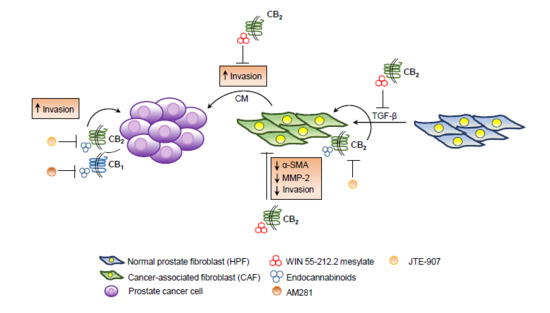
Treatment with Cannabinoids as a Promising Approach for Impairing Fibroblast Activation and Prostate Cancer Progression.
 “Endo-, phyto- and synthetic cannabinoids have been proposed as promising anti-cancer agents able to impair cancer cells’ behavior without affecting their non-transformed counterparts.
However, cancer outcome depends not only on cancer cells’ activity, but also on the stromal cells, which coevolve with cancer cells to sustain tumor progression.
Here, we show for the first time that cannabinoid treatment impairs the activation and the reactivity of cancer-associated fibroblasts (CAFs), the most represented stromal component of prostate tumor microenvironment.
Overall, our data strongly support the use of cannabinoids as anti-tumor agents in prostate cancer, since they are able to simultaneously strike both cancer and stromal cells.”
https://www.ncbi.nlm.nih.gov/pubmed/31991773
https://www.mdpi.com/1422-0067/21/3/787
Impact of Cannabinoids on Symptoms of Refractory Gastroparesis: A Single-center Experience.
“Cannabinoids are increasingly used for medicinal purposes, including neuropathy.
Gastroparesis is a neuromuscular disorder and neuropathy plays a large role in its pathogenesis. It is thus reasonable that cannabinoids can serve a beneficial role in the management of gastroparesis.
Our study evaluates the effect of cannabinoids on gastroparesis symptoms.
A significant improvement in the GCSI total symptom composite score was seen with either cannabinoid treatment (mean score difference of 12.8, 95% confidence interval 10.4-15.2; p-value < 0. 001). Patients prescribed marijuana experienced a statistically significant improvement in every GCSI symptom subgroup. Significant improvement in abdominal pain score was also seen with either cannabinoid treatment (mean score difference of 1.6; p-value <0.001).
Conclusions: Cannabinoids dramatically improve the symptoms of gastroparesis. Furthermore, an improvement in abdominal pain with cannabinoids represents a breakthrough for gastroparesis-associated abdominal pain treatment, for which there are currently no validated therapies.”
https://www.ncbi.nlm.nih.gov/pubmed/31993268
“In conclusion, cannabinoids dramatically improve refractory gastroparesis symptoms, including abdominal pain. Marijuana may be superior to dronabinol in improving these symptoms, though both cannabinoids seem to be promising as novel therapeutic options in gastroparesis.”
Normalization of mediotemporal and prefrontal activity, and mediotemporal-striatal connectivity, may underlie antipsychotic effects of cannabidiol in psychosis.
 “Recent evidence suggests that cannabidiol (CBD), a non-intoxicating ingredient present in cannabis extract, has an antipsychotic effect in people with established psychosis. However, the effect of CBD on the neurocognitive mechanisms underlying psychosis is unknown.
METHODS:
Patients with established psychosis on standard antipsychotic treatment were studied on separate days at least one week apart, to investigate the effects of a single dose of orally administered CBD (600 mg) compared to a matched placebo (PLB), using a double-blind, randomized, PLB-controlled, repeated-measures, within-subject cross-over design. Three hours after taking the study drug participants were scanned using a block design functional magnetic resonance imaging (fMRI) paradigm, while performing a verbal paired associate learning task. Fifteen psychosis patients completed both study days, 13 completed both scanning sessions. Nineteen healthy controls (HC) were also scanned using the same fMRI paradigm under identical conditions, but without any drug administration. Effects of CBD on brain activation measured using the blood oxygen level-dependent hemodynamic response fMRI signal were studied in the mediotemporal, prefrontal, and striatal regions of interest.
RESULTS:
Compared to HC, psychosis patients under PLB had altered prefrontal activation during verbal encoding, as well as altered mediotemporal and prefrontal activation and greater mediotemporal-striatal functional connectivity during verbal recall. CBD attenuated dysfunction in these regions such that activation under its influence was intermediate between the PLB condition and HC. CBD also attenuated hippocampal-striatal functional connectivity and caused trend-level symptom reduction in psychosis patients.
CONCLUSIONS:
This suggests that normalization of mediotemporal and prefrontal dysfunction and mediotemporal-striatal functional connectivity may underlie the antipsychotic effects of CBD.”
Cannabinoids for the Treatment of Chronic Pruritus: A Review.
 “Medical marijuana is becoming widely available to patients in the U.S. and with recreational marijuana now legalized in many states, patient interest is on the rise.
The endocannabinoid system plays an important role in skin homeostasis in addition to broader effects on neurogenic responses such as pruritus and nociception, inflammation, and immune reactions. There are numerous studies of in vitro and animal models that provide insight into the possible mechanisms of cannabinoid modulation on pruritus, with the most evidence behind neuronal modulation of both peripheral itch fibers and centrally-acting cannabinoid receptors.
In addition, human studies, while limited due to differences in cannabinoids used, disease models, and delivery method, have consistently shown significant reductions in both scratching and symptomatology in chronic pruritus. Clinical studies that have shown reduction in pruritus in several dermatologic (atopic dermatitis, psoriasis, asteatotic eczema, prurigo nodularis, allergic contact dermatitis) and systemic (uremic pruritus, cholestatic pruritus) diseases.
These preliminary human studies warrant controlled trials to confirm the benefit of cannabinoids for treatment of pruritus and to standardize treatment regimens and indications. In patients who have refractory chronic pruritus after standard therapies, cannabinoid formulations may be considered as an adjuvant therapy where it is legal.”
Endocannabinoid system in irritable bowel syndrome and cannabis as a therapy.
 “Irritable bowel syndrome (IBS) global burden is underestimated despite its high prevalence. It’s a gastrointestinal disease having obscure pathophysiology with multiple therapies yet unsatisfactory remedies.
The Endocannabinoid system (ECS) of our body plays a key role in maintaining normal physiology of the gastrointestinal tract as well as involves abnormalities including functional diseases like IBS. This review highlights the importance of the Endocannabinoid system, its connections with the normal gastrointestinal functions and abnormalities like IBS.
It also discusses the role of cannabis as medical therapy in IBS patients.
A literature search for articles related to endocannabinoids in IBS and medical cannabis in PubMed and Google Scholar was conducted. The studies highlighted the significant participation of ECS in IBS. However, the breach in obtaining the promising therapeutic model for IBS needed further investigation in ECS and uncover other treatments for IBS.
This review summarizes ECS, highlights the relationship of ECS with IBS and explores cannabis as a potential therapy to treat IBS.”
https://www.ncbi.nlm.nih.gov/pubmed/31987224
https://www.sciencedirect.com/science/article/pii/S0965229919310179?via%3Dihub
Tetrahydrocannabinol and Cannabidiol Use in an Outpatient Palliative Medicine Population.
 “Palliative medicine physicians are challenged by lack of guidance regarding effectiveness and dosing of cannabis products in the setting of their emerging popularity.
OBJECTIVE:
The aim of this study was to describe early patterns of tetrahydrocannabinol (THC) and cannabidiol (CBD) use in Florida following passage of the state’s first medical marijuana law. We describe here the perceived benefits, side effects, and beliefs expressed by patients in a single outpatient academic palliative medicine practice.
RESULTS:
In all, 24% (14/58) of respondents reported THC use, with half using THC on a daily basis. Patients reported improvements in pain, appetite, and nausea. In all, 71% (10/14) began using THC after the diagnosis of their chronic illness, and the most common form of usage was vaping. In all, 24% (14/58) of patients reported CBD use. Patients reported improvements in pain, and the most common form of usage was topical application. None of the patients had used CBD prior to the onset of their chronic illness. In all, 21% (3/14) of THC users and 21% (3/14) of CBD users thought that their substance was helping to cure their illness. Individual reported side effects in both groups were minimal.
CONCLUSIONS:
Approximately a quarter of outpatient palliative care patients use THC or CBD, often on a daily basis. Palliative care providers should be aware of the frequency, diverse usage, and beliefs behind cannabis product use in this patient population.”