
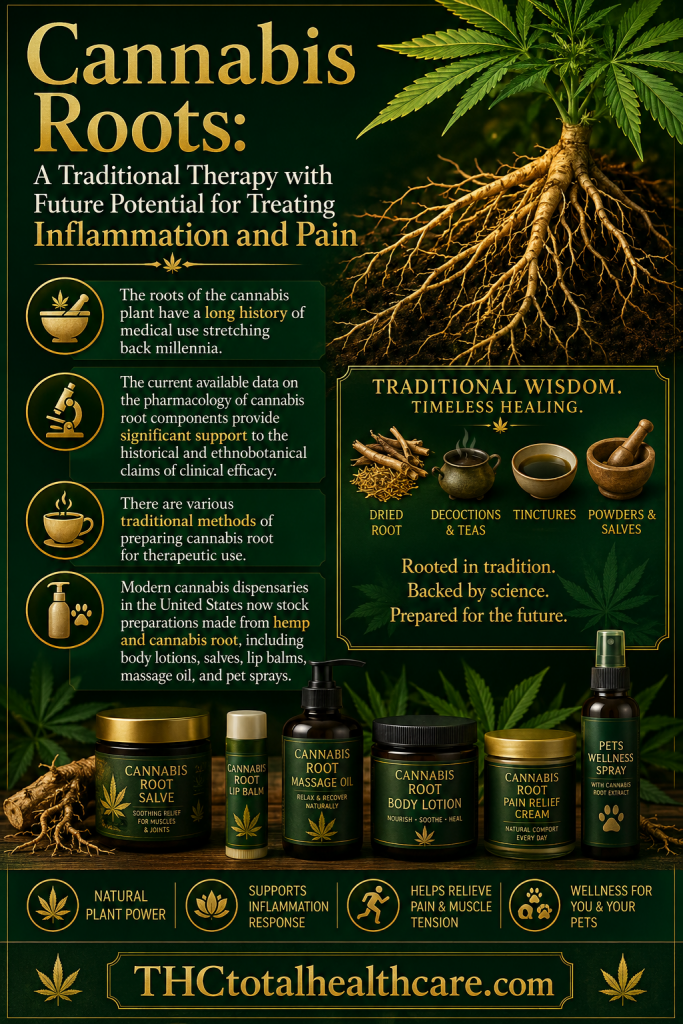
“Introduction: The roots of the cannabis plant have a long history of medical use stretching back millennia. However, the therapeutic potential of cannabis roots has been largely ignored in modern times.
Discussion: In the first century, Pliny the Elder described in Natural Histories that a decoction of the root in water could be used to relieve stiffness in the joints, gout, and related conditions. By the 17th century, various herbalists were recommending cannabis root to treat inflammation, joint pain, gout, and other conditions. There has been a subsequent paucity of research in this area, with only a few studies examining the composition of cannabis root and its medical potential. Active compounds identified and measured in cannabis roots include triterpenoids, friedelin (12.8 mg/kg) and epifriedelanol (21.3 mg/kg); alkaloids, cannabisativine (2.5 mg/kg) and anhydrocannabisativine (0.3 mg/kg); carvone and dihydrocarvone; N-(p-hydroxy-β-phenylethyl)-p-hydroxy-trans-cinnamamide (1.6 mg/kg); various sterols such as sitosterol (1.5%), campesterol (0.78%), and stigmasterol (0.56%); and other minor compounds, including choline. Of note, cannabis roots are not a significant source of Δ9-tetrahydrocannabinol (THC), cannabidiol, or other known phytocannabinoids.
Conclusion: The current available data on the pharmacology of cannabis root components provide significant support to the historical and ethnobotanical claims of clinical efficacy. Certainly, this suggests the need for reexamination of whole root preparations on inflammatory and malignant conditions employing modern scientific techniques.”
https://pubmed.ncbi.nlm.nih.gov/29082318
“There are various traditional methods of preparing cannabis root for therapeutic use.
The raw cannabis roots can be prepared by pounding and crushing the fresh root to extract its juices. There are numerous mentions of cannabis root preparations in water, especially boiling water, which suggest that early formulators were attempting to extract the water-soluble compounds in the roots. Throughout the 17th and 18th centuries, there are also many mentions of using cannabis root decoctions. The fresh ground root, juice, or cannabis root decoction has also been mixed with fat (oil or butter). There is also an account of mixing pulverized cannabis root with wine. Interestingly, topical applications of cannabis root-based preparations are most often described.
Modern cannabis dispensaries in the United States now stock preparations made from hemp and cannabis root, including body lotions, salves, lip balms, massage oil, and pet sprays.”
 “The cannabis plant and its active ingredients (i.e., cannabinoids and terpenoids) have been socially stigmatized for half a century. Luckily, with more than 430,000 published scientific papers and about 600 ongoing and completed clinical trials, nowadays cannabis is employed for the treatment of many different medical conditions. Nevertheless, even if a large amount of high-throughput functional genomic data exists, most researchers feature a strong background in molecular biology but lack advanced bioinformatics skills. In this work, publicly available gene expression datasets have been analyzed giving rise to a total of 40,224 gene expression profiles taken from cannabis plant tissue at different developmental stages. The resource presented here will provide researchers with a starting point for future investigations with Cannabis sativa.”