
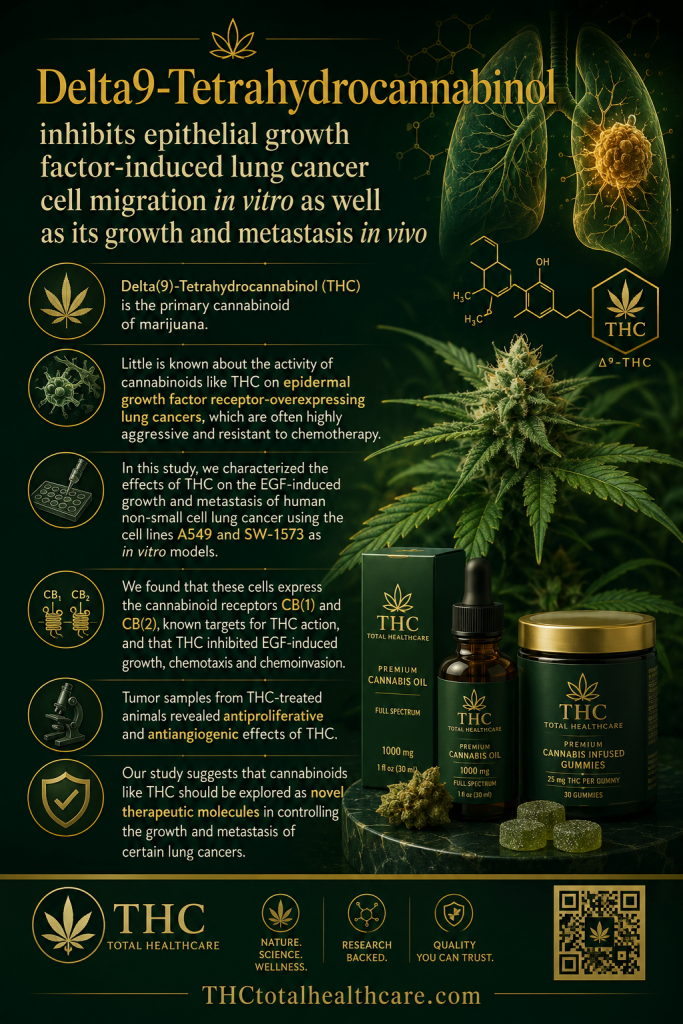
Delta9-Tetrahydrocannabinol inhibits epithelial growth factor-induced lung cancer cell migration in vitro as well as its growth and metastasis in vivo – Harvard Medical School

“Delta(9)-Tetrahydrocannabinol (THC) is the primary cannabinoid of marijuana and has been shown to either potentiate or inhibit tumor growth, depending on the type of cancer and its pathogenesis. Little is known about the activity of cannabinoids like THC on epidermal growth factor receptor-overexpressing lung cancers, which are often highly aggressive and resistant to chemotherapy. In this study, we characterized the effects of THC on the EGF-induced growth and metastasis of human non-small cell lung cancer using the cell lines A549 and SW-1573 as in vitro models. We found that these cells express the cannabinoid receptors CB(1) and CB(2), known targets for THC action, and that THC inhibited EGF-induced growth, chemotaxis and chemoinvasion. Moreover, signaling studies indicated that THC may act by inhibiting the EGF-induced phosphorylation of ERK1/2, JNK1/2 and AKT. THC also induced the phosphorylation of focal adhesion kinase at tyrosine 397. Additionally, in in vivo studies in severe combined immunodeficient mice, there was significant inhibition of the subcutaneous tumor growth and lung metastasis of A549 cells in THC-treated animals as compared to vehicle-treated controls. Tumor samples from THC-treated animals revealed antiproliferative and antiangiogenic effects of THC. Our study suggests that cannabinoids like THC should be explored as novel therapeutic molecules in controlling the growth and metastasis of certain lung cancers.”


http://www.ncbi.nlm.nih.gov/pubmed/17621270

Cannabinoid-associated cell death mechanisms in tumor models

“In recent years, cannabinoids (the active components of Cannabis sativa) and their derivatives have received considerable interest due to findings that they can affect the viability and invasiveness of a variety of different cancer cells. Moreover, in addition to their inhibitory effects on tumor growth and migration, angiogenesis and metastasis, the ability of these compounds to induce different pathways of cell death has been highlighted. Here, we review the most recent results generating interest in the field of death mechanisms induced by cannabinoids in cancer cells. In particular, we analyze the pathways triggered by cannabinoids to induce apoptosis or autophagy and investigate the interplay between the two processes. Overall, the results reported here suggest that the exploration of molecular mechanisms induced by cannabinoids in cancer cells can contribute to the development of safe and effective treatments in cancer therapy.”

http://www.ncbi.nlm.nih.gov/pubmed/22614735

Marijuana compound could stop aggressive cancer metastasis

“A compound found in cannabis could halt the spread of many forms of aggressive cancer, scientists have claimed.

Researchers found that the compound, called cannabidiol, had the ability to “switch off” the gene responsible for metastasis in an aggressive form of breast cancer, the Daily Mail reported.

Importantly, this substance does not produce the psychoactive properties of the cannabis plant.

The team from the California Pacific Medical Center, in San Francisco, first spotted its potential five years ago, after it stopped the proliferation of human breast cancer cells in the lab, the report said.

They discovered that the compound had turned off the overexpression of ID-1, stopping them from travelling to distant tissues.

Other potentially treatable cancers are forms of leukaemia, lung, ovarian and brain cancers, which also have high levels of ID-1.”

http://in.news.yahoo.com/marijuana-compound-could-stop-aggressive-cancer-metastasis-064950912.html

Cannabinoids for Cancer Treatment: Progress and Promise

“Cannabinoids are a class of pharmacologic compounds that offer potential applications as antitumor drugs, based on the ability of some members of this class to limit inflammation, cell proliferation, and cell survival. In particular, emerging evidence suggests that agonists of cannabinoid receptors expressed by tumor cells may offer a novel strategy to treat cancer. Here, we review recent work that raises interest in the development and exploration of potent, nontoxic, and nonhabit forming cannabinoids for cancer therapy.

 there is overwhelming evidence to suggest that cannabinoids can be explored as chemotherapeutic agents for the treatment of cancer.”

 http://cancerres.aacrjournals.org/content/68/2/339.long

The endocannabinoid system in the cancer therapy: an overview.

“The endocannabinoid system comprises the cannabinoid receptors type 1 (CB1) and type 2 (CB2), their endogenous ligands (endocannabinoids), and the proteins responsible for their biosynthesis and degradation. This ubiquitous signalling system, that has attracted a great deal of scientist interest in the past 15 years, regulates several physiological and pathological functions. In mammals, among other functions, the endocannabinoid is involved in nervous, cardiovascular, metabolic, reproductive and immune functions. Finally, yet importantly, endocannabinoids are known to exert important antiproliferative actions in a great number of tumor cells including breast, brain, skin, thyroid, prostate and colorectal. The following review describes our current knowledge on the effects of two of the most studied endocannabinoids (AEA and 2-AG) on various types of tumor and summarizes the possible mechanism of observed antitumor effects.”  http://www.ncbi.nlm.nih.gov/pubmed/21428888

http://www.eurekaselect.com/73874/article

The endocannabinoid system and cancer: therapeutic implication

Logo of brjpharm

“The endocannabinoid system is implicated in a variety of physiological and pathological conditions (inflammation, immunomodulation, analgesia, cancer and others).

The main active ingredient of cannabis, Δ(9) -tetrahydrocannabinol (Δ(9) -THC), produces its effects through activation of CB(1) and CB(2) receptors. CB(1) receptors are expressed at high levels in the central nervous system (CNS), whereas CB(2) receptors are concentrated predominantly, although not exclusively, in cells of the immune system.

Endocannabinoids are endogenous lipid-signalling molecules that are generated in the cell membrane from phospholipid precursors. The two best characterized endocannabinoids identified to date are anandamide (AEA) and 2-arachidonoylglycerol (2-AG). Here we review the relationship between the endocannabinoid system and anti-tumour actions (inhibition of cell proliferation and migration, induction of apoptosis, reduction of tumour growth) of the cannabinoids in different types of cancer.

This review will focus on examining how activation of the endocannabinoid system impacts breast, prostate and bone cancers in both in vitro and in vivo systems. The therapeutic potential of cannabinoids for cancer, as identified in clinical trials, is also discussed.

Identification of safe and effective treatments to manage and improve cancer therapy is critical to improve quality of life and reduce unnecessary suffering in cancer patients. In this regard, cannabis-like compounds offer therapeutic potential for the treatment of breast, prostate and bone cancer in patients.

Further basic research on anti-cancer properties of cannabinoids as well as clinical trials of cannabinoid therapeutic efficacy in breast, prostate and bone cancer is therefore warranted.” http://www.ncbi.nlm.nih.gov/pubmed/21410463

“The available literature suggests that the endocannabinoid system may be targeted to suppress the evolution and progression of breast, prostate and bone cancer as well as the accompanying pain syndromes. Many in vitro and in vivo studies have shown that cannabinoids are efficacious in reducing cancer progression (i.e. inhibition of tumour growth and metastases as well as induction of apoptosis and other anti-cancer properties) in breast, prostate and bone cancer. Although this review focuses on these three types of cancer, activation of the endocannabinoid signalling system produces anti-cancer effects in other types of cancer.” http://onlinelibrary.wiley.com/doi/10.1111/j.1476-5381.2011.01327.x/full

THC From Cannabis Destroys Cancer Cells

“The study results strongly suggest that if taken regularly, cannabis oil may be able to induce remission in leukemia patients without the horrendous side effects typically associated with standard radio-chemical treatment options. Although this is only one such study, other similar studies have shown equally impressive results.

 Many of the active ingredients found in cannabis-derived drugs show exceptional promise in treating some of the greatest hurdles facing modern medical science. In addition to their aforementioned capacity for safely treating certain forms of deadly cancer, they also show great promise in alleviating autoimmune conditions such as rheumatoid arthritis, multiple sclerosis, and even inflammatory bowel disease. A growing number of experts also note their possible viability treating a range of neurological disorders including Alzheimer’s and Lou Gehrig’s disease.”

http://www.globalhealingcenter.com/natural-health/thc-from-cannabis-destroys-cancer-cells/

Marijuana May Fight Lung Tumors – CBSNews

“the active ingredient in marijuana may help combat lung cancer, new research suggests.

Moreover, other early research suggests the cannabis compound could help fight brain, prostate, and skin cancers as well, Preet says.

The finding builds on the recent discovery of the body’s own cannabinoid system, Preet says. Known as endocannabinoids, the natural cannabinoids stimulate appetite and control pain and inflammation.

THC seeks out, attaches to, and activates two specific endocannabinoids that are present in high amounts on lung cancer cells, Preet says. This revs up their natural anti-inflammatory properties. Inflammation can promote the growth and spread of cancer.

In the new study, the researchers first demonstrated that THC inhibited the growth and spread of cells from two different lung cancer cell lines and from patient lung tumors. Then, they injected THC into mice that had been implanted with human lung cancer cells. After three weeks, tumors shrank by about 50 percent, compared with tumors in untreated mice.”

 http://www.cbsnews.com/2100-500368_162-2696726.html

Marijuana Compound May Fight Lung Cancer – ABCNews

“the active ingredient in pot may help fight lung cancer, new research shows.

Harvard University researchers have found that, in both laboratory and mouse studies, delta-tetrahydrocannabinol (THC) cuts tumor growth in half in common lung cancer while impeding the cancer’s ability to spread.

The compound “seems to have a suppressive effect on certain lines of cancer cells,” explained Dr. Len Horovitz, a pulmonary specialist at Lenox Hill Hospital in New York City.

According to the researchers, THC fights lung cancer by curbing epidermal growth factor (EGF), a molecule that promotes the growth and spread of particularly aggressive non-small cell lung cancers.”

http://abcnews.go.com/Health/Healthday/story?id=4506595

NBC News Reports that Cannabidiol (CBD) “Turns Off” the Cancer Gene Involved in Metastasis Findings by Scientists at California Pacific Medical Center gives Scientific Support for Cannabis Science Initiatives

“cannabidiol, (CBD), has the ability to “turn off” a gene that causes breast and other types of cancers to metastasize, according to the San Francisco Chronicle newspaper.

“What they found is that the cannabinoid turns off the overexpression of ID-1, which makes the cells lose their ability to travel to distant tissues. In other words, it keeps the cells more local and blocks their ability to metastasize. (spread to a new location) The researchers stressed cannabidiol works only on cancer cells that have these high levels of ID-1 and these do not include all cancerous tumors but, rather, aggressive, metastatic cells. But they’ve found such high levels in leukemia, colorectal, pancreatic, lung, ovarian, brain and other cancers.””

http://www.cnbc.com/id/49106127/NBC_News_Reports_that_Cannabidiol_CBD_Turns_Off_the_Cancer_Gene_Involved_in_Metastasis_Findings_by_Scientists_at_California_Pacific_Medical_Center_gives_Scientific_Support_for_Cannabis_Science_Initiatives