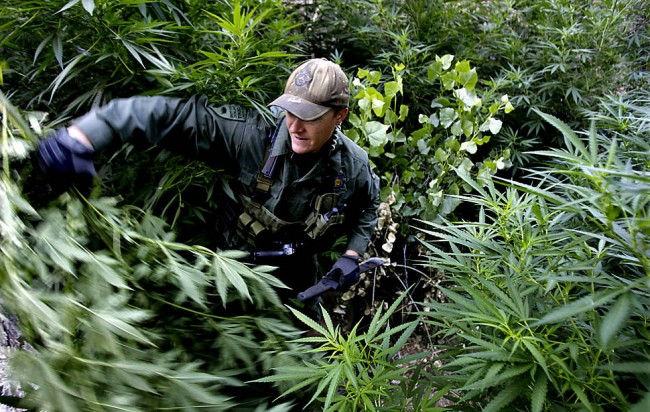
Marijuana Blood Sugar: A New Study Shows That Pot Smoking May Reduce Weight and Diabetes Risk

“A new study has shown there may be a link between marijuana and diabetes prevention.”
 
joint
 

“A new study has found that people who had used marijuana in the past month had smaller waists and lower levels of insulin resistance, which is a diabetes precursor, than those who had never tried the drug, according to Reuters.

“These are preliminary findings,” Dr. Murray Mittleman, who worked on the study at Beth Israel Deaconess Medical Center in Boston, told Reuters. “It looks like there may be some favorable effects on blood sugar control.”

More: http://www.travelerstoday.com/articles/6386/20130524/marijuana-blood-sugar-new-study-shows-pot-smoking-reduce-weight.htm

[From cannabis to selective CB2R agonists: molecules with numerous therapeutical virtues].

“Originally used in Asia for the treatment of pain, spasms, nausea and insomnia, marijuana is the most consumed psychotropic drug worldwide. The interest of medical cannabis has been reconsidered recently, leading to many scientific researches and commercialization of these drugs.

Natural and synthetic cannabinoids display beneficial antiemetic, anti-inflammatory and analgesic effects in numerous diseases, however accompanied with undesirable effects due to the CB1 receptor. Present researches focus on the design of therapeutical molecules targeting the CB2 receptors, and thus avoiding central side effects and therefore psychotropic effects caused by the CB1 receptor.”

http://www.ncbi.nlm.nih.gov/pubmed/23732102

Cannabinoid (CB)1 receptors are critical for the innate immune response to TLR4 stimulation.

“Sickness behaviours are host defence adaptations that arise from integrated autonomic outputs in response to activation of the innate immune system. These behaviours include fever, anorexia, and hyperalgesia intended to promote survival of the host when encountering pathogens. Cannabinoid (CB) receptor activation can induce hypothermia and attenuate lipopolysaccharide (LPS)-evoked fever. The aim of the present study was to examine the role of CB1 receptors in the LPS-evoked febrile response. CB1 receptor-deficient (CB1-/-) mice did not display LPS-evoked fever; likewise pharmacological blockade of CB1 receptors in wild-type mice blocked LPS-evoked fever. This unresponsiveness is not limited to thermogenesis, as the animals were not hyperalgesic after LPS administration. A toll-like receptor (TLR)3 agonist and viral mimetic polyinosinic:polycytidylic acid evoked a robust fever in CB1-/- mice suggesting TLR3-mediated responses are functional. LPS-evoked c-Fos activation in areas of the brain associated with the febrile response was evident in wild-type mice but not in CB1-/- mice. Liver and spleen TLR4 mRNA were significantly lower in CB1-/- mice compared to wild-type, and peritoneal macrophages from CB1-/- mice did not release pro-inflammatory cytokines in response to LPS. These data indicate that CB1 receptors play a critical role in LPS-induced febrile responses through inhibiting TLR4-mediated cytokine production.”

http://www.ncbi.nlm.nih.gov/pubmed/23739343

Medicinal Use of Marijuana — Polling Results – The New England Journal of Medicine

“Readers recently joined in a lively debate about the use of medicinal marijuana. In Clinical Decisions,1 an interactive feature in which experts discuss a controversial topic and readers vote and post comments, we presented the case of Marilyn, a 68-year-old woman with metastatic breast cancer. We asked whether she should be prescribed marijuana to help alleviate her symptoms. To frame this issue, we invited experts to present opposing viewpoints about the medicinal use of marijuana. J. Michael Bostwick, M.D., a professor of psychiatry at Mayo Clinic, proposed the use of marijuana “only when conservative options have failed for fully informed patients treated in ongoing therapeutic relationships.” Gary M. Reisfield, M.D., from the University of Florida, certified in anesthesiology and pain medicine, and Robert L. DuPont, M.D., a clinical professor of psychiatry at Georgetown Medical School, provide a counterpoint, concluding that “there is little scientific basis” for physicians to endorse smoked marijuana as a medical therapy.

We were surprised by the outcome of polling and comments, with 76% of all votes in favor of the use of marijuana for medicinal purposes — even though marijuana use is illegal in most countries. A total of 1446 votes were cast from 72 countries and 56 states and provinces in North America, and 118 comments were posted. However, despite the global participation, the vast majority of votes (1063) came from the United States, Canada, and Mexico. Given that North America represents only a minority of the general online readership of the Journal, this skew in voting suggests that the subject of this particular Clinical Decisions stirs more passion among readers from North America than among those residing elsewhere. Analysis of voting across all regions of North America showed that 76% of voters supported medicinal marijuana. Each state and province with at least 10 participants casting votes had more than 50% support for medicinal marijuana except Utah. In Utah, only 1% of 76 voters supported medicinal marijuana. Pennsylvania represented the opposite extreme, with 96% of 107 votes in support of medicinal marijuana.

Outside North America, we received the greatest participation from countries in Latin America and Europe, and overall results were similar to those of North America, with 78% of voters supporting the use of medicinal marijuana. All countries with 10 or more voters worldwide were at or above 50% in favor. There were only 43 votes from Asia and 7 votes from Africa, suggesting that in those continents, this topic does not resonate as much as other issues.

Where does this strong support for medicinal marijuana come from? Your comments show that individual perspectives were as polarized as the experts’ opinions. Physicians in favor of medicinal marijuana often focused on our responsibility as caregivers to alleviate suffering. Many pointed out the known dangers of prescription narcotics, supported patient choice, or described personal experience with patients who benefited from the use of marijuana. Those who opposed the use of medicinal marijuana targeted the lack of evidence, the lack of provenance, inconsistency of dosage, and concern about side effects, including psychosis. Common in this debate was the question of whether marijuana even belongs within the purview of physicians or whether the substance should be legalized and patients allowed to decide for themselves whether to make use of it.

In sum, the majority of clinicians would recommend the use of medicinal marijuana in certain circumstances. Large numbers of voices from all camps called for more research to move the discussion toward a stronger basis of evidence.”

http://www.nejm.org/doi/full/10.1056/NEJMclde1305159

“New England Journal of Medicine Endorses Medical Marijuana; San Francisco Medical Society Releases Study; New York Times Editorial Welcomes Debate” http://ndsn.org/feb97/nejm.html

Three out of four doctors recommend marijuana in New England Journal of Medicine poll

More than three out of four doctors support medical cannabis for a hypothetical breast cancer patient, New England Journal of Medicine reports“More than three out of four doctors support medical cannabis for a hypothetical breast cancer patient, New England Journal of Medicine reports

In a poll by the well-respected New England Journal of Medicine released today, more than three out of four doctors recommended medical cannabis for a hypothetical late-stage breast cancer patient.

“We were surprised by the outcome of polling and comments, with 76% of all votes in favor of the use of marijuana for medicinal purposes — even though marijuana use is illegal in most countries,” Jonathan N. Adler, M.D., and James A. Colbert, M.D. wrote for the NEJOM May 30th.

Marijuana is a federally illegal – schedule one drug – that the U.S. government claims has no medical value and is more dangerous than heroin or LSD. Yet 19 states have legalized cannabis for medical use, given its 10,000 year history as a safe herbal remedy for nausea, pain and insomnia among other conditions.”

More: http://blog.sfgate.com/smellthetruth/2013/05/30/three-out-of-four-doctors-recommend-marijuana-in-new-england-journal-of-medicine-poll/

Majority Support Medical Pot in New NEJM Poll

“To recommend, or not to recommend, medicinal marijuana? That’s the question recently posed in a New England Journal of Medicine interactive online poll. To get a feel for physicians’ opinions, NEJM presented readers with a fictional clinical situation. Here’s the scenario:

“Marilyn is a 68-year-old woman with breast cancer metastatic to the lungs and the thoracic and lumbar spine. She is currently undergoing chemotherapy with doxorubicin. She reports having very low energy, minimal appetite, and substantial pain in her thoracic and lumbar spine. For relief of nausea, she has taken ondansetron and prochlorperazine, with minimal success. She has been taking 1000 mg of acetaminophen every 8 hours for the pain. Sometimes at night she takes 5 mg or 10 mg of oxycodone to help provide pain relief. During a visit with her primary care physician she asks about the possibility of using marijuana to help alleviate the nausea, pain, and fatigue. She lives in a state that allows marijuana for personal medicinal use, and she says her family could grow the plants. As her physician, what advice would you offer with regard to the use of marijuana to alleviate her current symptoms? Do you believe that the overall medicinal benefits of marijuana outweigh the risks and potential harms?”

Readers weighed in with a variety of impassioned opinions. And the results, the authors said, were  surprising: 76% of respondents said they would recommend medicinal marijuana. Here’s part of the discussion:

“Physicians in favor of medicinal marijuana often focused on our responsibility as caregivers to alleviate suffering. Many pointed out the known dangers of prescription narcotics, supported patient choice, or described personal experience with patients who benefited from the use of marijuana. Those who opposed the use of medicinal marijuana targeted the lack of evidence, the lack of provenance, inconsistency of dosage, and concern about side effects, including psychosis. Common in this debate was the question of whether marijuana even belongs within the purview of physicians or whether the substance should be legalized and patients allowed to decide for themselves whether to make use of it.”” 

More: http://ripr.org/post/majority-support-medical-pot-new-nejm-poll 

Majority of Clinicians Support Medicinal Marijuana Use

“A majority of clinicians appears to support the use of medicinal marijuana, according to research published in the May 30 issue of the New England Journal of Medicine.”

Majority of Clinicians Support Medicinal Marijuana Use 
“(HealthDay News) – A majority of clinicians appears to support the use of medicinal marijuana, according to research published in the May 30 issue of the New England Journal of Medicine.
 

Jonathan N. Adler, MD, and James A. Colbert, MD, associate editors for the New England Journal of Medicine, describe the results of polling and comments in an interactive feature in which experts discussed the use of medicinal marijuana for a 68-year old woman with metastatic breast cancer.”

More: http://www.empr.com/majority-of-clinicians-support-medicinal-marijuana-use/article/295539/#

Survey: 76 percent of doctors approve of medical marijuana use – CBS

“A majority of doctors would approve the use of medical marijuana, according to a new survey.”

“”We were surprised by the outcome of polling and comments, with 76 percent of all votes in favor of the use of marijuana for medicinal purposes — even though marijuana use is illegal in most countries,” the survey’s authors wrote.

The results appeared in the New England Journal of Medicine on May 30. It included responses from 1,446 doctors from 72 different countries and 56 different states and provinces in North America. In addition, 118 doctors posted comments about their decision on the survey.

Doctors who said they would prescribe it talked a lot about the responsibility of caregivers to help minimize their patients suffering, their patients’ personal choice and the known dangers of prescription narcotics and painkillers. They also pointed out knowledge of personal cases where marijuana was able to help patients.”

More: http://www.cbsnews.com/8301-204_162-57587129/survey-76-percent-of-doctors-approve-of-medical-marijuana-use/

Marijuana first plants cultivated by man for medication (Update)

“Marijuana (Cannabis sativa L.) is one of the first plants cultivated by man. Shrouded in controversy, the intriguing history of cannabis as a medication dates back thousands of years before the era of Christianity.

Scientists believe the hemp plant originated in Asia. In 2737 B.C., Emperor Shen Neng of China prescribed tea brewed from marijuana leaves as a remedy for muscle injuries, rheumatism, gout, malaria, and memory loss. During the Bronze Age in 1400 B.C., cannabis was used throughout the eastern Mediterranean to ease the pain of childbirth and menstrual maladies.

More than 800 years before the birth of Christ, hemp was extensively cultivated in India for both its fiber and healing medicinal properties. William Brooke O’Shaughnessy, an Irish physician famous for his investigative research in pharmacology, is credited with introducing the therapeutic, healing properties of cannabis to Western medicine. During the 1830’s Dr. O’Shaughnessy, working for the British in India, conducted extensive experiments on lab animals. Encouraged by his results, Dr. O’Shaughnessy commenced patient treatment with marijuana for pain and muscle spasms. Further experiments indicated that marijuana was beneficial in the treatment of stomach cramps, migraine headaches, insomnia and nausea. Marijuana was also proven to be an effective anticonvulsant.

From the 1840s to the 1890s, hashish and marijuana extracts were among the most widely prescribed medications in the United States The 1850 United States Census records 8,327 marijuana plantations, each larger than 2000 acres. Recreational use of marijuana was not evident until early in the 20th century. Marijuana cigarettes became popular, introduced by migrants workers that brought marijuana with them from Mexico. With the onset of Prohibition, recreational use of marijuana skyrocketed. During the early 1930s, hash bars could be found all across the United States.

Although protested by the American Medical Association, the 1937 Marijuana Tax Act banned the cultivation and use of cannabis by federal law. Under the law, cultivation, distribution and consumption of cannabis products for medicinal, practical or recreational was criminalized and harsh penalties were implemented.”

More: http://guardianlv.com/2013/06/marijuana-first-plants-cultivated-by-man-for-medication/

marijuana

Phytocannabinoids

“Phytocannabinoids, also called ”natural cannabinoids”, ”herbal cannabinoids”, and ”classical cannabinoids”, are only known to occur naturally in significant quantity in the cannabis plant, and are concentrated in a viscous resin that is produced in glandular structures known as trichomes.

In addition to cannabinoids, the resin is rich in terpenes, which are largely responsible for the odour of the cannabis plant.

Phytocannabinoids are nearly insoluble in water but are soluble in lipids, alcohols, and other non-polar organic solvents. However, as phenols, they form more water-soluble phenolate salts under strongly alkaline conditions.

All-natural cannabinoids are derived from their respective 2-carboxylic acids (2-COOH) by decarboxylation (catalyzed by heat, light, or alkaline conditions).

Types

At least 66 cannabinoids have been isolated from the cannabis plant. To the right the main classes of natural cannabinoids are shown. All classes derive from cannabigerol-type compounds and differ mainly in the way this precursor is cyclized.

Tetrahydrocannabinol (THC), cannabidiol (CBD) and cannabinol (CBN) are the most prevalent natural cannabinoids and have received the most study. Other common cannabinoids are listed below:

  • CBG Cannabigerol
  • CBC Cannabichromene
  • CBL Cannabicyclol
  • CBV Cannabivarin
  • THCV Tetrahydrocannabivarin
  • CBDV Cannabidivarin
  • CBCV Cannabichromevarin
  • CBGV Cannabigerovarin
  • CBGM Cannabigerol Monoethyl Ether

Tetrahydrocannabinol

Tetrahydrocannabinol (THC) is the primary psychoactive component of the plant. It appears to ease moderate pain (analgetic) and to be neuroprotective. THC has approximately equal affinity for the CB1 and CB2 receptors. Its effects are perceived to be more cerebral.

”Delta”-9-Tetrahydrocannabinol (Δ9-THC, THC) and ”delta”-8-tetrahydrocannabinol (Δ8-THC), mimic the action of anandamide, a neurotransmitter produced naturally in the body. The THCs produce the ”high” associated with cannabis by binding to the CB1 cannabinoid receptors in the brain.

Cannabidiol

Cannabidiol (CBD) is not psychoactive, and was thought not to affect the psychoactivity of THC. However, recent evidence shows that smokers of cannabis with a higher CBD/THC ratio were less likely to experience schizophrenia-like symptoms.

This is supported by psychological tests, in which participants experience less intense psychotic effects when intravenous THC was co-administered with CBD (as measured with a PANSS test).

It has been hypothesized that CBD acts as an allosteric antagonist at the CB1 receptor and thus alters the psychoactive effects of THC.

It appears to relieve convulsion, inflammation, anxiety, and nausea. CBD has a greater affinity for the CB2 receptor than for the CB1 receptor.

Cannabigerol

Cannabigerol (CBG) is non-psychotomimetic but still affects the overall effects of Cannabis. It acts as an α2-adrenergic receptor agonist, 5-HT1A receptor antagonist, and CB1 receptor antagonist. It also binds to the CB2 receptor.

Tetrahydrocannabivarin

Tetrahydrocannabivarin (THCV) is prevalent in certain South African and Southeast Asian strains of Cannabis. It is an antagonist of THC at CB1 receptors and attenuates the psychoactive effects of THC.

Cannabichromene

Cannabichromene (CBC) is non-psychoactive and does not affect the psychoactivity of THC It is found in nearly all tissues in a wide range of animals.

Two analogs of anandamide, 7,10,13,16-docosatetraenoylethanolamide and ”homo”-γ-linolenoylethanolamine, have similar pharmacology.

All of these are members of a family of signalling lipids called ”N”-acylethanolamides, which also includes the noncannabimimetic palmitoylethanolamide and oleoylethanolamine, which possess anti-inflammatory and orexigenic effects, respectively. Many ”N”-acylethanolamines have also been identified in plant seeds and in molluscs.

  • 2-arachidonoyl glycerol (2-AG)

Another endocannabinoid, 2-arachidonoyl glycerol, binds to both the CB1 and CB2 receptors with similar affinity, acting as a full agonist at both, and there is some controversy over whether 2-AG rather than anandamide is chiefly responsible for endocannabinoid signalling ”in vivo”.

In particular, one ”in vitro” study suggests that 2-AG is capable of stimulating higher G-protein activation than anandamide, although the physiological implications of this finding are not yet known.

  • 2-arachidonyl glyceryl ether (noladin ether)

In 2001, a third, ether-type endocannabinoid, 2-arachidonyl glyceryl ether (noladin ether), was isolated from porcine brain.

Prior to this discovery, it had been synthesized as a stable analog of 2-AG; indeed, some controversy remains over its classification as an endocannabinoid, as another group failed to detect the substance at “any appreciable amount” in the brains of several different mammalian species.

It binds to the CB1 cannabinoid receptor (”K”i = 21.2 nmol/L) and causes sedation, hypothermia, intestinal immobility, and mild antinociception in mice. It binds primarily to the CB1 receptor, and only weakly to the CB2 receptor.

Like anandamide, NADA is also an agonist for the vanilloid receptor subtype 1 (TRPV1), a member of the vanilloid receptor family.

  • Virodhamine (OAE)

A fifth endocannabinoid, virodhamine, or ”O”-arachidonoyl-ethanolamine (OAE), was discovered in June 2002. Although it is a full agonist at CB2 and a partial agonist at CB1, it behaves as a CB1 antagonist ”in vivo”.

In rats, virodhamine was found to be present at comparable or slightly lower concentrations than anandamide in the brain, but 2- to 9-fold higher concentrations peripherally.

Function

Endocannabinoids serve as intercellular ‘lipid messengers’, signaling molecules that are released from one cell and activate the cannabinoid receptors present on other nearby cells.

Although in this intercellular signaling role they are similar to the well-known monoamine neurotransmitters, such as acetylcholine and dopamine, endocannabinoids differ in numerous ways from them. For instance, they use retrograde signaling.

Furthermore, endocannabinoids are lipophilic molecules that are not very soluble in water. They are not stored in vesicles, and exist as integral constituents of the membrane bilayers that make up cells. They are believed to be synthesized ‘on-demand’ rather than made and stored for later use.

The mechanisms and enzymes underlying the biosynthesis of endocannabinoids remain elusive and continue to be an area of active research.

The endocannabinoid 2-AG has been found in bovine and human maternal milk.

Retrograde signal

Conventional neurotransmitters are released from a ‘presynaptic’ cell and activate appropriate receptors on a ‘postsynaptic’ cell, where presynaptic and postsynaptic designate the sending and receiving sides of a synapse, respectively.

Endocannabinoids, on the other hand, are described as retrograde transmitters because they most commonly travel ‘backwards’ against the usual synaptic transmitter flow.

They are, in effect, released from the postsynaptic cell and act on the presynaptic cell, where the target receptors are densely concentrated on axonal terminals in the zones from which conventional neurotransmitters are released.

Activation of cannabinoid receptors temporarily reduces the amount of conventional neurotransmitter released.

This endocannabinoid mediated system permits the postsynaptic cell to control its own incoming synaptic traffic.

The ultimate effect on the endocannabinoid-releasing cell depends on the nature of the conventional transmitter being controlled.

For instance, when the release of the inhibitory transmitter GABA is reduced, the net effect is an increase in the excitability of the endocannabinoid-releasing cell.

On the converse, when release of the excitatory neurotransmitter glutamate is reduced, the net effect is a decrease in the excitability of the endocannabinoid-releasing cell.

Range

Endocannabinoids are hydrophobic molecules. They cannot travel unaided for long distances in the aqueous medium surrounding the cells from which they are released, and therefore act locally on nearby target cells. Hence, although emanating diffusely from their source cells, they have much more restricted spheres of influence than do hormones, which can affect cells throughout the body.

Other thoughts

Endocannabinoids constitute a versatile system for affecting neuronal network properties in the nervous system.

”Scientific American” published an article in December 2004, entitled “The Brain’s Own Marijuana” discussing the endogenous cannabinoid system.

The current understanding recognizes the role that endocannabinoids play in almost every major life function in the human body.

U.S. Patent # 6630507

In 2003 The U.S.A.’s Government as represented by the Department of Health and Human Services was awarded a patent on cannabinoids as antioxidants and neuroprotectants. U.S. Patent 6630507.”

http://www.news-medical.net/health/Phytocannabinoids.aspx