
 “Inflammasomes are cytoplasmic inflammatory signaling protein complexes that detect microbial materials, sterile inflammatory insults, and certain host-derived elements. Inflammasomes, once activated, promote caspase-1-mediated maturation and secretion of pro-inflammatory cytokines, interleukin (IL)-1β and IL-18, leading to pyroptosis. Current advances in inflammasome research support their involvement in the development of chronic inflammatory disorders in contrast to their role in regulating innate immunity.
Cannabis (marijuana) is a natural product obtained from the Cannabis sativa plant, and pharmacologically active ingredients of the plant are referred to as cannabinoids. Cannabinoids and cannabis extracts have recently emerged as promising novel drugs for chronic medical conditions. Growing evidence indicates the potent anti-inflammatory potential of cannabinoids, especially Δ9-tetrahydrocannabinol (Δ9-THC), cannabidiol (CBD), and synthetic cannabinoids; however, the mechanisms remain unclear. Several attempts have been made to decipher the role of cannabinoids in modulating inflammasome signaling in the etiology of chronic inflammatory diseases.
In this review, we discuss recently published evidence on the effect of cannabinoids on inflammasome signaling. We also discuss the contribution of various cannabinoids in human diseases concerning inflammasome regulation. Lastly, in the milieu of coronavirus disease-2019 (COVID-19) pandemic, we confer available evidence linking inflammasome activation to the pathophysiology of COVID-19 suggesting overall, the importance of cannabinoids as possible drugs to target inflammasome activation in or to support the treatment of a variety of human disorders including COVID-19.”
https://pubmed.ncbi.nlm.nih.gov/33584697/
“Cannabis has been shown to possess anti-inflammatory effects owing to its constituents, cannabinoids and terpenoids. Overall, cannabinoids hold a great promise as additional therapeutics to support the current treatment of chronic inflammatory diseases, along with COVID-19”
https://www.frontiersin.org/articles/10.3389/fimmu.2020.613613/full
 “This study aims to add evidence regarding the impact marijuana use has on the prevalence of cardiovascular disease.
 “Plant-based therapies date back centuries. Cannabis sativa is one such plant that was used medicinally up until the early part of the 20th century.
 “Cannabis sativa L. is an aromatic annual herb belonging to the family Cannabaceae and it is widely distributed worldwide. Cultivation, selling, and consumption of cannabis and cannabis related products, regardless of its use, was prohibited in Lebanon until April 22, 2020. Nevertheless, cannabis oil has been traditionally used unlawfully for many years in Lebanon to treat diseases such as arthritis, diabetes, cancer and few neurological disorders.
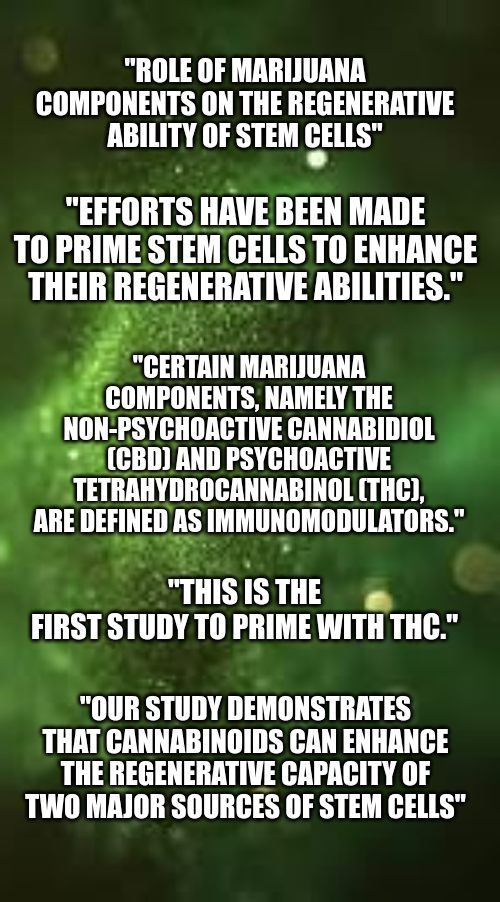
 “Stem cell therapy promotes tissue regeneration and wound healing. Efforts have been made to prime stem cells to enhance their regenerative abilities.
 “A significant number of cannabinoids are known to have analgesic and anti-inflammatory properties in various diseases. Due to their presynaptic/terminal location, cannabinoid receptors can inhibit synaptic transmission and have the potential to regulate neurogenic inflammation. Neurogenic inflammation occurs when a noxious signal is detected in the periphery initiating an antidromic axon reflex in the same sensory neurone leading to depolarization of the afferent terminal. Neuropeptides are subsequently released and contribute to vasodilation, plasma extravasation and modulation of immune cells. Endocannabinoids, synthetic cannabinoids and phytocannabinoids can reduce neuroinflammation by inhibiting afferent firing and inflammatory neuropeptide release. Thus, in addition to a direct effect on vascular smooth muscle and inflammatory cells, cannabinoids can reduce inflammation by silencing small diameter neurones. This review examines the neuropharmacological processes involved in regulating antidromic depolarization of afferent nerve terminals by cannabinoids and the control of neurogenic inflammation in different diseases.”
 “Effective treatment choices to the severe acute respiratory syndrome coronavirus-2 (SARS-CoV-2) are limited because of the absence of effective target-based therapeutics. The main object of the current research was to estimate the antiviral activity of cannabinoids (CBDs) against the human coronavirus SARS-CoV-2.
 “Chronic adolescent exposure to Δ-9-Tetrahydrocannabinol (THC) is linked to elevated neuropsychiatric risk and induces neuronal, molecular and behavioural abnormalities resembling neuropsychiatric endophenotypes. Previous evidence has revealed that the mesocorticolimbic circuitry, including the prefrontal cortex (PFC) and mesolimbic dopamine (DA) pathway are particularly susceptible to THC-induced pathological alterations, including dysregulation of DAergic activity states, loss of PFC GABAergic inhibitory control and affective and cognitive abnormalities. There are currently limited pharmacological intervention strategies capable of preventing THC-induced neuropathological adaptations.
 “Cannabis sativa is a well-known plant which has been of benefit since ancient times in several medicinal systems, including Chinese, Indian, Greek and Egyptian ones.