“Numerous physical, psychological, and emotional benefits have been attributed to marijuana since its first reported use in 2,600 BC in a Chinese pharmacopoeia. The phytocannabinoids, cannabidiol (CBD), and delta-9-tetrahydrocannabinol (Δ9-THC) are the most studied extracts from cannabis sativa subspecies hemp and marijuana. CBD and Δ9-THC interact uniquely with the endocannabinoid system (ECS). Through direct and indirect actions, intrinsic endocannabinoids and plant-based phytocannabinoids modulate and influence a variety of physiological systems influenced by the ECS.
Category Archives: Brain Cancer
INSIGHT ON THE IMPACT OF ENDOCANNABINOID SYSTEM IN CANCER: A REVIEW.
 “In the last decades, the endocannabinoid system has attracted a great interest in medicine and cancer disease is probably one of its most promising therapeutic areas.
On the one hand, endocannabinoid system expression has been found altered in numerous types of tumours compared to healthy tissue, and this aberrant expression has been related to cancer prognosis and disease outcome, suggesting a role of this system in tumour growth and progression that depends on cancer type.
On the other hand, it has been reported that cannabinoids exert an anticancer activity by inhibiting the proliferation, migration and/or invasion of cancer cells; and also tumour angiogenesis.
The endocannabinoid system may be considered as a new therapeutic target, although further studies to fully establish the effect of cannabinoids on tumour progression remain necessary.”
https://www.ncbi.nlm.nih.gov/pubmed/29663308
“In the last decades, the endocannabinoid system has attracted a great interest in medicine and cancer disease is probably one of its most promising therapeutic areas.
On the one hand, endocannabinoid system expression has been found altered in numerous types of tumours compared to healthy tissue, and this aberrant expression has been related to cancer prognosis and disease outcome, suggesting a role of this system in tumour growth and progression that depends on cancer type.
On the other hand, it has been reported that cannabinoids exert an anticancer activity by inhibiting the proliferation, migration and/or invasion of cancer cells; and also tumour angiogenesis.
The endocannabinoid system may be considered as a new therapeutic target, although further studies to fully establish the effect of cannabinoids on tumour progression remain necessary.”
https://www.ncbi.nlm.nih.gov/pubmed/29663308
The use of cannabis in supportive care and treatment of brain tumor
“Anticancer Effects of Cannabinoids may be able to Prolong Life.
Cannabinoids are multitarget substances. Currently available are dronabinol (synthetic delta-9-tetrahydrocannabinol, THC), synthetic cannabidiol (CBD) the respective substances isolated and purified from cannabis, a refined extract, nabiximols (THC:CBD = 1.08:1.00); and nabilone, which is also synthetic and has properties that are very similar to those of THC. Cannabinoids have a role in the treatment of cancer as palliative interventions against nausea, vomiting, pain, anxiety, and sleep disturbances. THC and nabilone are also used for anorexia and weight loss, whereas CBD has no orexigenic effect. The psychotropic effects of THC and nabilone, although often undesirable, can improve mood when administered in low doses. CBD has no psychotropic effects; it is anxiolytic and antidepressive. Of particular interest are glioma studies in animals where relatively high doses of CBD and THC demonstrated significant regression of tumor volumes (approximately 50% to 95% and even complete eradication in rare cases). Concomitant treatment with X-rays or temozolomide enhanced activity further. Similarly, a combination of THC with CBD showed synergistic effects. Although many questions, such as on optimized treatment schedules, are still unresolved, today’s scientific results suggest that cannabinoids could play an important role in palliative care of brain tumor patients. THC, a partial CB1, CB2 agonist, has the stigma of psychotropic effects that are mediated by CB1 stimulation. However, CB1 stimulation is necessary for improving mood and appetite and many other effects. At present, it is hard to imagine a better approach than adjusting THC doses individually to balance wanted versus unwanted effects. Generally, higher doses are needed to achieve analgesic and antiemetic effects. Even much higher, supraphysiologic oral doses would be needed to combat tumors. Combinations were synergistic under many circumstances such as in pain and antitumor studies. Cannabinoids differ in their antitumor activities and probably in their mechanisms and targets, which is a rationale for combinations. However, for many pharmacological effects (except against tumors) roughly 10-times higher daily doses are needed for CBD compared to THC. In summary, the endocannabinoid system is likely playing a crucial role in palliative care. The future will show whether an optimized treatment strategy with cannabinoids can also prolong life of brain tumor patients by their virtue to combat cancer cells.”https://academic.oup.com/nop/article/4/3/151/2918616
“Cannabinoid Drug Prolongs the Life of Brain Tumor Patients in Phase II Trials” https://labiotech.eu/gw-pharmaceuticals-brain-tumor/
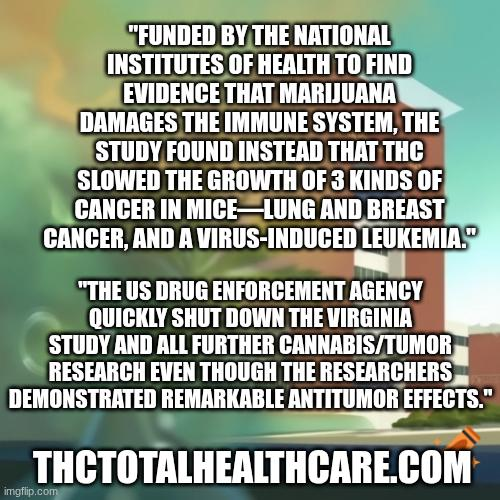
]]>“Funded by the National Institutes of Health to find evidence that marijuana damages the immune system, the study found instead that THC slowed the growth of 3 kinds of cancer in mice—lung and breast cancer, and a virus-induced leukemia. The US Drug Enforcement Agency quickly shut down the Virginia study and all further cannabis/tumor research even though the researchers demonstrated remarkable antitumor effects.”
CBD Enhances the Anticancer Effects of THC

“Δ9-Tetrahydrocannabinol (Δ9-THC) and other cannabinoids can act as direct anticancer agents in multiple types of cancer in culture and in vivo.
Cannabidiol Enhances the Inhibitory Effects of Δ9-Tetrahydrocannabinol on Human GlioblastomaCell Proliferation and Survival.
Δ9-THC and Cannabidiol Inhibit the Growth of Multiple Glioblastoma Cell Lines.
Cannabidiol Enhances the Inhibitory Effects of Δ9-THC on Glioblastoma Cell Growth.
Combination treatments with cannabinoids may improve overall efficacy”


 “Glioblastoma (GBM) is the most common primary malignant brain tumor in adults. The challenging problem in cancer treatment is to find a way to upregulate radiosensitivity of GBM while protecting neurons and neural stem/progenitor cells in the brain. The goal of the present study was upregulation of the cytotoxic effect of γ-irradiation in GBM by non-psychotropic and non-toxic