“Genus Cannabis belong to family Cannabaceae and is traditionally used as medicinal plant against many diseases notably asthma, malaria, treatment of skin diseases, diabetes and headache. The plant Cannabis sativa L. is flowering and an annual herbaceous plant located to eastern Asia but now of cosmopolitan distribution due to extensive cultivation.
Aim of the study: The aim of review is to provide a complete evaluation of the botanical, ethnological and chemical aspects of Cannabis sativa L., and its importance in pharmacological studies.
Results and discussions: This article briefly reviews the botany, traditional knowledge, pharmacological and therapeutic application of the plant C. sativa. This is an attempt to compile and document information about the chemical constituent, pharmacological and therapeutic effects of C. sativa as important herbal drug due to its safety and effectiveness. Studies have revealed its use as anti-bacterial, anti-fungal, anti-cancer, anti-inflammatory and improving testicular function in rats. Consumption of C. sativa is greater in all over the world among all other drugs of abuse in its various forms such as marijuana, hashish and cannabis oil. The study of herbal medicine spans the knowledge of biology, history, source, physical and chemical nature, and mechanism of action, traditional, medicinal and therapeutic use of drug. This article also provide knowledge about macroscopically and microscopically characters of Cannabis sativa with geographical sources. The wellknown cannabinoids are Tetrahydrocannabinol (THC), Cannabidiol (CBD) and Cannabichromene (CBC) and their pharmacological properties and importance have been extensively studied. Hence, efforts are required to establish and validate evidence regarding safety and practices of Ayurveda medicines.
Conclusion: Thes studies will help in expanding the current therapeutic potential of C. sativa and it also provide a strong support to its future clinical use as herbal medicines having safe in use with no side effects.”
 “The prevalence rates of depression and anxiety are at least two times higher in diabetic patients, increasing morbidity and mortality.
 “The synthetic atypical cannabinoid Abn-CBD, a
  “Phytocannabinoids (pCBs) are a large family of meroterpenoids isolated from the plant Cannabis sativa. Δ9-Tetrahydrocannabinol (THC) and cannabidiol (CBD) are the best investigated phytocannabinoids due to their relative abundance and interesting bioactivity profiles. In addition to various targets, THC and CBD are also well-known agonists of peroxisome proliferator-activated receptor gamma (PPARγ), a nuclear receptor involved in energy homeostasis and lipid metabolism. In the search of new pCBs potentially acting as PPARγ agonists, we identified cannabimovone (CBM), a structurally unique abeo-menthane pCB, as a novel PPARγ modulator via a combined computational and experimental approach. The ability of CBM to act as dual PPARγ/α agonist was also evaluated. Computational studies suggested a different binding mode toward the two isoforms, with the compound able to recapitulate the pattern of H-bonds of a canonical agonist only in the case of PPARγ. Luciferase assays confirmed the computational results, showing a selective activation of PPARγ by CBM in the low micromolar range. CBM promoted the expression of PPARγ target genes regulating the adipocyte differentiation and prevented palmitate-induced insulin signaling impairment. Altogether, these results candidate CBM as a novel bioactive compound potentially useful for the treatment of insulin resistance-related disorders.”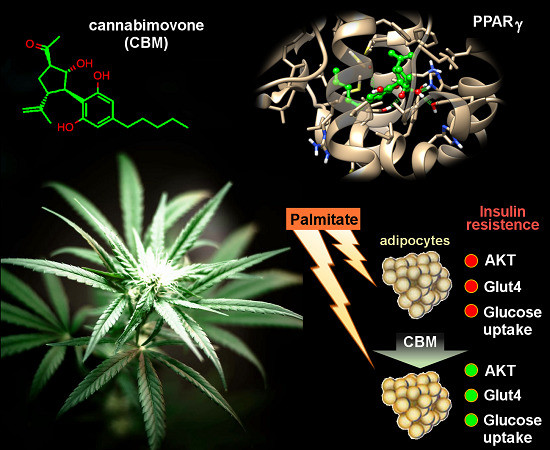
 “Cardiovascular complications are the major cause of mortality in diabetic patients. However, the molecular mechanisms underlying diabetes-associated arrhythmias are unclear.
 “The cellular microenvironment plays a critical role in the maintenance of bone marrow-derived mesenchymal stem cells (BM-MSCs) and their subsequent cell lineage differentiation. Recent studies suggested that individuals with adipocyte-related metabolic disorders have altered function and adipogenic potential of adipose stem cell subpopulations, primarily BM-MSCs, increasing the risk of heart attack, stroke or diabetes.
 “Beta-caryophyllene (BCP) is a flavoring agent, whereas l-arginine (LA) is used as a food supplement.
 “Confident relationships between diabetes and liver damage have previously been established.
 “Endocannabinoid system consists of