
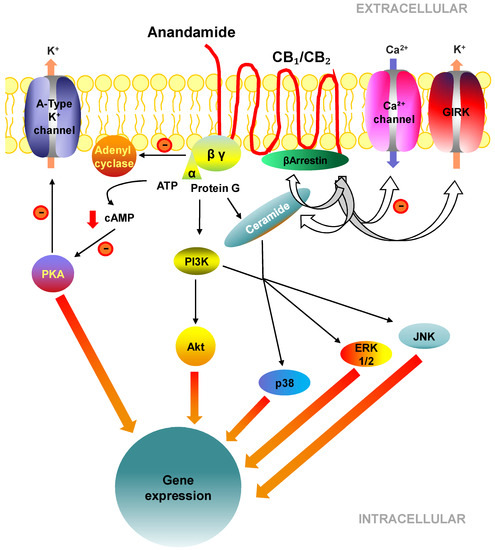
 “Hepatic fibrosis is the consequence of an unresolved wound healing process in response to chronic liver injury and involves multiple cell types and molecular mechanisms. The hepatic endocannabinoid and apelin systems are two signalling pathways with a substantial role in the liver fibrosis pathophysiology-both are upregulated in patients with advanced liver disease. Endogenous cannabinoids are lipid-signalling molecules derived from arachidonic acid involved in the pathogenesis of cardiovascular dysfunction, portal hypertension, liver fibrosis, and other processes associated with hepatic disease through their interactions with the CB1 and CB2 receptors. Apelin is a peptide that participates in cardiovascular and renal functions, inflammation, angiogenesis, and hepatic fibrosis through its interaction with the APJ receptor. The endocannabinoid and apelin systems are two of the multiple cell-signalling pathways involved in the transformation of quiescent hepatic stellate cells into myofibroblast like cells, the main matrix-producing cells in liver fibrosis. The mechanisms underlying the control of hepatic stellate cell activity are coincident despite the marked dissimilarities between the endocannabinoid and apelin signalling pathways. This review discusses the current understanding of the molecular and cellular mechanisms by which the hepatic endocannabinoid and apelin systems play a significant role in the pathophysiology of liver fibrosis.”
Category Archives: Endocannabinoid System
Medical Marijuana Guidelines for Practice: Health Policy Implications.
 “Cannabis use in pediatric health care remains limited, however, there is increasing evidence on the pharmacologic benefits of medical marijuana for chronic conditions in childhood. Realizing the need for guidance in practice, the National Council of State Boards of Nursing (NCSBN) published guidelines to aid in decision making in nursing practice. While focusing primarily on adult use of cannabis, the guidelines do address special populations such as children and adolescents. This article reviews the endocannabinoid system, current state of legislation on medical marijuana, policy considerations, recent FDA approval of a cannabis product for pediatric use, NCSBN National Nursing Guidelines for Medical Marijuana, and pediatric implications for nursing practice.”
https://www.ncbi.nlm.nih.gov/pubmed/31655786
https://www.jpedhc.org/article/S0891-5245(19)30399-2/fulltext
Effects of Cannabis and Its Components on the Retina: A Systematic Review.
 “Cannabis is the most prevalent drug in the world and its consumption is growing. Cannabinoid receptors are present in the human central nervous system. Recent studies show evidence of the effects of cannabinoids on the retina, and synthesizing the results of these studies may be relevant for ophthalmologists. Thus, this review adopts standardized, systematic review methodology to investigate the effects of exposure to cannabis and components on the retina.
RESULTS:
We retrieved 495 studies, screened 229 studies, assessed 52 studies for eligibility, and included 16 studies for qualitative analysis. The cannabinoids most frequently investigated were delta-9-tetrahydrocannabinol (THC), abnormal cannabidiol, synthetic cannabinoid, and cannabidiol (CDB). The outcomes most studied were neuroretinal dysfunction, followed by vascular effects. The studies also included investigation of neuroprotective and anti-inflammatory effects and teratogenic effects.
CONCLUSIONS:
This review suggests that cannabinoids may have an important role in retinal processing and function.”
https://www.ncbi.nlm.nih.gov/pubmed/31648567
https://www.tandfonline.com/doi/abs/10.1080/15569527.2019.1685534?journalCode=icot20
A time-dependent contribution of hippocampal CB1, CB2, and PPARγ receptors to cannabidiol-induced disruption of fear memory consolidation.
 “Preclinical studies have shown that cannabidiol (CBD) mitigates fear memories by facilitating their extinction or interfering with their generalization and reconsolidation. The brain regions and mechanisms underlying these effects, and their temporal window, are still poorly understood. The present paper aimed at investigating related questions in the dorsal hippocampus (DH) during contextual fear consolidation.
KEY RESULTS:
CBD impaired memory consolidation when given immediately or 1 h after fear conditioning, but not after 3 h. The DH Arc expression was reduced by systemic CBD treatment in both cases. Immediately after fear conditioning, the CBD effect was abolished by CB1 or CB2 receptor blockade, partly reduced by 5-HT1A or A2A antagonism, and remained unchanged after antagonism of PPARγ receptors. 1 h after fear conditioning, the CBD effect was only prevented by PPARγ receptor antagonism. Besides, the FAAH inhibition impaired memory consolidation when URB597 was infused immediately, but not 1 hour after fear conditioning.
CONCLUSIONS AND IMPLICATIONS:
CBD disrupts memory consolidation up to 1 h after fear conditioning, allowing an extended window of opportunity to mitigate aversive memories after their acquisition. The results suggest time-dependent participation of DH anandamide, CB1, CB2, and PPARγ receptors in this process.”
https://www.ncbi.nlm.nih.gov/pubmed/31648363
https://bpspubs.onlinelibrary.wiley.com/doi/abs/10.1111/bph.14895
Cannabidiol and Cannabinoid Compounds as Potential Strategies for Treating Parkinson’s Disease and L-DOPA-Induced Dyskinesia.
 “Parkinson’s disease (PD) and L-DOPA-induced dyskinesia (LID) are motor disorders with significant impact on the patient’s quality of life. Unfortunately, pharmacological treatments that improve these disorders without causing severe side effects are not yet available. Delay in initiating L-DOPA is no longer recommended as LID development is a function of disease duration rather than cumulative L-DOPA exposure.
Manipulation of the endocannabinoid system could be a promising therapy to control PD and LID symptoms.
In this way, phytocannabinoids and synthetic cannabinoids, such as cannabidiol (CBD), the principal non-psychotomimetic constituent of the Cannabis sativa plant, have received considerable attention in the last decade.
In this review, we present clinical and preclinical evidence suggesting CBD and other cannabinoids have therapeutic effects in PD and LID. Here, we discuss CBD pharmacology, as well as its neuroprotective effects and those of other cannabinoids.
Finally, we discuss the modulation of several pro- or anti-inflammatory factors as possible mechanisms responsible for the therapeutic/neuroprotective potential of Cannabis-derived/cannabinoid synthetic compounds in motor disorders.”
https://www.ncbi.nlm.nih.gov/pubmed/31637586
https://link.springer.com/article/10.1007%2Fs12640-019-00109-8
Cannabinoid receptor type 1 modulates the effects of polyunsaturated fatty acids on memory of stressed rats.
 “Memory and GABAergic activity in the hippocampus of stressed rats improve after n-3 polyunsaturated fatty acid (PUFA) supplementation.
On the other hand, cannabinoid receptor type 1 (CB1) strongly regulates inhibitory neurotransmission in the hippocampus. Speculation about a possible relation between stress, endocannabinoids, and PUFAs.
Here, we examined whether the effects of PUFAs on memory of chronically stressed rats depends on pharmacological manipulation of CB1 receptors.
Memory improved in the stressed rats that were treated with AM251 and/or n-3 PUFAs. Supplementation with n-6 PUFAs did not affect memory of stressed rats, but co-treatment with AM251 improved it, while co-treatment with WIN55,212-2 did not affect memory.
Our results demonstrate that activity of the CB1 receptors may modulate the effects of PUFAs on memory of stressed rats. This study suggests that endocannabinoids and PUFAs can both become a singular system by being self-regulated in limbic areas, so they control the effects of stress on the brain.”
https://www.ncbi.nlm.nih.gov/pubmed/31637966
https://www.tandfonline.com/doi/abs/10.1080/1028415X.2019.1659561?journalCode=ynns20
The endocannabinoid system: Novel targets for treating cancer induced bone pain.
 “Treating Cancer-induced bone pain (CIBP) continues to be a major clinical challenge and underlying mechanisms of CIBP remain unclear.
Recently, emerging body of evidence suggested the endocannabinoid system (ECS) may play essential roles in CIBP. Here, we summarized the current understanding of the antinociceptive mechanisms of endocannabinoids in CIBP and discussed the beneficial effects of endocannabinoid for CIBP treatment.
Targeting non-selective cannabinoid 1 receptors or selective cannabinoid 2 receptors, and modulation of peripheral AEA and 2-AG, as well as the inhibition the function of fatty acid amide hydrolase (FAAH) and monoacylglycerol lipase (MAGL) have produced analgesic effects in animal models of CIBP.
Management of ECS therefore appears to be a promising way for the treatment of CIBP in terms of efficacy and safety. Further clinical studies are encouraged to confirm the possible translation to humans of the very promising results already obtained in the preclinical studies.”
https://www.ncbi.nlm.nih.gov/pubmed/31627091
“Thus, cannabinoids may be clinically useful for treating chronic pain and CIBP.”
https://www.sciencedirect.com/science/article/pii/S075333221933731X?via%3Dihub
Ligands of the CB2 cannabinoid receptors augment activity of the conventional antidepressant drugs in the behavioural tests in mice.
 “Although a lot of information can be found on the specific dual role of the endocannabinoid system in the emotional-related responses, little is known whether stimulation or inhibition of the CB receptors may affect the activity of the frequently prescribed antidepressant drugs.
Our interests have been particularly focused on the potential influence of the CB2 receptors, as the ones whose central effects are relatively poorly documented when compared to the central effects of the CB1 receptors. Therefore, we evaluated the potential interaction between the CB2 receptor ligands (i.e., JWH133 – CB2 receptor agonist and AM630 – CB2 receptor inverse agonist) and several common antidepressant drugs that influence the monoaminergic system (i.e., imipramine, escitalopram, reboxetine).
Summarizing, the results of the present study revealed that both activation and inhibition of the CB2 receptor function have a potential to strengthen the antidepressant activity of drugs targeting the monoaminergic system. Most probably, the described interaction has a pharmacodynamic background.”
https://www.ncbi.nlm.nih.gov/pubmed/31626848
“Interplay between CB2 receptor ligands and antidepressants is pharmacodynamic in nature.”
https://www.sciencedirect.com/science/article/pii/S0166432819311891?via%3Dihub
Altered cannabinoid receptor expression in pancreatic islets in experimental model of uremia.
 “Uremia leads to a number of metabolic and hormonal disorders including defective carbohydrate metabolism.
Endocannabinoids exert their effect on insulin and glucagon secretion via activation of specific receptors named CB1 and CB2. For this reason and the absence of reports on location and immunoreactivity of CB1, CB2 receptors compared to immunoreactivity of insulin- and glucagon- secreting cells in experimental uremia, the author decided to investigate this issue.
The aim of the present study was the immunohistochemical localization and evaluation of cannabinoid receptors (CB1, CB2), insulin and glucagon in the pancreatic islets of uremic rats.
RESULTS:
It was revealed the decreased immunoreactivity of the CB1 receptor and higher intensity of the immunohistochemical reaction against CB2 receptor as compared to the value in the control animals. Significantly higher immunoreactivity of glucagon-positive cells and weaker immunoreactivity of insulin-positive cells were observed in pancreatic islets of uremic rats.
CONCLUSIONS:
The obtained results indicate the involvement of cannabinoid receptors in the pathomechanism of carbohydrate metabolism disorders, associated with abnormal secretion of hormones by the α and β cells in uremia.”
https://www.ncbi.nlm.nih.gov/pubmed/31625133
https://journals.viamedica.pl/folia_morphologica/article/view/64828
“Uremia is a clinical syndrome marked by elevated concentrations of urea in the blood and associated with fluid, electrolyte, and hormone imbalances and metabolic abnormalities, which develop in parallel with deterioration of renal function. The term uremia, which literally means urine in the blood, was first used by Piorry to describe the clinical condition associated with renal failure” https://emedicine.medscape.com/article/245296-overview
Neuropeptide Y and cannabinoids interaction in the amygdala after exposure to shock and reminders model of PTSD.
 “Modulation of cannabinoid and neuropeptide Y (NPY) receptors may offer therapeutic benefits for post-traumatic stress disorder (PTSD).
In this study, we aimed to investigate the functional interaction between these systems in the basolateral amygdala (BLA) in a rat model of PTSD.
The findings suggest that the functional interaction between the eCB and NPY1 systems is complex and provide a rationale for exploring novel therapeutic strategies that target the cannabinoid and NPY systems for stress-related diseases.”
https://www.ncbi.nlm.nih.gov/pubmed/31622603
https://www.sciencedirect.com/science/article/pii/S0028390819303661?via%3Dihub