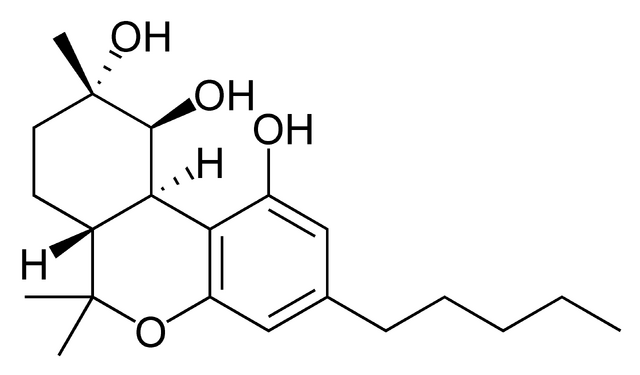
“Cannabiripsol [(-) (6aR, 9S, 10S, 10aR)9,10-dihydroxy-hexahydrocannabinol] (1), a new cannabinoid was isolated from a South African Cannabis variant. The structure was determined by spectral means and by synthesis.”

“Cannabiripsol [(-) (6aR, 9S, 10S, 10aR)9,10-dihydroxy-hexahydrocannabinol] (1), a new cannabinoid was isolated from a South African Cannabis variant. The structure was determined by spectral means and by synthesis.”
“Seven new naturally occurring hydroxylated cannabinoids (1-7), along with the known cannabiripsol (8), have been isolated from the aerial parts of high-potency Cannabis sativa.
The structures of the new compounds were determined by 1D and 2D NMR spectroscopic analysis, GC-MS, and HRESIMS as 8α-hydroxy-Δ9-tetrahydrocannabinol (1), 8β-hydroxy-Δ9-tetrahydrocannabinol (2), 10α-hydroxy-Δ8-tetrahydrocannabinol (3), 10β-hydroxy-Δ8-tetrahydrocannabinol (4), 10α-hydroxy-Δ9,11-hexahydrocannabinol (5), 9β,10β-epoxyhexahydrocannabinol (6), and 11-acetoxy-Δ9-tetrahydrocannabinolic acid A (7).
The binding affinity of isolated compounds 1-8, Δ9-tetrahydrocannabinol, and Δ8-tetrahydrocannabinol toward CB1 and CB2 receptors as well as their behavioral effects in a mouse tetrad assay were studied.
The results indicated that compound 3, with the highest affinity to the CB1 receptors, exerted the most potent cannabimimetic-like actions in the tetrad assay, while compound 4 showed partial cannabimimetic actions. Compound 2, on the other hand, displayed a dose-dependent hypolocomotive effect only.”
“This work aims at developing and optimizing a valuable oral delivery carrier for the cannabinoid derivative CB13, which presents a high therapeutic potential in chronic pain states that respond poorly to conventional analgesics, but also shows highly unfavorable physicochemical properties.
CB13-loaded lipid nanoparticles (LNP) formulations were developed…
The LNP formulation proposed proved to be a promising carrier for the oral delivery of CB13, a cannabinoid with high therapeutic potential in chronic pain states that currently lack a valid oral treatment.”
“Cannabinoids have been suggested to protect retinal ganglion cells in different models of toxicity…
These results suggest that endogenous and synthetic cannabinoids protect retinal amacrine neurons from AMPA excitotoxicity in vivo via a mechanism involving the CB1 receptors, and the PI3K/Akt and/or MEK/ERK1/2 signaling pathways.”
“We have previously shown that agonists selective for the cannabinoid receptor 2 (CB2), including O-1966, inhibit the Mixed Lymphocyte Reaction (MLR), an in vitro correlate of organ graft rejection, predominantly through effects on T-cells. Current studies explored the mechanism of this immunosuppression by O-1966 using mouse spleen cells…
These data support the potential of CB2-selective agonists as useful therapeutic agents to prolong graft survival in transplant patients, and strengthens their potential as a new class of immunosuppressive agents with broader applicability.”
“Management of chronic pain is one of the most common reasons given by individuals seeking medical cannabis. However, very little information exists about the concurrent use of cannabis and prescription pain medication (PPM).
This study fills this gap in knowledge by systematically comparing medical cannabis users who use or do not use PPM, with an emphasis on understanding whether concurrent use of cannabis and PPM is associated with more serious forms of alcohol and other drug involvement…
PPM users rated the efficacy of cannabis higher than PPM for pain management and indicated a strong desire to reduce PPM usage.
Use of PPM among medical cannabis users was not identified as a correlate for more serious forms of alcohol and other drug involvement.”
“Symptoms of severe intestinal dysmotility decrease patients’ quality of life and may prevent them from sustaining adequate oral intake. Dronabinol is a synthetic cannabinoid that is labeled for use in AIDS-related anorexia and chemotherapy-associated nausea and vomiting that has additional efficacy in patients with other etiologies of nausea, vomiting, and anorexia.
We present a 58-year-old female with a history of nausea, vomiting, abdominal pain, and inability to maintain oral intake after multiple laparotomies for ectopic pregnancy, recurrent caecal volvulus, and cholecystitis. After eight years of unsuccessful trials of medicines, dietary modifications, and a partial colectomy, she began a trial of dronabinol, which caused almost complete remission of her symptoms. When this medication was discontinued by her payer, she was unable to maintain oral intake and therefore, was admitted to the hospital for fluid resuscitation and resumption of dronabinol.
The use of dronabinol in this patient with severe intestinal dysmotility allowed her to maintain her nutritional status orally and obviated the need for enteral or parenteral feeding. Unfortunately, it was not covered by her insurance company for this indication.
Dronabinol has the potential to improve quality of life for patients beyond those undergoing chemotherapy or suffering from AIDS. Lack of access to this medicine for patients with intestinal dysmotility after all other modalities have been tried can lead to morbid and expensive complications, such as inpatient admission and surgery for enteral access.”
http://www.ncbi.nlm.nih.gov/pubmed/25974259
“Our experience with this demonstrates that dronabinol can be an effective and well-tolerated treatment option for nausea, vomiting, and abdominal pain secondary to intestinal dysmotility where other modalities have failed.” http://www.ncbi.nlm.nih.gov/pmc/articles/PMC4446691/
“Emerging evidence indicates the involvement of GPR55 and its proposed endogenous ligand, lysophosphatidylinositol (LPI), in nociception…
Thus, we provide the first pharmacological evidence that GPR55 activation at central levels is pronociceptive, suggesting that interfering with GPR55 signaling in the PAG may promote analgesia.”
“The G protein-coupled receptor GPR55 has been proposed as a new cannabinoid receptor associated with bone remodelling, nervous system excitability, vascular homeostasis as well as in several pathophysiological conditions including obesity and cancer.
Our data suggest that GPR55 could play deleterious role in ox-LDL-induced foam cells and could be a novel pharmacological target to manage atherosclerosis and other related cardiovascular diseases.”
“Hemp (Cannabis sativa L.) suspension culture cells were transformed with Agrobacterium tumefaciens strain EHA101 carrying the binary plasmid pNOV3635. The plasmid contains a phosphomannose isomerase (PMI) selectable marker gene. Cells transformed with PMI are capable of metabolizing the selective agent mannose, whereas cells not expressing the gene are incapable of using the carbon source and will stop growing. Callus masses proliferating on selection medium were screened for PMI expression using a chlorophenol red assay. Genomic DNA was extracted from putatively transformed callus lines, and the presence of the PMI gene was confirmed using PCR and Southern hybridization. Using this method, an average transformation frequency of 31.23% ± 0.14 was obtained for all transformation experiments, with a range of 15.1-55.3%.”