

“Currently, an increasing number of diseases related to insulin resistance and obesity is an alarming problem worldwide. It is well-known that the above states can lead to the development of type 2 diabetes, hypertension, and cardiovascular diseases. An excessive amount of triacylglycerols (TAGs) in a diet also evokes adipocyte hyperplasia and subsequent accumulation of lipids in peripheral organs (liver, cardiac muscle). Therefore, new therapeutic methods are constantly sought for the prevention, treatment and alleviation of symptoms of the above mentioned diseases.
Currently, much attention is paid to Cannabis derivatives-phytocannabinoids, which interact with the endocannabinoid system (ECS) constituents. Δ9-tetrahydrocannabinol (Δ9-THC) and cannabidiol (CBD) are the most abundant compounds of Cannabis plants and their therapeutic application has been suggested. CBD is considered as a potential therapeutic agent due to its anti-inflammatory, anti-oxidant, anti-tumor, neuroprotective, and potential anti-obesity properties. Therefore, in this review, we especially highlight pharmacological properties of CBD as well as its impact on obesity in different tissues.”
https://www.ncbi.nlm.nih.gov/pubmed/32194509
“A well-known ancient plant Cannabis sativa has been a subject of scientific interest for over 50 years. Moreover, it has been used for recreational and medical purposes for thousands of years. The plant comprises about 100 phytocannabinoids, which are C21 terpenophenolic constituents. Nowadays, the most-studied phytocannabinoids are: Δ9– tetrahydrocannabinol (Δ9-THC), Δ9-tetrahydrocannabivarin (Δ9-THCV), cannabinol (CBN), cannabidiol (CBD), cannabidivarin (CBDV), cannabigerol (CBG), and cannabichromene (CBC). So far, many studies have shown therapeutic properties of the above mentioned Cannabis compounds. Therefore, the aim of the current review is to focus on the emerging potential of CBD and other phytocannabinoids, which act as novel therapeutic agents in obesity treatment. From the existing data, we can conclude that CBD has the promising potential as a therapeutic agent and might be effective in alleviating the symptoms of insulin resistance, type 2 diabetes and metabolic syndrome.”
https://www.frontiersin.org/articles/10.3389/fendo.2020.00114/full


 “Triple negative breast cancer (TNBC) is the deadliest form of breast cancer because compared with other types of breast cancer, it is more aggressive, diagnosed at later stage and more likely to develop recurrence.
Many patients do not experience adequate tumor control after current clinical treatments involving surgical removal, chemotherapy and/or radiotherapy, leading to disease progression and significantly decreased quality of life.
Here we report a new combinatory therapy strategy involving
“Triple negative breast cancer (TNBC) is the deadliest form of breast cancer because compared with other types of breast cancer, it is more aggressive, diagnosed at later stage and more likely to develop recurrence.
Many patients do not experience adequate tumor control after current clinical treatments involving surgical removal, chemotherapy and/or radiotherapy, leading to disease progression and significantly decreased quality of life.
Here we report a new combinatory therapy strategy involving  “Glioblastoma (GBM) is the most common and aggressive brain tumor, which causes the highest number of deaths worldwide. It is a highly vascularized tumor, infiltrative, and its tumorigenic capacity is exacerbated. All these hallmarks are therapeutic targets in GBM treatment, including surgical removal followed by radiotherapy and chemotherapy.
Current therapies have not been sufficient for the effective patient’s management, so the classic therapies have had to expand and incorporate new alternative treatments, including natural compounds.
This review summarizes natural products and their physiological effects in in vitro and in vivo models of GBM, specifically by modulating signaling pathways involved in angiogenesis, cell migration/invasion, cell viability, apoptosis, and chemoresistance. The most important aspects of natural products and their derivatives were described in relation to its antitumoral effects.
As a final result, it can be obtained that within the compounds with more evidence that supports or suggests its clinical use are the
“Glioblastoma (GBM) is the most common and aggressive brain tumor, which causes the highest number of deaths worldwide. It is a highly vascularized tumor, infiltrative, and its tumorigenic capacity is exacerbated. All these hallmarks are therapeutic targets in GBM treatment, including surgical removal followed by radiotherapy and chemotherapy.
Current therapies have not been sufficient for the effective patient’s management, so the classic therapies have had to expand and incorporate new alternative treatments, including natural compounds.
This review summarizes natural products and their physiological effects in in vitro and in vivo models of GBM, specifically by modulating signaling pathways involved in angiogenesis, cell migration/invasion, cell viability, apoptosis, and chemoresistance. The most important aspects of natural products and their derivatives were described in relation to its antitumoral effects.
As a final result, it can be obtained that within the compounds with more evidence that supports or suggests its clinical use are the  “The endocannabinoid system has emerged as a considerable target for the treatment of diverse diseases.
In addition to the well-established palliative effects of
“The endocannabinoid system has emerged as a considerable target for the treatment of diverse diseases.
In addition to the well-established palliative effects of  “Studies have emphasized an antineoplastic effect of the non-psychoactive, phyto-cannabinoid,
 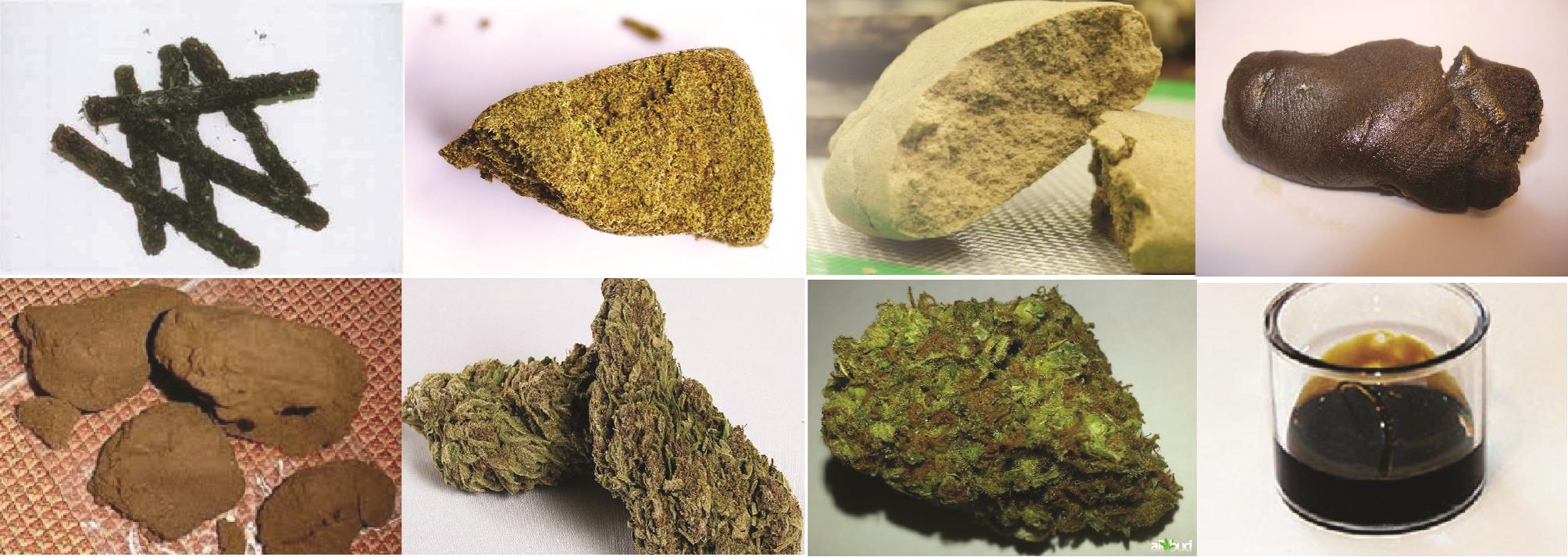 “Cannabis products. First row, left to right: Indian, Lebanese, Turkish and Pakistani hashish. Second row, left to right: Swiss hashish, Zairean marijuana, Swiss marijuana, Moroccan hash oil.”]]>